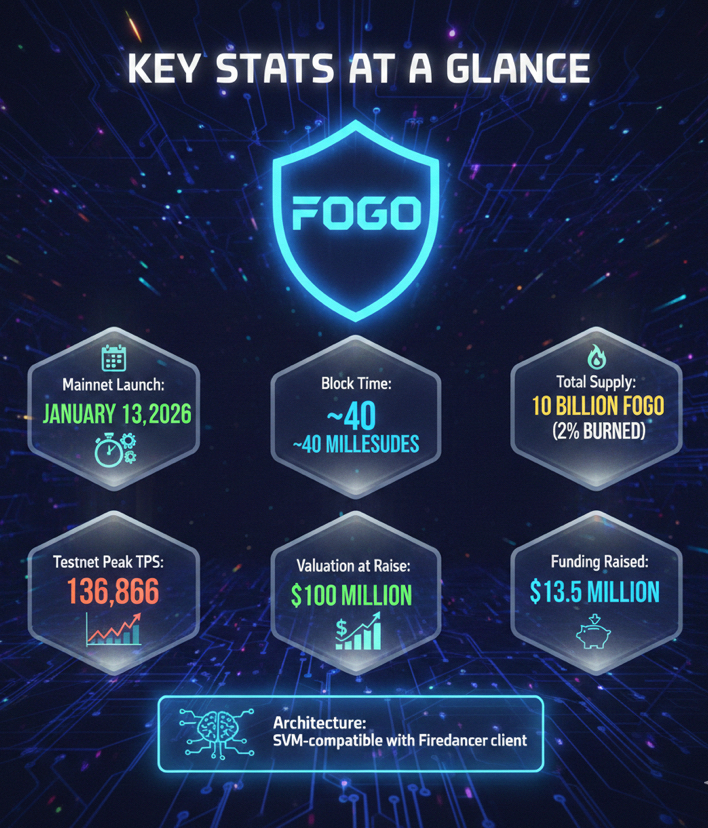
Fogo combines several innovative architectural choices to deliver institutional-grade performance:
The Firedancer Advantage
At its core, Fogo runs a single, optimized Firedancer-based client. Firedancer originally developed by Jump Crypto is a high-performance validator client written in C that maximizes throughput and minimizes latency. While Solana supports multiple clients (which can create bottlenecks waiting for the slowest one), Fogo standardized on just the fastest implementation. This eliminates the "lowest common denominator" problem that drags down other networks.
Multi-Local Consensus: The "Zone" Strategy
Here's where it gets interesting. Fogo uses multi-local consensus validators physically co-locate in specific geographic zones (like New York, London, or Tokyo data centers) to achieve ultra-low latency. During normal operations, block times drop to around 40 milliseconds with sub-second finality.
But wait doesn't that sacrifice decentralization? Not entirely. Fogo rotates these zones across epochs through on-chain voting. This "follow-the-sun" model provides:
• Jurisdictional decentralization (no single government can capture the network)
• Infrastructure resilience (protection against regional outages)
• Strategic positioning (ability to locate near financial data sources)
If consensus fails in a zone, the network falls back to global mode with 400ms blocks safety over speed when needed.
Curated Validator Set
Fogo doesn't let just anyone run a validator. There's a curated selection process requiring both minimum stake thresholds and operational approval. This ensures every validator can actually handle the performance demands. Underperforming nodes get removed, preventing the "weakest link" scenario that kills speed on other chains.
What Makes Fogo Different from Solana and Other Fast Chains?
This is where Fogo's philosophy really shines through. While Solana is a general-purpose ecosystem handling everything from NFTs to payments to DeFi, Fogo is built specifically for execution-sensitive financial applications.
The Key Differences: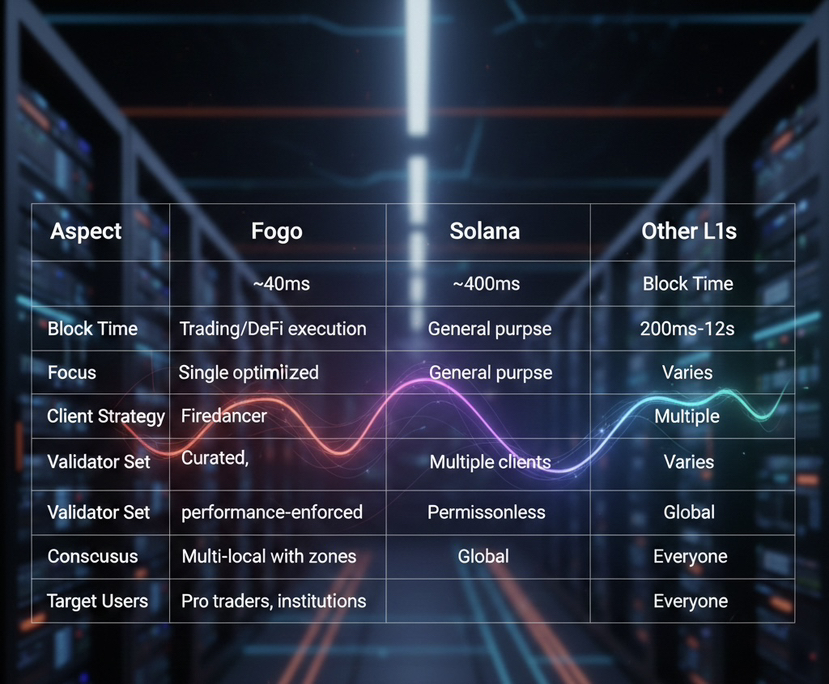
Fogo isn't trying to replace Solana it's carving out a specialized niche for applications where consistency matters more than theoretical throughput.As one analysis put it: "Fogo is positioned not to replace existing chains but to serve as a specialized execution layer for markets that demand consistency over theoretical throughput".
What Can You Actually Do on Fogo?
The ecosystem is growing with applications that leverage Fogo's speed advantages:
Trading Platforms
• Ambient Finance: A perpetual futures platform using a "Dual Flow Batch Auction" model instead of traditional order books, designed to reduce MEV and improve execution fairness.
• Valiant: A spot trading platform supporting multiple market structures including concentrated liquidity pools and on-chain order books.
DeFi Infrastructure
• Pyron & FogoLend: Money market protocols for low-latency lending/borrowing with time-sensitive liquidations.
• Brasa: Liquid staking protocol allowing users to stake $FOGO while maintaining liquidity.
• FluxBeam: Trading tools including spot DEX, contract inspection, and Telegram-based interfaces
Cross-Chain & Data
• Wormhole: Primary bridge for asset transfers via Portal Bridge
• Pyth Oracle: Price feeds (many Fogo contributors also work on Pyth, ensuring tight integration)
Fogo Sessions: The Game-Changer
One of Fogo's most user-friendly innovations is Fogo Sessions a system enabling gasless, signature-free transactions while maintaining security. Using account abstraction and paymasters, users can interact with dApps without holding native tokens for gas or signing every single action. This bridges the Web2 usability gap while keeping Web3 security standards.
Tell Me About the $FOGO Token What's Its Purpose?
The $FOGO token is the native asset powering the network, with a 10 billion total supply (though 2% was burned at genesis, reducing effective supply).
Token Utility:
• Transaction fees: Pay for network usage (with fee abstraction options)
• Staking: Secure the network and earn rewards
• Ecosystem incentives: Grants, liquidity mining, and partner rewards.
Tokenomics Designed for Long-Term Stability:
Fogo's token distribution reflects its "engineering over hype" philosophy:
• ~39% unlocked at TGE: Foundation (21.8%), launch liquidity (6.5%), community airdrops (6%), and Binance Prime sale (2%)
• ~59% locked with 4-year vesting: Core contributors (34%), institutional investors (12.1%), advisors (7%), and Echo raises (8.7%) have 12-month cliffs followed by gradual unlocks.
This structure intentionally limits early sell pressure and aligns insiders with long-term network success. The foundation controls a significant portion (~30%), which has raised some centralization concerns, but also ensures sustained development funding.
What Are the Real Risks and Trade-Offs?
No blockchain is perfect, and Fogo makes deliberate trade-offs in pursuit of its performance goals:
Centralization Concerns
• Single client dependency: Relying solely on Firedancer means any bug in that codebase affects the entire network
• Curated validators: While this ensures performance, it reduces permissionless participation compared to fully open networks
• Foundation control: With 30%+ of supply and validator selection influence, the team holds significant power.
Competition Risk
As Solana integrates Firedancer into its own mainnet, Fogo's speed advantage may narrow. The project needs to build ecosystem network effects quickly to justify its existence as a separate chain.
Infrastructure Complexity
The multi-local consensus requires validators to physically coordinate zone rotations. This adds operational overhead that could impact reliability if not managed carefully.
Early-Stage Risks
As a new mainnet (launched January 2026), Fogo faces typical early-stage challenges: limited dApp selection (~10 at launch vs. thousands on Solana), developing tooling, and proving long-term stability under real-world load.
Who Is Fogo Really For?
Fogo isn't trying to be the next Ethereum killer or a meme coin playground. It's specifically designed for:
1. Professional traders and market makers who need predictable, low-latency execution
2. DeFi protocols handling time-sensitive operations like liquidations and auctions
3. Institutional players requiring performance comparable to traditional finance infrastructure
4. Developers building execution-critical applications within the SVM ecosystem.
If you're looking for a chain to mint NFTs or run simple DeFi vaults, existing options work fine. But if you're building a high-frequency trading platform or derivatives exchange where milliseconds translate to millions, Fogo's infrastructure starts making real sense.
The Bottom Line: Is Fogo Just Hype or Genuine Innovation?
Fogo represents a mature, engineering-first approach to blockchain scaling. Rather than chasing the highest theoretical TPS number for marketing materials, the team focused on consistent, real-world performance under load.
The project's discipline shows in its choices:
• Standardizing on one optimized client instead of supporting multiple slower ones
• Curating validators to ensure quality over quantity
• Accepting geographic centralization during epochs in exchange for latency, while rotating zones to maintain long-term decentralization
• Locking team and investor tokens for years rather than rushing to liquidity
Whether Fogo succeeds depends on whether enough serious financial applications migrate to justify its specialized infrastructure. The technology is impressive, but ecosystem network effects will ultimately determine its fate. For now, it's a compelling experiment in trading-focused blockchain design one that prioritizes reliability and execution quality over vanity metrics.