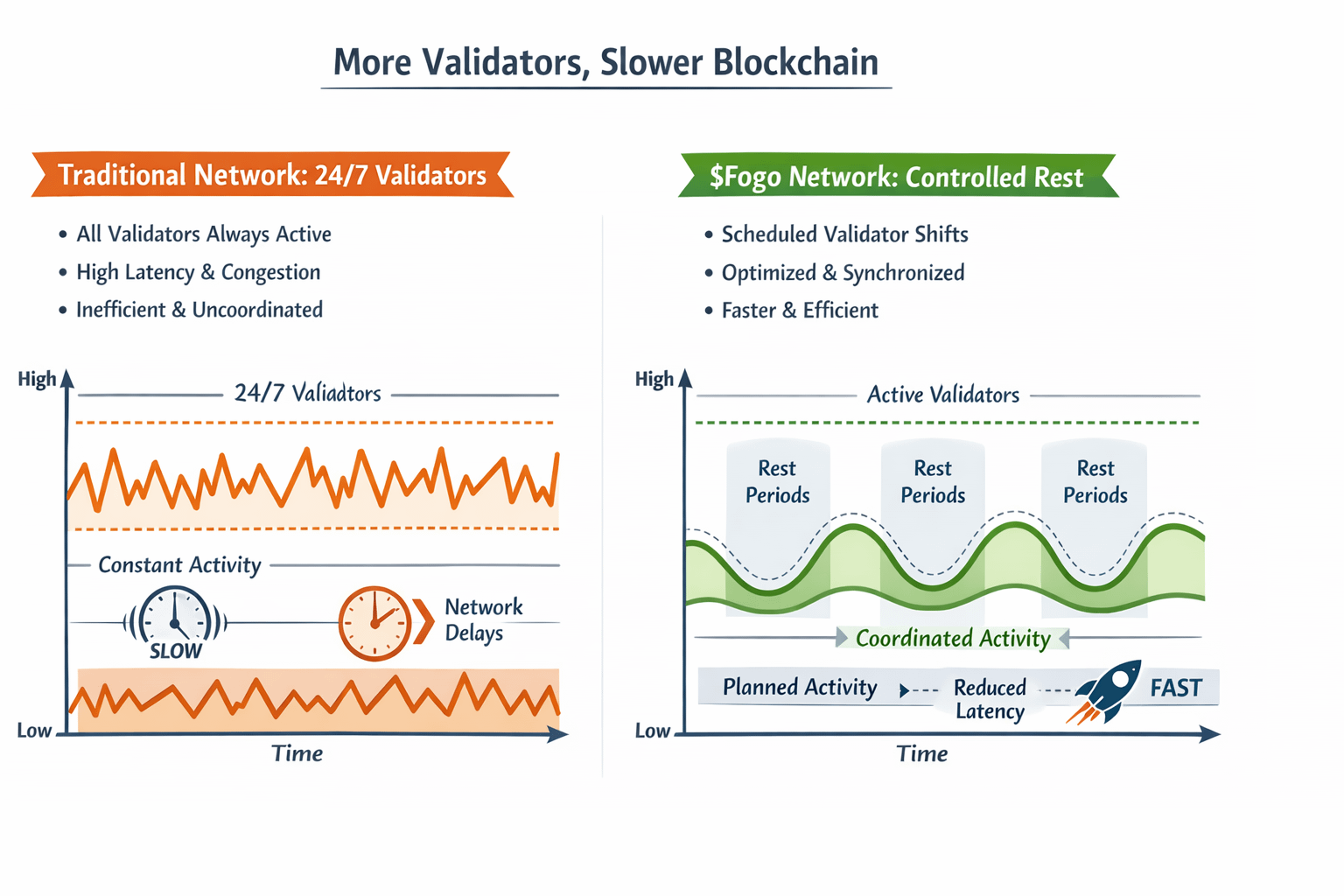
You might have asked yourself why adding validators to a blockchain can sometimes make it slower instead of faster.
Builders and traders have thought for a time that more validators mean a better network.. That is not true. Validators can actually slow down the network, delay transactions. Make users frustrated. When a network is slow it is not a technical problem. It costs people opportunities and money.
Most blockchain networks think that if all validators are always online the network is safe and decentralized.. That is not how it works.
. Having a lot of validators online can create problems, delays and inefficiency.
. Validators in the wrong time zones or with computers do not help. They just slow things down.
. Traders get the job done.
. People end up throwing money away on fees and missing out on the best moves.They miss opportunities.
Each blockchain node runs on computers, software and network conditions. This makes it secure.. It also limits how well it works.
. A validator in New York at 3 AM Singapore time causes delays.
. The network can only go fast as its slowest validator.
. When validators are not aligned it creates problems, temporary forks and higher delay.
. Adding validators does not make it more secure. It just makes it harder to coordinate.
Fogo changes what decentralization means for performance and security.
. The right validator, at the time in the right place: faster and cleaner agreement.
. Validators take breaks at times to reduce network noise.
. There are rules to make sure validators act predictably.
. Validators are close to crypto exchanges to reduce delay.
. Validators only participate at times like a schedule to avoid 24/7 operation.
By making validators work together at times Fogo makes the network go faster without being less secure.
Think of stock exchanges.
. Market makers and traders do not quote prices all the time. They follow a schedule.
. They plan maintenance times to manage risk and be more efficient.
. Each person has a role and a time to be active.
@Fogo Official does the same for blockchain. Validators work like a team peaking at times. They do not cause problems when they are not supposed to be active and the network stays secure and predictable.
The blockchain industry thinks decentralization means everyone is always online. $FOGO says that is not true.
. Decentralization is about getting results not just having everyone online.
. A network with all nodes online but not working together is actually really noisy.
. Taking breaks and working together are advantages.
. True strength is when the system keeps working even when some parts are offline.
If getting results is more important, than being online all the time how should the blockchain industry change its idea of decentralization?
Have you ever wondered why more validators can slow down a blockchain? #Fogo shows that less can be more if Fogo participation is structured wisely.
What if the next generation of blockchains does not reward being online all the time? Working together with integrity?