
It started like a stupid little issue.
Not a disaster. Not alarms everywhere. Just a message nobody wanted to deal with, sent too late, with that tone that means something is off but no one wants to say it yet. A wallet action looked wrong. The approvals looked technically valid. The timeline looked messy. The kind of thing that turns into a long night.
The chain was fine.
That was the first annoying part.
Blocks were moving. Dashboards looked healthy. Someone still opened the latency chart because people like numbers when the room starts getting tense. If the chart looks clean, it feels like control. But everybody in that room knew, even before anyone said it out loud, that this wasn’t a speed problem.
It was a permissions problem.
By around 2 a.m., the conversation got real. Security wanted the signing path. Ops wanted to know who approved what and when. Compliance wanted exact scope. Legal wanted timestamps written in plain English, not “roughly around then.” Someone asked why a temporary access path was still open. Someone else said, “we thought it was restricted.” Nobody likes that sentence during an incident.
This is the part people skip when they talk about chains.
They talk about TPS. They talk about latency. They compare finality like drag racers comparing quarter-mile times. And sure, speed matters. Waiting is painful. Slow systems create workarounds, and workarounds create risk. That part is true.
But the thing that actually breaks teams, breaks trust, and keeps people awake is usually not “the blocks were too slow.”
It’s that someone had too much permission for too long.
It’s that a key got exposed.
It’s that the chain did exactly what it was told to do by a signer who should never have had that much power in the first place.
That’s the real story more often than anyone wants to admit.
So when I think about Fogo, I don’t really start with the benchmark chest-thumping. I start with the grown-up question: what happens when real people use this under pressure?
Not ideal users. Real users.
People in boring meetings trying to get approvals through before end of day. Risk committees arguing over thresholds. Engineers half-reading wallet prompts after a long deployment. Someone in an audit room trying to explain why policy said one thing and the actual signing flow allowed something much wider. Teams doing postmortems and pretending they are not replaying the same preventable pattern for the third time.
That’s where Fogo gets interesting to me.
Yes, it’s an SVM-based high-performance L1 with Firedancer roots. That matters. Performance matters. But the reason it matters is not because “fast” sounds cool. It matters because if you’re going to move fast, you need better guardrails, not weaker ones.
Otherwise you just fail faster.
And this is why Fogo Sessions feels important in a very practical, human way.
Enforced, time-bound, scope-bound delegation.
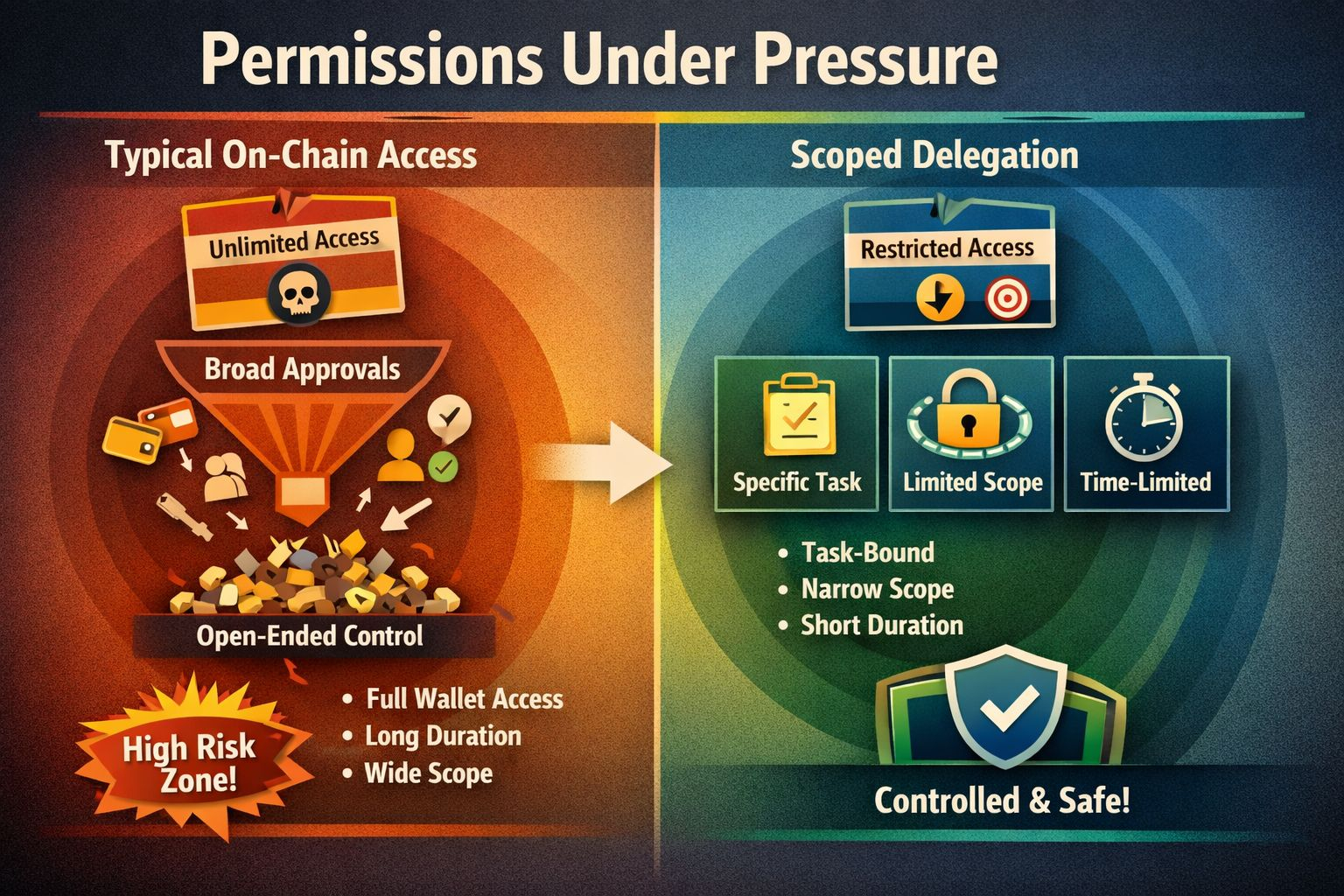
That sounds technical, but honestly it’s just common sense dressed properly. It’s a visitor badge. It’s “you can enter this room, not the whole building.” It’s “you can do this task until 5 p.m., then access expires.” It’s a pre-approved operating envelope instead of “here, take my wallet and be careful.”
That difference is huge.
Because right now, a lot of on-chain UX quietly asks people to make a bad trade. Do the work quickly, or do it safely. And when teams are under pressure, they choose whatever gets the work done. They approve broader access than they want. They leave permissions open longer than intended. They rely on memory and good behavior instead of enforcement.
Then later, in the postmortem, everyone says the same things: we thought it was limited, we assumed it expired, we meant to rotate that key, we didn’t realize the scope was that wide.
Nobody says, “the chain wasn’t fast enough.”
Scoped delegation + fewer signatures is the next wave of on-chain UX.
I really believe that, and not because it sounds neat.
Because more signatures is not automatically safer. Sometimes it just means more prompts, more fatigue, more blind clicking. If every action asks for full trust, people stop treating signatures like decisions and start treating them like chores. That’s when mistakes stop feeling like mistakes and start feeling inevitable.
But if the network can enforce tight scope and short duration, then fewer signatures can actually mean better safety. Less ceremony. More intent. Smaller blast radius if something goes wrong.
That’s the kind of progress that matters in real life.
Fogo’s architecture also makes more sense when you stop looking at it like a benchmark and look at it like a workplace. Modular execution environments above a conservative, boring settlement layer. That’s not boring in a bad way. That’s boring in the way a good accounting system is boring. In the way a good lock is boring. In the way you want the foundation of anything serious to be boring.
Let the upper layers move, adapt, specialize, experiment around user intent.
Let the settlement layer be steady, clear, and disciplined.
That split feels right because real systems need both. Flexibility where humans are messy. Conservatism where records become final.
And yes, EVM compatibility is useful, but mostly for practical reasons. It reduces friction. Teams know the tools. Engineers have Solidity muscle memory. Auditors know what they’re looking at. Existing habits can carry over without forcing everyone to relearn the basics during a migration. That is not a vanity feature. That is operational mercy.
The native token is security fuel. That’s the useful framing. Staking, in the healthiest framing, is responsibility. Skin in the game. Exposure to consequences. Not a magic reward machine. Long-horizon emissions, if done right, signal patience. They say this is being built to last, not just to look exciting for a season.
But none of this means “no risk.”
Bridges and migrations are still where things get fragile. Always. People underestimate them because they imagine the risk is mostly in code, but a lot of the danger is in operations. Timing. Coordination. Wrong environment. Wrong signer. Wrong address copied into the right script. Audit coverage that doesn’t fully match the messy path production actually takes. Human error when everyone is tired and trying not to delay launch.
That’s why bridge incidents feel so violent when they happen. Not just financially. Emotionally. Institutionally.
Trust doesn’t degrade politely—it snaps.
One minute everyone is talking about progress. The next minute they’re in a room trying to reconstruct who approved what and whether the system ever really enforced the limits people believed were there.
And that’s why I think the whole “waiting on finality” conversation can miss the point if it becomes the only thing we care about. Finality matters, yes. Speed matters, yes. But if you solve waiting and ignore permissions, you haven’t solved the human problem. You’ve just made it easier for a bad approval to become a fast irreversible event.
What actually helps is a chain that understands boundaries.
A chain that lets users act quickly without handing over total control.
A chain that can enforce “this action, this scope, this time window” instead of pretending every signature should be all-powerful.
A chain that can say no, not because it is slow or rigid, but because the request exceeds what was actually authorized.
That kind of “no” is not anti-user. It’s protective. It’s respectful. It assumes users are human, teams get tired, and process drift is real. It turns security from a policy document into something the network itself helps carry.
That’s the version of Fogo that feels worth paying attention to: not just fast, but responsible at speed. Not just performance, but controlled performance. Not just better throughput, but better behavior under pressure.
Because in the end, the goal is not to build a ledger that says yes as fast as possible.
The goal is to build a ledger that knows when yes is a mistake.
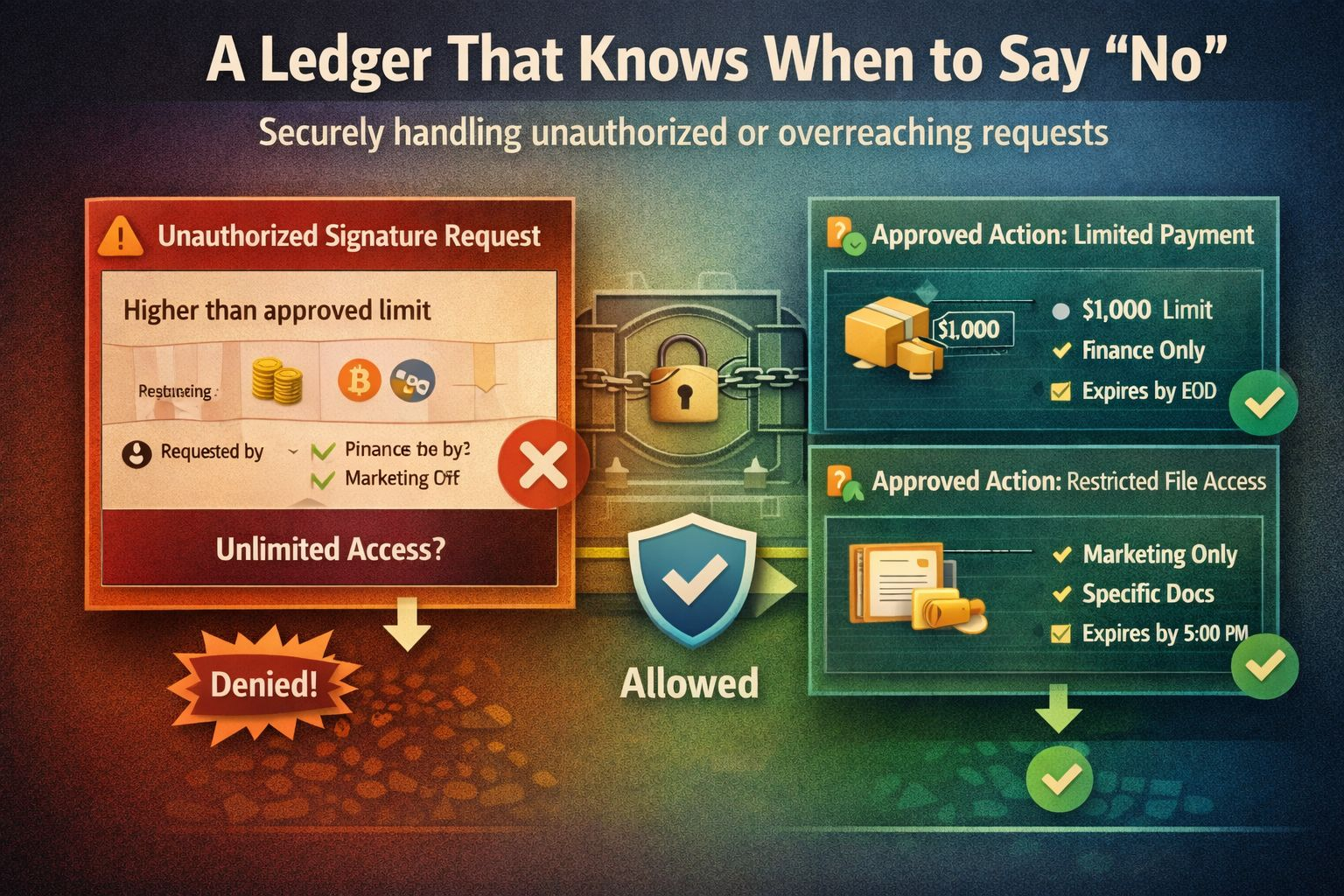
A fast ledger that can say “no” at the right moments isn’t limiting freedom; it’s preventing predictable failure.
