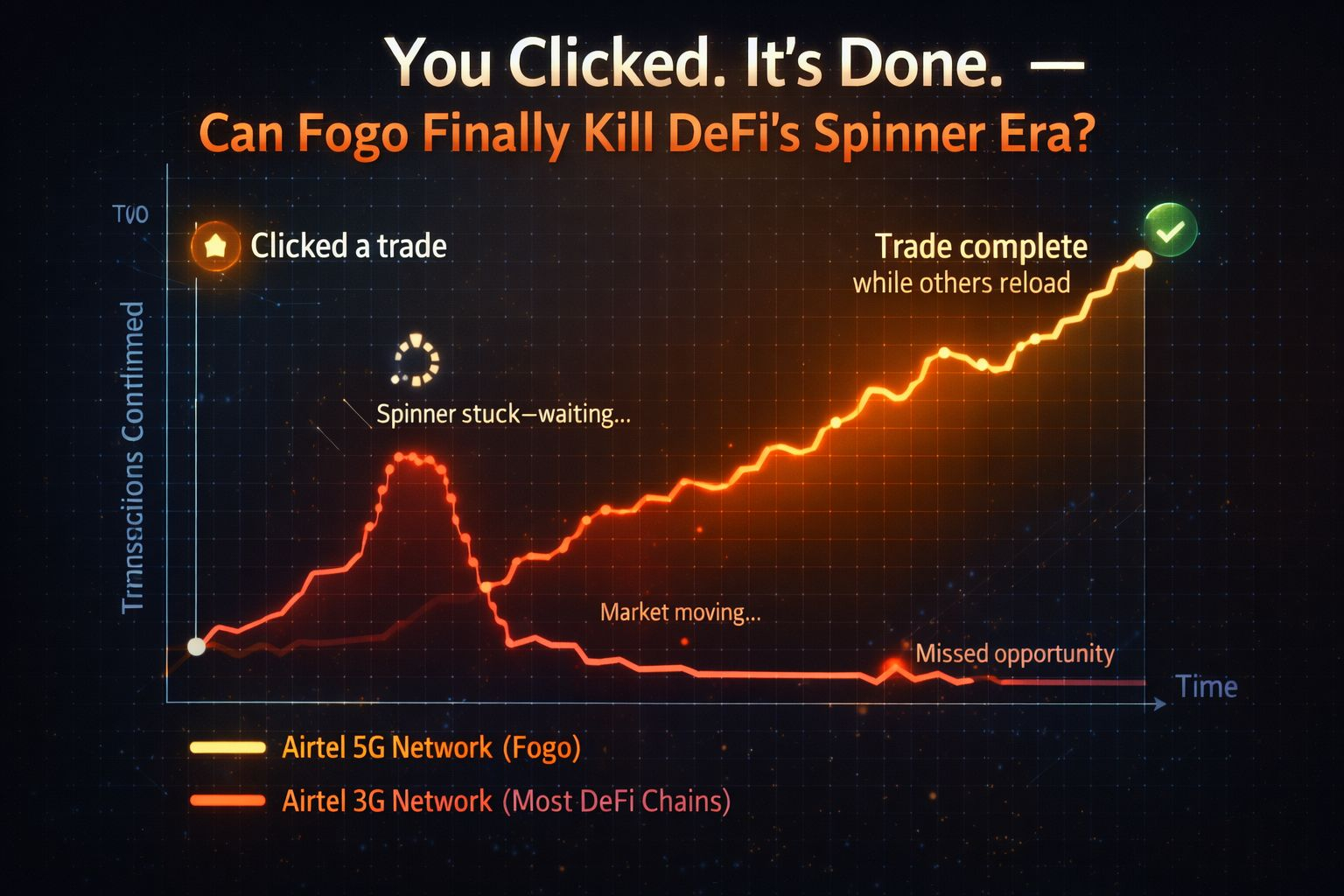
2 AM
Screen glowing in the dark.
Heart rate slightly up.
Market’s moving.
This is the window.
I clicked.
Spinner spinning.
"Did it go through?"
Refresh.
"Should I click again?"
Clicked again.
And by then — the moment was gone.
This isn’t just my story.
This is every DeFi trader’s story.
“Bro, Have You Seen Fogo?”
Two months ago, my friend Marcus texted me:
“Yo. Found this chain. They’re saying you literally forget about confirmations.”
I laughed.
Another hype project, I thought.
“What’s the TPS?” I asked.
“That’s the thing. They’re barely talking about TPS.”
That stopped me.
Because everyone talks about TPS.
The ones who don’t?
They’re either failing —
or they’re doing something fundamentally different.
The Biggest Lie in DeFi
The industry is stuck in one dangerous belief:
“Fast is enough.”
No. It isn’t.
A car that hits 200 km/h but stops every 10 kilometers isn’t fast.
It’s frustrating.
Theoretical TPS ≠ Real-world execution speed.
What happens when congestion spikes?
When volatility hits?
When thousands of traders press “Confirm” at once?
For most chains — performance collapses exactly when it matters most.
And yet we celebrate peak numbers
like they mean something to the trader fighting latency in real time.
The “Waiting Tax”
Marcus texted again one night.
“I calculated how many trades I missed last month because of confirmation delays.”
The number hurt.
That’s when I understood something.
There’s a hidden cost in DeFi.
I call it the Waiting Tax.
You won’t see it in your fee breakdown.
But it’s there.
• In every spinner
• In every confirmation popup
• In every second of uncertainty
It steals focus.
Creates doubt.
Breaks momentum.
For serious traders, that mental disruption often costs more than slippage.
And most chains pretend it doesn’t exist.
What Fogo Is Actually Asking
When I finally read deeper, one line changed everything.
They weren’t asking:
“How many transactions can we process?”
They were asking:
“How fast does a trade settle — reliably — under real pressure?”
That’s a completely different question.
And it changes the design philosophy entirely.
What Makes $FOGO Different?
. SVM + Firedancer
Built for hardware-level efficiency.
Tighter execution loops.
Performance holds under stress — not just during calm markets.
. Zone-Based Validator Coordination
Not random distribution.
Structured coordination.
Stability under load instead of chaos under congestion.
. Session Keys
Authorize bounded activity in advance.
You keep control — but eliminate repetitive confirmation friction.
This isn’t a UX trick.
It’s infrastructure rethinking the cost of hesitation.
The Best Infrastructure Is Invisible
You don’t think about electricity when lights work.
You don’t think about plumbing when water flows.
You don’t think about highways when traffic moves smoothly.
Great infrastructure disappears.
That’s the real ambition here.
Not “Wow, this chain is fast.”
But:
“I didn’t even notice the chain.”
You just traded.
The Spinner Was Never Normal
Marcus said something that stuck with me:
“We’ve treated the spinner like it’s part of the deal. Like it’s supposed to be there.”
It was never supposed to be there.
Normal ≠ acceptable.
If Fogo can remove the Waiting Tax —
not in demos, not in ideal conditions —
but when real traders hit the network simultaneously,
Then it stops being “another fast chain.”
It becomes invisible infrastructure.
And invisible infrastructure wins.
Have you ever missed a trade because of a spinner?
Drop your story below.