$NVDAon Fabric Foundation: Building the Open infrastructure for Human.
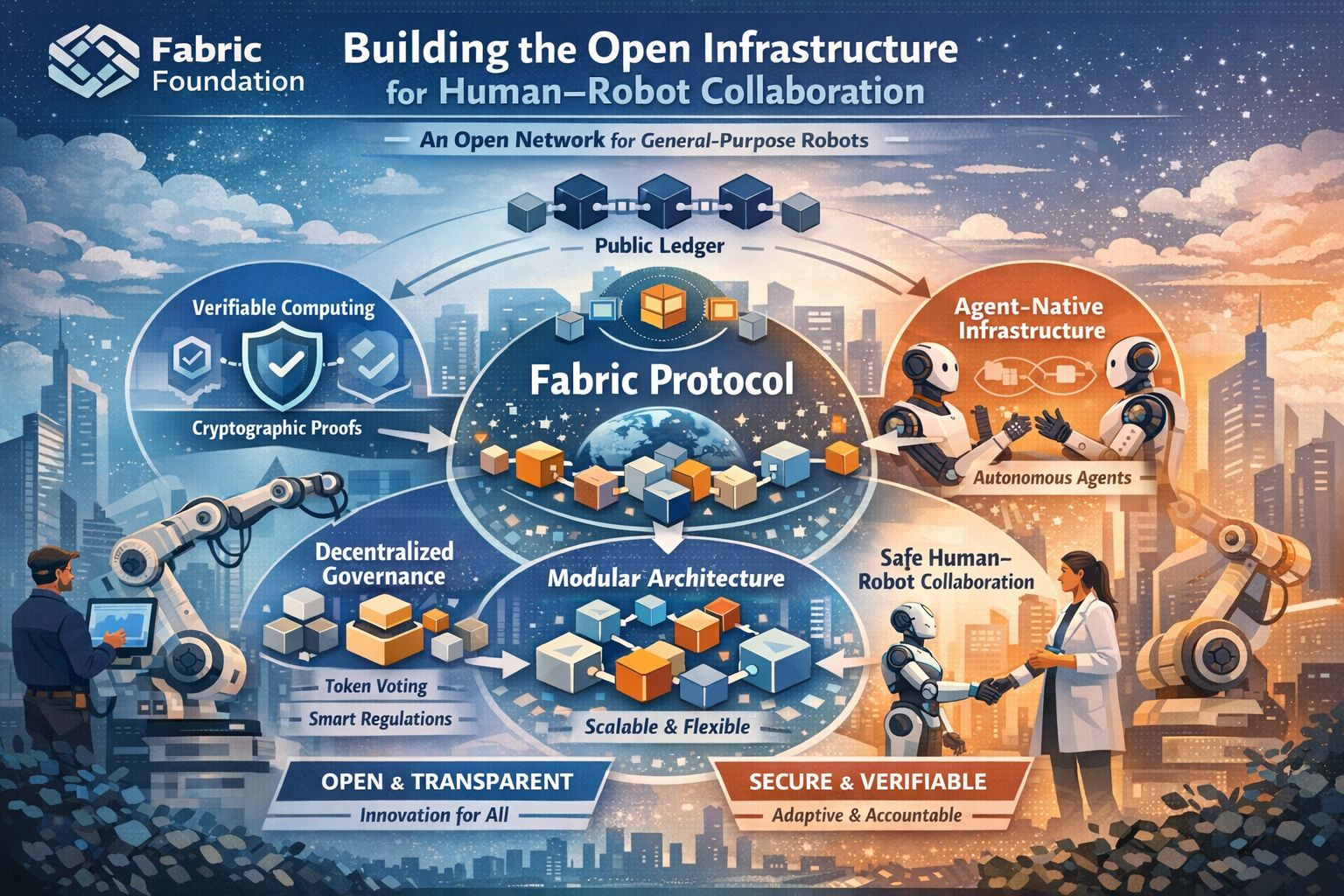
In an era where robotics and artificial intelligence are rapidly reshaping industries, the need for open, transparent, and trustworthy infrastructure has never been greater. The **Fabric Foundation** stands at the forefront of this transformation, supporting the development of the Fabric Protocol—an open global network designed to enable the construction, governance, and collaborative evolution of general-purpose robots. Through verifiable computing, agent-native infrastructure, and public ledger coordination, the foundation aims to create a safe and scalable ecosystem for human–machine collaboration.
The Fabric Foundation is a non-profit organization committed to advancing open robotics infrastructure for the benefit of society. Its mission centers on creating a decentralized framework where robots and intelligent agents can operate securely, transparently, and in alignment with human values. Rather than relying on closed corporate systems, the foundation promotes open standards and public accountability to ensure that robotics development remains accessible and trustworthy.
The vision of the foundation is to build a world where robots are not isolated tools but collaborative agents—capable of learning, adapting, and evolving within a regulated and verifiable digital environment. By supporting Fabric Protocol, the foundation provides the technological and governance backbone necessary for this future.
At the heart of the foundation’s work lies Fabric Protocol, a global open network that coordinates data, computation, and regulatory mechanisms through a public ledger. This ledger acts as a transparent record of robotic activity, computational proofs, and governance decisions, ensuring accountability and traceability.
The protocol is built on modular infrastructure, meaning developers and organizations can integrate components as needed. This flexibility allows the system to support a wide range of use cases—from industrial automation and healthcare robotics to research, logistics, and smart cities.
By combining verifiable computing with agent-native architecture, Fabric Protocol ensures that robots and AI agents can prove their actions and decisions. This is critical in high-stakes environments where safety, compliance, and trust are essential.
One of the most innovative aspects of the Fabric ecosystem is its focus on verifiable computing. In traditional systems, verifying whether a robot or AI agent performed a task correctly often requires trust in a centralized authority. Fabric Protocol changes this dynamic by enabling cryptographic proofs of computation.
Through verifiable computing, robots can demonstrate that they followed approved algorithms, respected safety parameters, and complied with governance rules. These proofs are recorded on the public ledger, creating a transparent audit trail. This reduces disputes, enhances reliability, and builds confidence among users, regulators, and developers.
For industries such as healthcare or autonomous transportation, where mistakes can have serious consequences, this layer of verification is essential.
#AxiomMisconductInvestigation Agent-Native Infrastructure
Fabric Protocol is designed as an agent-native infrastructure, meaning it treats robots and AI agents as first-class participants in the network. Instead of simply executing commands, agents can interact with the ledger, request resources, register updates, and participate in governance processes.
This approach enables collaborative evolution. Developers across the world can contribute improvements to robotic behaviors and models, while governance mechanisms ensure that changes are reviewed and validated before deployment. Over time, this creates a continuously improving ecosystem of general-purpose robots.
Agent-native systems also enable machine-to-machine coordination. Robots can share data securely, allocate tasks among themselves, and optimize workflows in real time. This distributed coordination reduces inefficiencies and increases overall productivity.
As robotics becomes more powerful, governance becomes increasingly important. The Fabric Foundation recognizes that technological progress must be accompanied by responsible oversight. Fabric Protocol integrates governance mechanisms directly into its infrastructure.
Through tokenized voting, transparent rule-setting, and publicly recorded decisions, stakeholders—including developers, researchers, institutions, and possibly even regulators—can participate in shaping the network’s direction. This ensures that changes are made collectively and transparently.
Regulatory compliance can also be embedded into the protocol. Smart rules and programmable policies allow robots to operate within defined boundaries, automatically enforcing safety standards and legal requirements.
By combining decentralized governance with verifiable compliance, the foundation seeks to balance innovation with accountability.
The modular design of Fabric Protocol allows it to scale efficiently. Different modules handle computation, identity, data storage, and governance. Developers can plug into specific layers without needing to rebuild the entire system.
This modularity supports experimentation and customization. For example, a research institution may focus on advanced robotic perception modules, while an industrial manufacturer integrates task-specific automation components. Because all modules connect through the shared protocol and ledger, interoperability is maintained.
Scalability is also achieved through distributed computation. Instead of relying on a single centralized server, Fabric Protocol leverages decentralized networks to process data and verify results. This enhances resilience and reduces the risk of single points of failure.
#USIsraelStrikeIran Enabling Safe Human–Machine Collaboration
The ultimate goal of the Fabric Foundation is to facilitate safe and productive collaboration between humans and machines. In workplaces, homes, hospitals, and public spaces, robots must operate in harmony with human needs and expectations.
By providing verifiable proof of behavior, transparent governance, and modular safety controls, Fabric Protocol creates an environment where humans can trust robotic systems. This trust is essential for widespread adoption.
Moreover, open access to the protocol encourages diverse participation. Developers from different regions and disciplines can contribute improvements, ensuring that robotic systems reflect a broad range of perspectives and values.
#BlockAILayoffs Economic and Social Impact
An open robotics network has significant economic implications. By lowering barriers to entry, the Fabric Foundation supports innovation among startups, researchers, and small enterprises. This democratization of robotics infrastructure could accelerate technological progress and create new industries.
Socially, transparent and accountable robotic systems can reduce inequality in access to automation. Instead of being controlled by a few corporations, general-purpose robots can be developed and governed collectively.
The foundation’s non-profit structure reinforces its commitment to public benefit. By prioritizing openness and safety over profit, it aims to align technological advancement with societal well-being.
#USIsraelStrikeIran Challenges and the Road Ahead
Despite its ambitious vision, the Fabric Foundation faces several challenges. Ensuring global participation, maintaining security, and balancing decentralization with efficiency are complex tasks. Additionally, integrating regulatory frameworks across jurisdictions requires careful coordination.
However, the foundation’s emphasis on modularity, transparency, and collaboration provides a strong foundation for overcoming these obstacles. As robotics continues to evolve, the need for open and verifiable infrastructure will only grow
The Fabric Foundation represents a forward-thinking approach to robotics and AI infrastructure. By supporting Fabric Protocol, it provides a global open network for constructing, governing, and evolving general-purpose robots. Through verifiable computing, agent-native design, public ledger coordination, and decentralized governance, the foundation seeks to create a future where human–machine collaboration is safe, transparent, and beneficial to all.