

As intelligent machines move from research labs into factories, hospitals, warehouses, and homes, an important question arises: who builds and governs the systems these machines depend on? Just as the internet needed open standards to grow safely and fairly, the age of robotics and AI requires shared infrastructure designed for transparency, coordination, and trust.
The Fabric Protocol, supported by the non-profit Fabric Foundation, is designed to help meet this need. It provides a global open network that supports the creation, governance, and improvement of general-purpose robots. Instead of treating robots as isolated proprietary tools, Fabric views them as part of a connected ecosystem where safety, accountability, and interoperability are essential.
Why Shared Infrastructure Is Important
In the past, major technologies reached their full potential when built on open foundations. The internet, GPS, and open-source software allowed innovation to grow while maintaining common standards.
Intelligent machines now need similar infrastructure because they:
operate in real-world environments where safety matters
depend on shared data and computing resources
must follow regulations and safety standards
interact with humans and other machines in real time
Without shared systems, robotics technology could become fragmented, difficult to manage, and hard to regulate.
Building Trust with Verifiable Computing
One of the biggest challenges in deploying intelligent machines is trust. People need to know that machines are operating safely and following the rules.
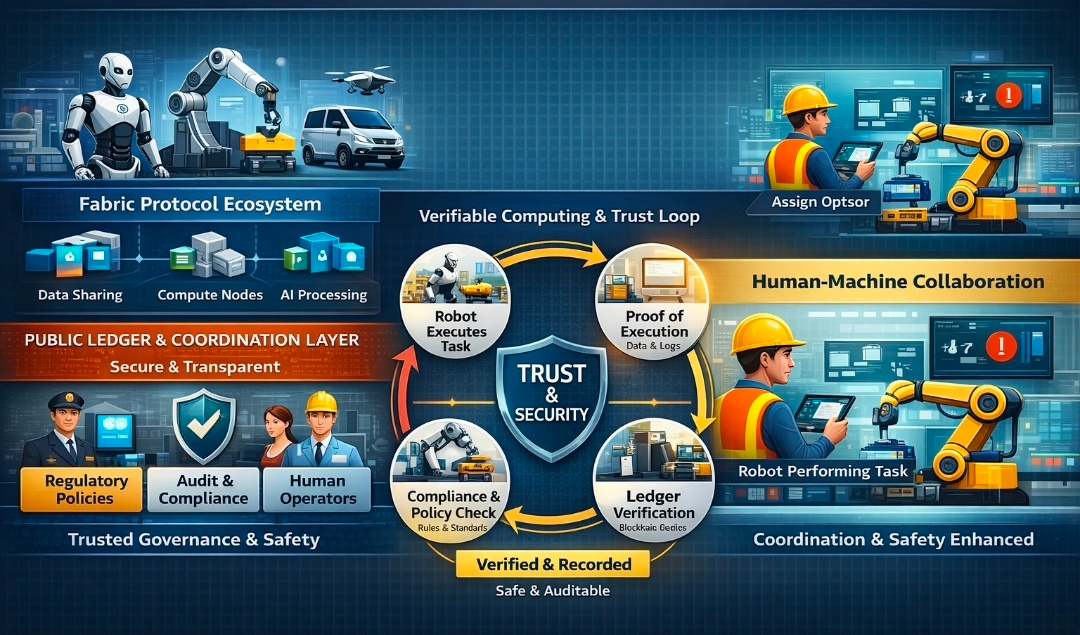
Fabric Protocol addresses this through verifiable computing, which allows systems to prove what actions were taken and how decisions were made. This makes it possible to audit machine behavior and confirm compliance with safety requirements.
This is especially important in areas like healthcare, manufacturing, and public services, where reliability and accountability are critical.
Coordinating Data, Compute, and Governance
Fabric Protocol uses a public ledger to coordinate three key elements:
Data: Secure sharing and validation of sensor inputs, training data, and operational records.
Computation: Distributed processing that ensures tasks can be verified and reproduced.
Governance: Transparent enforcement of policies so machines operate within safety and ethical guidelines.
Together, these elements help intelligent machines function as accountable participants within a regulated ecosystem.
Modular Infrastructure Encourages Innovation
Fabric’s modular design allows developers and organizations to build interoperable components instead of closed systems. Parts such as perception, mobility, and decision-making modules can evolve independently while still working together through shared standards.
This approach speeds up innovation and prevents vendor lock-in, allowing startups, universities, and public institutions to contribute alongside large companies.
Keeping Humans at the Center
Public infrastructure for intelligent machines must prioritize human needs. Fabric supports agent-native systems designed for collaborative environments, ensuring machines assist and enhance human capabilities rather than replace them.
By embedding governance, transparency, and coordination into the infrastructure itself, Fabric helps create systems that are:
safer to deploy
easier to regulate
more accountable
aligned with human values
A Shared Foundation for the Future
Intelligent machines will soon perform essential work across many sectors. The key challenge is ensuring this future is safe, fair, and accessible.
Building public-good infrastructure helps ensure intelligent machines remain aligned with human intent and benefit society as a whole. By combining open governance, verifiable computing, and modular coordination, Fabric Protocol offers a path toward responsible integration of intelligent machines into everyday life.
Just as the internet connected people through shared standards, public infrastructure can connect humans and intelligent machines through shared trust.