
Most blockchain projects talk a lot about openness.
That has been part of the culture from the start. Everything visible. Everything verifiable. Everything out in the open, at least in theory. And for a while, that sounded like the cleanest possible model. No hidden layers. No special access. No need to trust someone’s private database.
But you can usually tell when an idea has been pushed a little too far. The original strength starts creating a different kind of weakness.
That is where @MidnightNetwork starts to make sense.
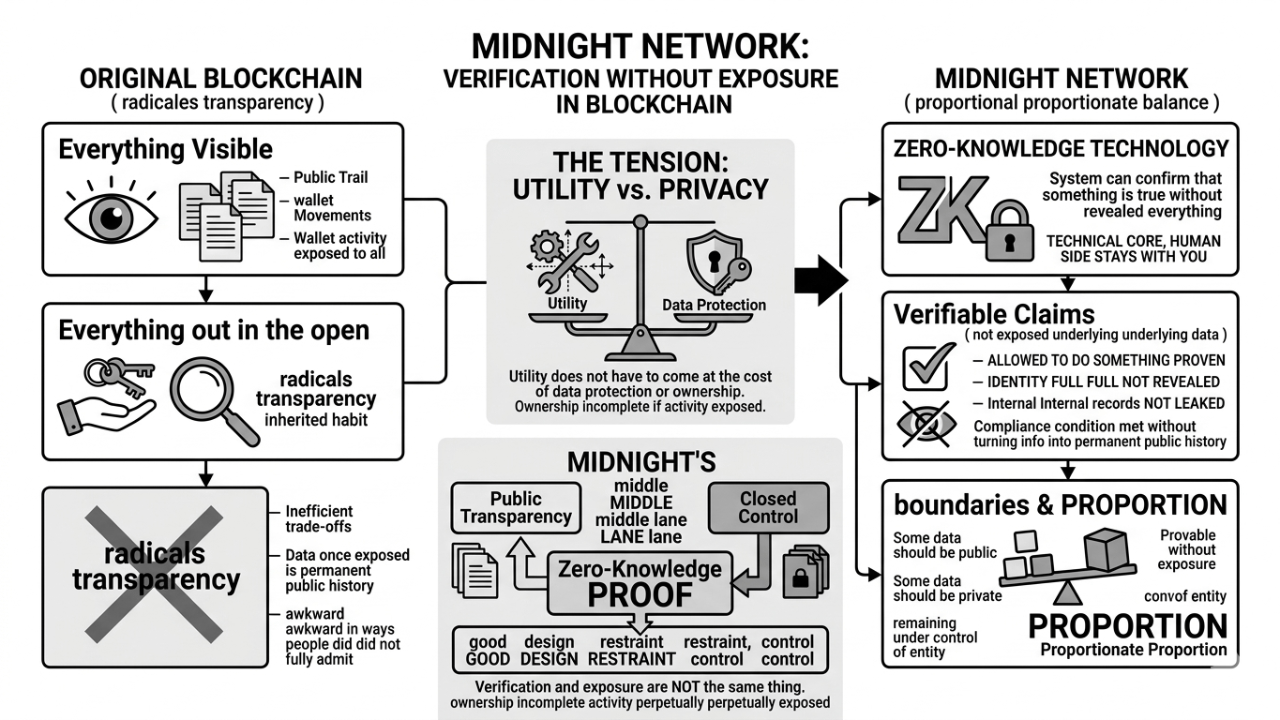
It is built around zero-knowledge proof technology, which sounds technical at first, maybe even a little cold, but the basic idea is not that hard to sit with. A system can confirm that something is true without forcing a person to reveal everything behind it. That is the part that matters. Not secrecy for the sake of secrecy. Not mystery. Just a more careful way of proving things.
And honestly, that feels overdue.
Public blockchains made transparency feel normal. Almost sacred, in some corners. But once people started actually using these systems in more serious ways, the trade-off became harder to ignore. If every transaction, interaction, or wallet movement leaves a trail that anyone can inspect, then ownership starts to feel a bit strange. You hold the asset, maybe. You control the keys. But your activity is still exposed in a way that would feel completely unreasonable in most other parts of life.
That is the tension Midnight seems to be built around.
It is trying to keep the useful parts of blockchain infrastructure without treating total visibility as the price of entry. And that changes the tone of the whole conversation. The question is no longer just whether a network is decentralized or efficient or programmable. The question changes from this to that: what should be verifiable, and what should remain private?
That sounds simple, but it shifts a lot.
Because once you ask that question seriously, you start noticing how many systems collect or expose more data than they actually need. A person may need to prove they are allowed to do something without revealing their full identity. A company may need to confirm compliance without exposing internal records. An application may need to show that a condition has been met without turning user information into permanent public history.
It becomes obvious after a while that verification and exposure are not the same thing.
Older digital systems often blurred those two ideas together. To prove something, you showed everything. Or almost everything. It was inefficient, but also just accepted. Blockchains inherited part of that habit, then made it permanent and visible at scale. The result was powerful, yes, but also awkward in ways people did not fully admit at first.
Because in practice, few people actually want radical transparency in every part of their lives.
They may want clear rules. Fair systems. Trustworthy records. But that does not mean they want every detail of their activity open to strangers, analysts, competitors, or whoever happens to be watching. There is a difference between accountability and exposure, and a lot of blockchain systems still struggle to respect that difference.
That’s where things get interesting with Midnight.
The network seems to be built around the idea that utility does not have to come at the cost of data protection or ownership. And that phrase can sound polished if you rush past it, but it is worth slowing down. Utility matters because a network still has to do something real. It has to support transactions, logic, coordination, maybe applications people can actually use. Data protection matters because information, once exposed, is hard to take back. And ownership matters because control means less than people think if the system demands too much personal visibility in return.
So Midnight is not really asking people to choose between usefulness and privacy.
It is suggesting that the two might belong together.
That is a subtle difference, though maybe not a small one.
Zero-knowledge systems, when they are described plainly, are really about boundaries. They let a network validate a statement without revealing the full underlying data. That is the technical core, but the human side is what stays with you. In normal life, we already expect this kind of boundary to exist. We do not hand over our entire history just to prove one fact. We do not treat private information as public by default. We usually share what is necessary and keep the rest contained.
Blockchain, in many cases, reversed that instinct.
It made full visibility feel like the honest option, and privacy feel suspicious or secondary. But that framing was always a little incomplete. Privacy is not automatically about hiding wrongdoing. Sometimes it is just about keeping normal information from becoming public infrastructure. Sometimes it is about proportion.
That word matters here. Proportion.
Because when people talk about data protection, the discussion often becomes extreme very quickly. Either everything should be open, or everything should disappear behind encryption. But real systems usually live somewhere in the middle. Some data should be public. Some should not. Some should be provable without being exposed. Some should remain under the control of the person or entity involved.
Midnight seems to live in that middle space.
And maybe that is why the idea feels more mature than some of the louder narratives in this industry. It does not need to promise a complete reinvention of everything. It only needs to address a problem that has been sitting in plain sight for years. Public chains are useful, but they often reveal too much. Private systems protect information, but they can lose openness or composability if not designed carefully. So the real challenge is not choosing one side forever. It is designing systems that know when to reveal and when not to.
That balance is difficult, of course.
Nothing about privacy infrastructure is simple once you move past the headline. The cryptography can be complex. The implementation matters a lot. Performance trade-offs are real. Usability can suffer if the design becomes too abstract or too heavy for normal users. There is also the regulatory side, which never stays quiet for long when privacy enters the conversation. A network can have a thoughtful technical structure and still run into broader questions about trust, compliance, and interpretation.
So none of this should be treated as easy.
Still, the need is real enough that these efforts keep returning, and for good reason. People want digital systems that can prove things cleanly without exposing themselves more than necessary. Businesses want tools that do not force them to leak operational details just to participate. Developers want infrastructure that gives them more options than the old binary choice between public transparency and closed control.
You can usually tell when a technology is addressing something real because the argument around it starts changing shape. At first, people ask whether it works. Then later, they start asking where else it could apply. With privacy-preserving blockchain tools, that shift already seems to be happening. The conversation is less about whether privacy belongs on-chain at all, and more about how it should be built, how much is enough, and what kinds of use cases actually benefit from it.
That feels like progress, even if it is quiet progress.
And maybe Midnight Network fits best in that quieter lane. Not as a dramatic answer to every weakness in blockchain, but as part of a broader correction. A reminder that transparency, while useful, is not always the same thing as good design. A reminder that ownership is incomplete if your activity is permanently exposed. A reminder that proving something does not always require showing everything.
That last point stays with me.
Because it seems small at first. Almost obvious. Of course you should be able to verify something without oversharing. Of course digital systems should give people more control over what gets revealed. But for a long time, the tools did not really support that very well, or not at scale, or not in ways that felt practical. So people adapted to a world where too much disclosure became normal.
Then better tools arrived, and the old normal started to look less convincing.
That is probably the clearest way to understand Midnight. Not as a loud promise, and not as a trend word wrapped around cryptography, but as one more sign that blockchain infrastructure is slowly becoming more aware of its own limits. Utility matters. Verification matters. But so do restraint, privacy, and control.
And once you start seeing that, it becomes harder to accept systems that expose everything by default.
Not because openness is bad.
Just because it was never meant to be absolute.
#night $NIGHT