
been going through Fabric's economic architecture section and honestly? the cold start problem is the most underrated challenge in the entire protocol 😂
everyone talks about long term tokenomics. emissions, buybacks, governance. but section 7 of the whitepaper addresses something more immediate — what happens in the earliest days of the network when there are no robots generating revenue, no users paying fees, and no track record to attract operators?
what caught my attention:
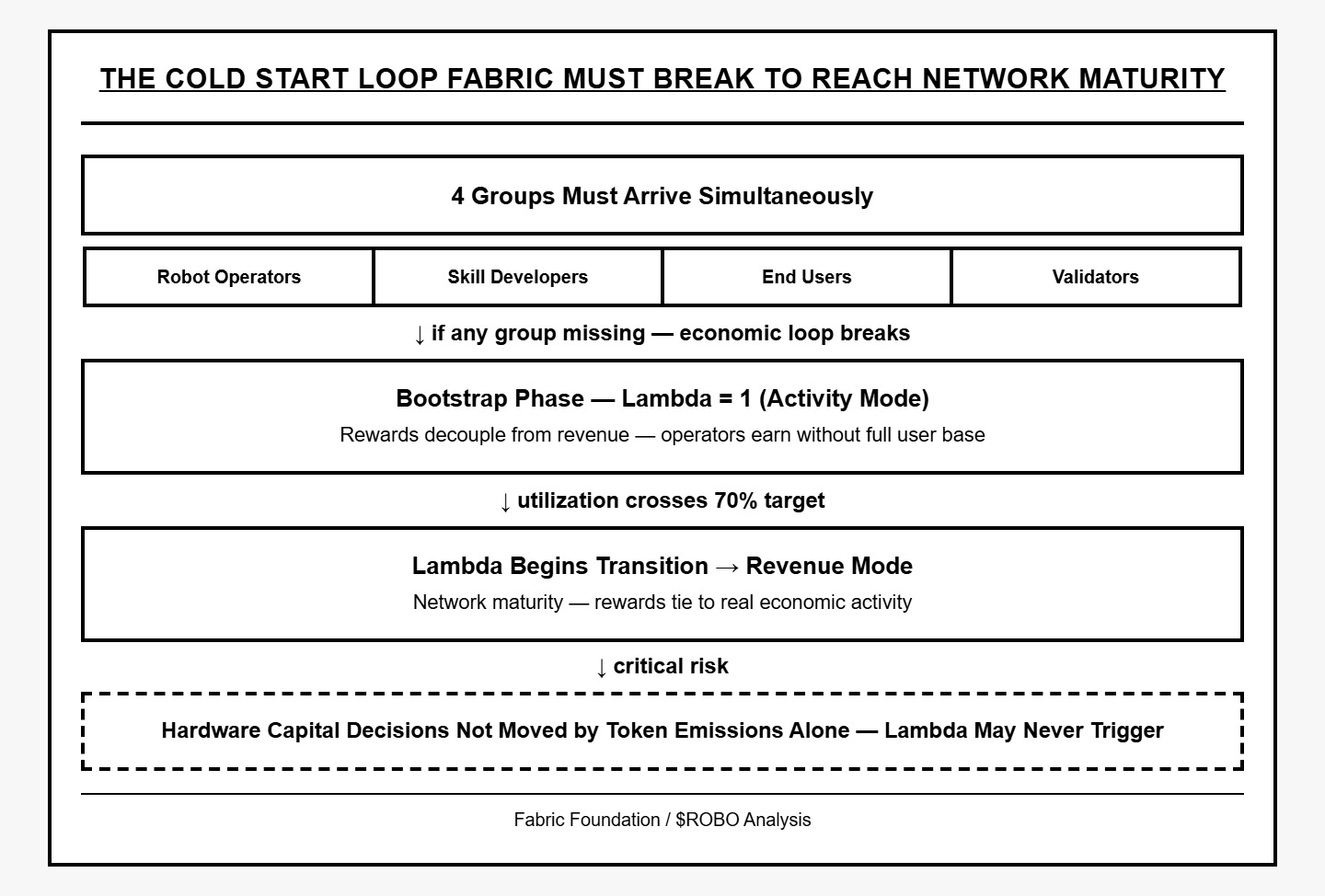
the cold start problem in Fabric is unusually complex. most protocols just need to attract liquidity or validators. Fabric needs to simultaneously attract robot operators who own physical hardware, developers who build skill chips, users who pay for robot services, and validators who monitor fraud. all four groups need to show up at roughly the same time. if any one group is missing the entire economic loop breaks.
the whitepaper is explicit about this. early in the network's life, revenue may be sparse, making revenue-based rewards insufficient to attract operators. so Fabric built three specific mechanisms to address this.
mechanism 1 — hybrid graph value with lambda transition:
the HGV reward system runs in pure activity mode during bootstrap. lambda equals 1. this means robots earn rewards based on verified task activity — not revenue generated. an operator completing real tasks earns protocol rewards even if those tasks generate minimal fees.
this is critical. it decouples early operator income from early user adoption. operators can earn rewards while the user base is still small. the system only shifts toward revenue weighting as network utilization crosses the target threshold.
mechanism 2 — contribution score with active participation floor:
the reward formula contains a minimum activity threshold. participants need a contribution score above 1% of mean score and at least 15 active days per 30-day epoch to qualify. this sounds restrictive but its actually a cold start feature — it filters out passive token holders from early reward distribution and concentrates rewards among genuinely active operators.
concentrated early rewards mean early operators earn meaningfully more per unit of work than they will at network maturity. this creates a first-mover incentive that the whitepaper is deliberately engineering into the reward structure.
mechanism 3 — emission engine with utilization feedback:
the adaptive emission engine increases emissions when network utilization falls below the 70% target. during cold start, utilization will be near zero. so emissions automatically rise to attract additional supply side participation.
this is inflationary pressure used strategically. the circuit breaker caps emission changes at 5% per epoch to prevent volatility. but the direction is clear — low utilization triggers higher emissions, higher emissions attract more operators, more operators build supply side capacity.
my concern though:
all three mechanisms assume operators are rational and responsive to token-denominated incentives during bootstrap. but robot operators have significant upfront hardware costs. a humanoid robot platform costs tens of thousands of dollars. the decision to deploy hardware onto Fabric isnt made by comparing epoch reward rates — its made by assessing long term network viability, regulatory environment, insurance requirements, and customer acquisition.
token emissions during cold start may be insufficient to move that decision for serious hardware operators. the participants most responsive to bootstrap incentives may be small operators running low-cost platforms — not the enterprise-grade deployments that would generate meaningful revenue and credibility for the network.
honestly dont know if:
the three bootstrap mechanisms are genuinely sufficient to attract the quality and scale of operators needed to demonstrate real network utility — or if Fabric enters a prolonged cold start phase where token incentives attract small operators, activity metrics look healthy on-chain, but revenue remains near zero and the lambda transition from activity to revenue weighting never actually triggers.
watching: operator hardware value at Q2 activation, ratio of activity-weighted vs revenue-weighted HGV in first 90 days, whether lambda begins transitioning within the first 6 months post activation 🤔
what's your take — three mechanisms enough to solve cold start for a physical robot network, or a bootstrap design built for digital networks being applied to a problem that requires hardware capital most token incentives cant move?? 🤔
#ROBO @Fabric Foundation $ROBO
