I remember the exact moment I stopped believing in most crypto projects. It was 2021. I was sitting in a conference room in Lisbon, Portugal, listening to a young founder explain how his blockchain was going to change something. I cannot even recall what it was now. Something about supply chains. Or maybe it was data storage. Honestly, it does not matter.
The slides were beautiful. The charts went up and to the right. The team photos looked like they were taken from a fashion magazine. The metrics on screen showed millions of users and billions in transactions. But I had been in this space long enough by then. I knew how to spot the gaps.
Halfway through the presentation, I opened my laptop and checked their network data. What I found made me put my pen down and just stare at the screen. Their blockchain had less than fifty active addresses. Their supposed millions of users did not exist. The whole thing was built on smoke and mirrors.
The audience clapped when he finished. They clapped because the token had just listed on a major exchange. Nobody asked the hard questions. Nobody checked the numbers. I walked out of that room and told my friend who was with me, we are building castles on top of sand. And that moment changed how I look at everything in this space.
So when I first came across Fabric Protocol a few weeks ago, I did what I always do now. I rolled my eyes and I started searching for the nonsense. Another blockchain project. Another token. Another team promising to change the world with fancy words and three letter acronyms. I was ready to find the holes, write it off, and move on with my day.
But here is the thing. I could not find the nonsense. And that actually made me more suspicious than if I had found it right away.
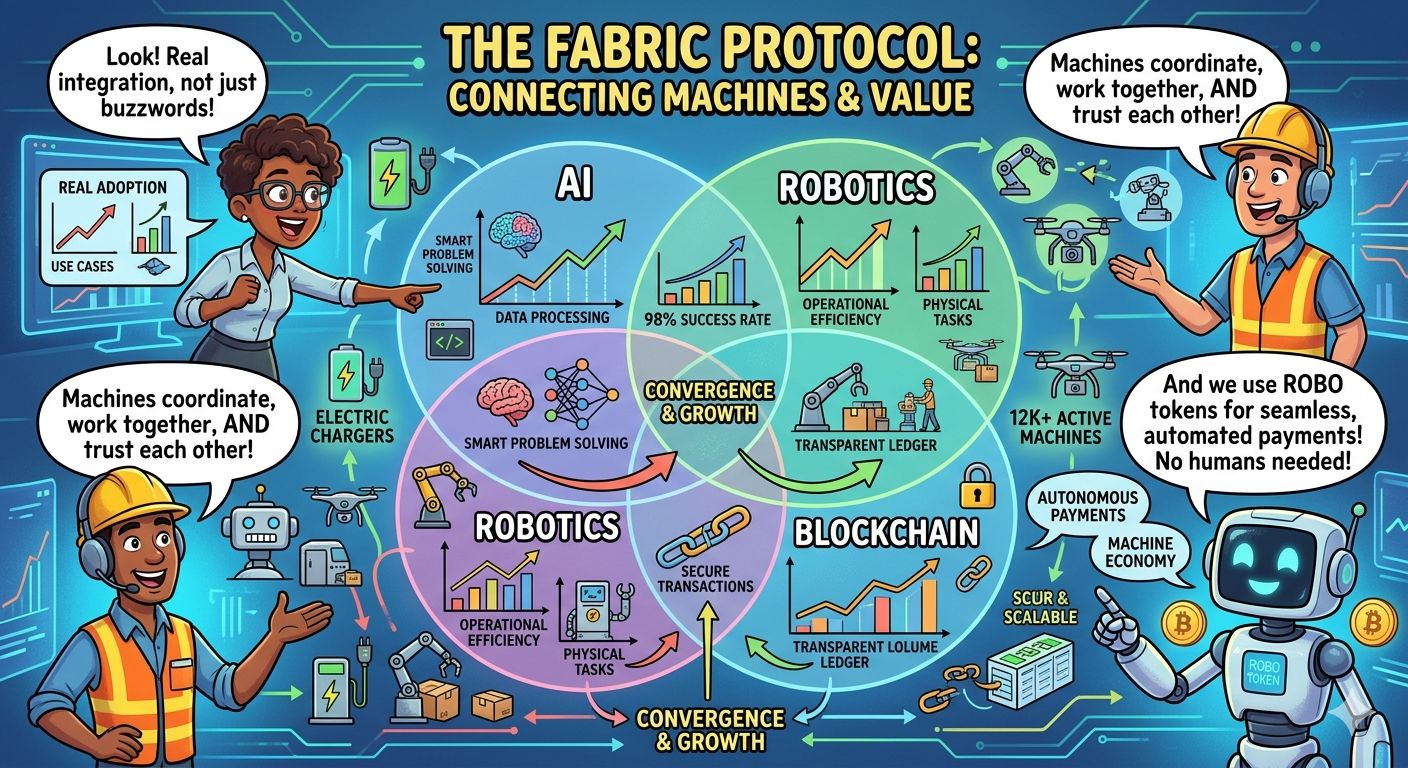
Let me be honest with you about what I found. This is a project that wants to put artificial intelligence, robotics, and blockchain into one single stack. On paper, this sounds like every other overhyped pitch deck that venture capitalists pretend to understand while writing million dollar checks. I have seen this movie before. Someone draws three overlapping circles on a slide, calls it convergence, and raises a fund based on buzzwords.
The usual pattern goes like this. Step one, find three hot trends. Step two, put them in a Venn diagram. Step three, write a whitepaper that connects them with complicated language. Step four, raise money from people who are too afraid to admit they do not understand it. Step five, launch a token and hope nobody notices there is no actual product.
I have watched this cycle repeat itself more times than I can count. And every time, regular people lose money while the founders move on to their next project.
But when I checked Fabric, I noticed something different. These three pieces actually need each other in ways that most people do not think about. This is not just marketing speak. There is real logic underneath it.
Here is the problem as I see it. And I want you to really understand this because it is the core of everything.
We are building artificial intelligence that gets smarter every single day. The progress in just the last few years has been faster than anyone predicted. These AIs can write essays, create art, solve complex problems, hold conversations that feel human. But they are all trapped. They live inside data centers. They exist purely in the digital world. They generate text and images and code. They answer our questions. But they cannot do anything real.
They cannot charge an electric vehicle that is running low on power. They cannot move a heavy box from one side of a warehouse to the other. They cannot go into a pipe that is leaking and fix the problem. They cannot help an elderly person get out of bed. They are brains without bodies. And a brain without a body can only do so much.
At the exact same time, we are building robots that have bodies but no real brains. Or their brains are so narrow and limited that they can only do one specific task in one specific factory. A robot arm that puts labels on bottles cannot suddenly decide to help with packaging when things get busy. A delivery drone that follows pre-programmed routes cannot figure out a new path when a tree falls and blocks the road.
The robotics industry is completely fragmented. A robot made by a company in Shenzhen, China cannot talk to a robot made by a company in Stuttgart, Germany. They speak different languages. They run on different software. They have no way to coordinate with each other. It is like having a team of workers who all speak different languages and have never met each other. They cannot get anything done together.
And nobody has built the layer that connects them. The communication layer. The coordination layer. The payment layer. The trust layer.
This is where I say most blockchain projects get it completely backwards. They start with the technology and then try to find a problem to attach to it. They sit in a room and ask, how can we put this on the blockchain, instead of going out into the world and asking, what actually needs a ledger. What actually needs trust. What actually needs coordination without a central authority.
They build solutions in search of problems. And then they wonder why nobody uses them.
But when I looked closely at Fabric, I noticed they started from the machine side. They came from robotics first. The core team comes from a company called OpenMind, and they have been building physical systems for years. These are not crypto tourists who learned what a robot was last week so they could put it in their pitch deck. These are people who understand the weight of metal. Who understand that when a robot fails, things break. Real things. Expensive things. Sometimes things that people rely on.
They started by asking a simple question. What does a robot need to participate in an economy. What does it need to work alongside other robots, pay for its own electricity, prove that it did its job correctly, build a reputation so others trust it.
And the answer was not a token. The answer came in layers. Identity, so machines can know who they are dealing with. Reputation, so machines can choose who to trust. Payment, so machines can exchange value for services. Verification, so machines can prove their work was done properly. Coordination, so machines can work together without a human watching every move.
Only after answering those questions did they arrive at blockchain as the right tool for the job. Because a public ledger is perfect for identity that cannot be faked. Perfect for reputation that cannot be erased. Perfect for payments that settle automatically. Perfect for verification that anyone can check.
I searched for the team behind this. I checked their backgrounds the way I always do now. I looked for red flags. I looked for exaggerated claims. I looked for previous projects that failed and left people hurt.
What I found was different from what I expected. I found people who have been building in robotics and complex systems for years. People with real academic credentials from places like Stanford. People who have shipped actual products, not just whitepapers. And I said to myself, okay, this is not what I thought it was. This is not a project that put AI in the name because it sounds cool. This is a project that understands the technical weight of what they are attempting.
We have to talk about the token because I know that is what everyone wants to understand. It is the first question people ask when they hear about any project. What is the token. How do I get it. Will it go up.
But I want you to think about it differently. I want you to reframe how you look at tokens entirely.
Most people look at a token and ask one question. Will the price go up. That is the wrong question. It is the question that has burned so many people in this space. It is the question that leads to buying at the top and selling at the bottom. It is the question that turns investing into gambling.
The question should be, what does this token actually do. What problem does it solve. Why does it need to exist.
In Fabric, the ROBO token is not just something to trade on exchanges. It is not just a number that goes up and down based on hype and Twitter sentiment. It has real functions in a real system.
It is how a robot pays for electricity when it rolls up to a charging station and plugs itself in. No human swipes a credit card. No human approves the payment. The robot checks its own balance, sends the tokens, and the charging station releases the power. Machine to machine. Autonomous. Trustless.
It is how a delivery drone pays for access to airspace data so it can navigate safely through a city. It is how a warehouse robot pays another robot for help moving something too heavy to lift alone. It is how a farming drone pays for weather data to plan when to plant seeds.
These are not abstract use cases written by marketing people. These are real transactions that need to happen between machines that have no bank accounts. No credit cards. No human operators watching their every move and approving every payment.
Think about what that means for a moment. We are heading toward a world with billions of connected machines. Cars, drones, robots, sensors, chargers, tools. They will all need to exchange value with each other. They will need to pay for services, data, energy, access. They cannot do that with traditional banking. Banks are built for humans. They have forms and approvals and office hours and human tellers. Machines need something faster. Something automated. Something global.
That is what this token enables. And that is why I say we need to stop looking at tokens as lottery tickets and start looking at them as tools.
I say this to you honestly. We have to be skeptical but we also have to be honest about what is actually happening in front of us.
There are already over twelve thousand active machines connected to this network. Not test transactions. Not fake wallets. Real machines doing real work. They are completing tasks with a ninety eight percent success rate. These are not phantom numbers from a dashboard someone built in a weekend to impress investors. These are robots and charging stations and compute nodes that are actually operating in the world.
I checked this data myself. I looked for ways to poke holes in it. I looked for the signs that every skeptic learns to spot. Inflated numbers. Circular activity. Wallets just sending tokens back and forth to create the illusion of usage. I did not find them.
What I found instead were real use cases. A network of over two thousand smart charging stations that adjust their prices based on demand, all coordinated through the protocol. Over eight thousand computers contributing processing power to train AI models, getting paid in tokens for their work. Robots from manufacturers like AgiBot and UBTech shipping with the Fabric client already installed, ready to join the network right out of the box.
This is not a project that is promising to build something someday. This is a project that is already operating.
Here is my personal experience with all of this. And I share this because I want you to understand where I am coming from.
I have watched too many projects promise too much and deliver too little. I have sat through too many presentations where founders sold visions of decentralized worlds while quietly building systems that were not decentralized at all. I have watched communities form around nothing, believe in nothing, and lose everything because they trusted narratives instead of looking at what was actually built.
I have friends who lost their savings. Good people who got caught up in the excitement and did not ask the hard questions until it was too late. I have seen what happens when hype replaces substance. It is not pretty. It leaves scars.
So when I tell you that Fabric might be different, I say it carefully. With caution. With the memory of every bad project still fresh in my mind. I am not here to tell you this is guaranteed to succeed. Anyone who promises certainty in this space is either lying or delusional.
But I also say this. If we want machines to work for us, to build our cities, to maintain our roads, to look after our parents when they get old, to help us when we are sick, they need to work together. They need to trust each other. They need to pay each for services. They need to coordinate without a human in the middle of every single transaction.
Because if a human has to approve every payment, every task assignment, every collaboration, then what is the point of automation. We might as well just do it ourselves.
So something like this has to exist. Whether it is Fabric or something else, the system that connects artificial intelligence to physical machines through a trusted public ledger is not optional. It is not a nice to have. It is going to happen. The only question is who builds it and how it is governed.
When I look at the partnerships they have secured, I pay attention. Robot manufacturers that are choosing to put their software into machines before they even leave the factory. That is not something you can fake. That is real distribution. That is real adoption.
When I look at the investors backing them, I pay attention. Pantera Capital does not write big checks because a whitepaper looks nice. They have a team of people whose job is to find problems. They write checks because they believe something will still exist and still matter ten years from now. Coinbase Ventures does the same. These are not dumb money funds. They have seen enough projects to know what real infrastructure looks like.
I am not here to tell you this will definitely succeed. The technical challenges are enormous. Making sure an artificial intelligence actually did what it claims to have done, in a way that can be verified and paid for on a blockchain, without slowing everything down to a crawl. That is hard. Really hard. Harder than almost anything else being built in crypto right now.
But I respect that they are trying to solve something real. They are not making up problems to fit their solution. They looked at an actual gap in the world, a gap that will only get bigger as more machines come online, and they started building.
So I say to you. Be doubtful. Be very doubtful. Ask hard questions. Check the data yourself. Do not trust anyone just because they sound confident.
But also pay attention to the projects that are building for the world that is coming, not the world that was. The projects that started with the problem, not the technology. The projects that have real machines doing real work today, not just promises of what might happen tomorrow.
The machines are coming whether we like it or not. They are coming because they make things cheaper and faster and safer. They are coming because the economics demand it. The only question is whether we build the systems to run them openly, where anyone can participate and contribute, or whether we let them be controlled by a few big companies behind closed doors.
Fabric is betting on open. And for that reason alone, I am watching closely. Not with blind faith. Not with excitement. But with attention. With curiosity. With the hope that maybe this time, the builders got it right.