Midnight’s Dual-Token Economy: How $NIGHT and DUST Redefine Blockchain Tokenomics
Blockchain networks have traditionally relied on a single token model to perform multiple roles. The same token often acts as both a store of value and the fuel required to run transactions or applications. While this approach worked in early blockchain systems, it has also created several challenges such as unpredictable transaction fees, economic imbalance, and difficulties for developers trying to build scalable applications.
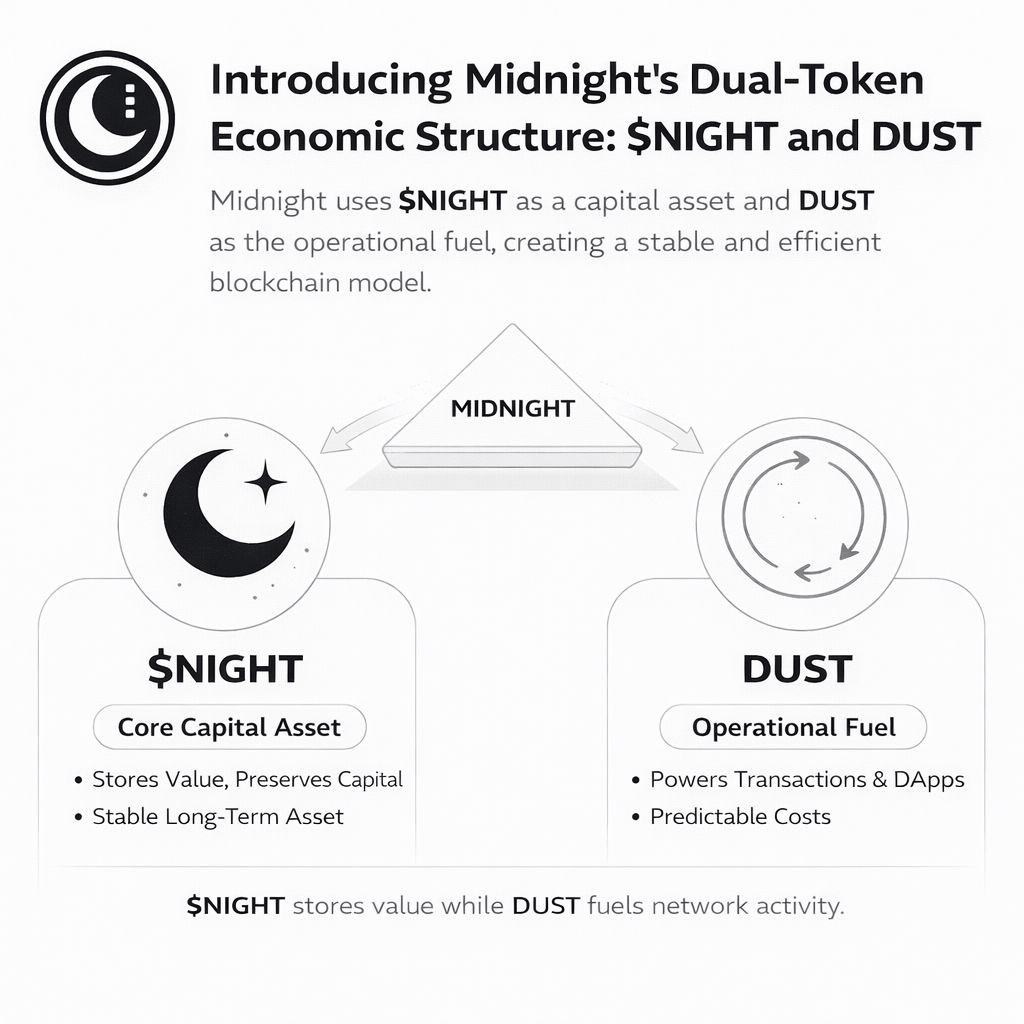
Midnight introduces a different approach by designing a dual-token economic structure built around two key elements: $NIGHT and DUST. Instead of forcing one asset to carry the entire economic responsibility of the network, Midnight separates the roles of value storage and operational fuel. This model aims to create a more balanced, efficient, and sustainable blockchain ecosystem.
At the core of the system is NIGHT, the primary capital asset of the Midnight network. $NIGHT represents long-term value within the ecosystem and acts as the economic backbone for participants. Rather than being constantly spent on transaction fees, it functions as a foundational asset that users can hold as part of the network’s value layer. This separation allows holders to maintain exposure to the ecosystem without the constant pressure of operational spending.
Alongside NIGHT is DUST, the operational resource that powers network activity. DUST is used to execute transactions, run smart contracts, and support decentralized applications within the Midnight ecosystem. By using a dedicated resource for operational activity, Midnight can maintain a more predictable environment for both users and developers.
One of the biggest advantages of this system is economic stability. In traditional blockchain models, heavy network activity can push transaction fees higher because the same token is used for both investment demand and network usage. This can create periods where transaction costs become expensive or unpredictable. Midnight’s separation of NIGHT and DUST helps reduce this pressure by isolating the value layer from operational demand.
The model also benefits developers building applications on the network. Predictable operational costs make it easier to design scalable decentralized applications. When developers know that transaction resources are structured around a separate operational layer, they can build with greater confidence and efficiency.
Another important element of Midnight’s ecosystem is its token distribution and incentive structure. Through mechanisms such as the Glacier Drop, the network introduces distribution models designed to encourage participation across multiple communities and blockchain ecosystems. This cooperative approach helps expand the network while rewarding contributors and early participants.
The Midnight tokenomics framework also focuses on multi-chain accessibility and participation. By designing a system that can interact with multiple blockchain environments, Midnight aims to create a privacy-focused infrastructure that supports broader adoption across the Web3 ecosystem.
As blockchain technology continues to evolve, economic models are becoming just as important as technical innovation. Networks that can balance usability, scalability, and long-term sustainability will likely play a major role in shaping the future of decentralized systems.
Midnight’s dual-token design represents one such attempt to rethink blockchain economics. By separating NIGHT as the capital asset and DUST as the operational fuel, the network creates a structure where value storage and network activity can coexist without interfering with each other.
@MidnightNetwork MidnightNetwork
In simple terms, #night preserves long-term value while DUST powers everyday network activity. Together, they form the foundation of Midnight’s evolving ecosystem and highlight a new direction for blockchain tokenomics built around stability, efficiency, and practical usability.