Okey, let me be honest with you. When I first heard about Fabric Protocol, I rolled my eyes so hard I nearly pulled a muscle. Another crypto project promising to put robots on the blockchain. Another team of smart people using big words like "verifiable computing" and "agent-native infrastructure" to sell a dream. I have been around long enough to know that usually, when someone says they are combining AI, robotics, and blockchain, they are either confused or trying to confuse you. The hardware isn't ready. The software is messy. And most of these projects die quietly after burning through investor money.
But I checked this one out anyway. I dug around. I read their stuff. And I have to tell you why my personal experience in this industry made me stop and think twice.
Here is what I have realized. We are all obsessed with making robots smarter. We want them to open doors, recognize our faces, and maybe even make us coffee. That is cool and all, but it misses the real problem. I search for answers every day, talking to people building in this space, and the bottleneck keeps coming back to the same thing. It is not intelligence. It is trust.
Think about it. If a robot cleans my house and breaks something valuable, who is responsible? Do I blame the robot? Do I sue the company that made it? Do I just accept that machines break things sometimes and move on? If a delivery drone drops a package and it hits someone's car, how do we figure out what went wrong? Was it bad software? Was it a sensor glitch? Was it just wind? Right now, we have no good answers. We are building these incredibly powerful machines, but we have no court system for them. No way to verify what they actually did. No way to hold them accountable.
That is the real problem nobody is talking about. We are so busy making robots smarter that we forgot to build the rules they have to live by.
This is where Fabric Protocol stopped sounding like hype to me and started sounding like something real. They are not trying to build a better robot. They are building something much more boring and much more important. They are building a witness.
Imagine every airplane has a black box. When a plane crashes, we don't just guess what happened. We pull that box. We check the data. We figure out exactly who or what failed. In the real world, we have cameras and witnesses and police reports. But when an AI makes a decision in a fraction of a second, we have nothing. The code runs, the decision gets made, and then it is gone. There is no record. There is no proof. There is just whatever the machine tells us after the fact.
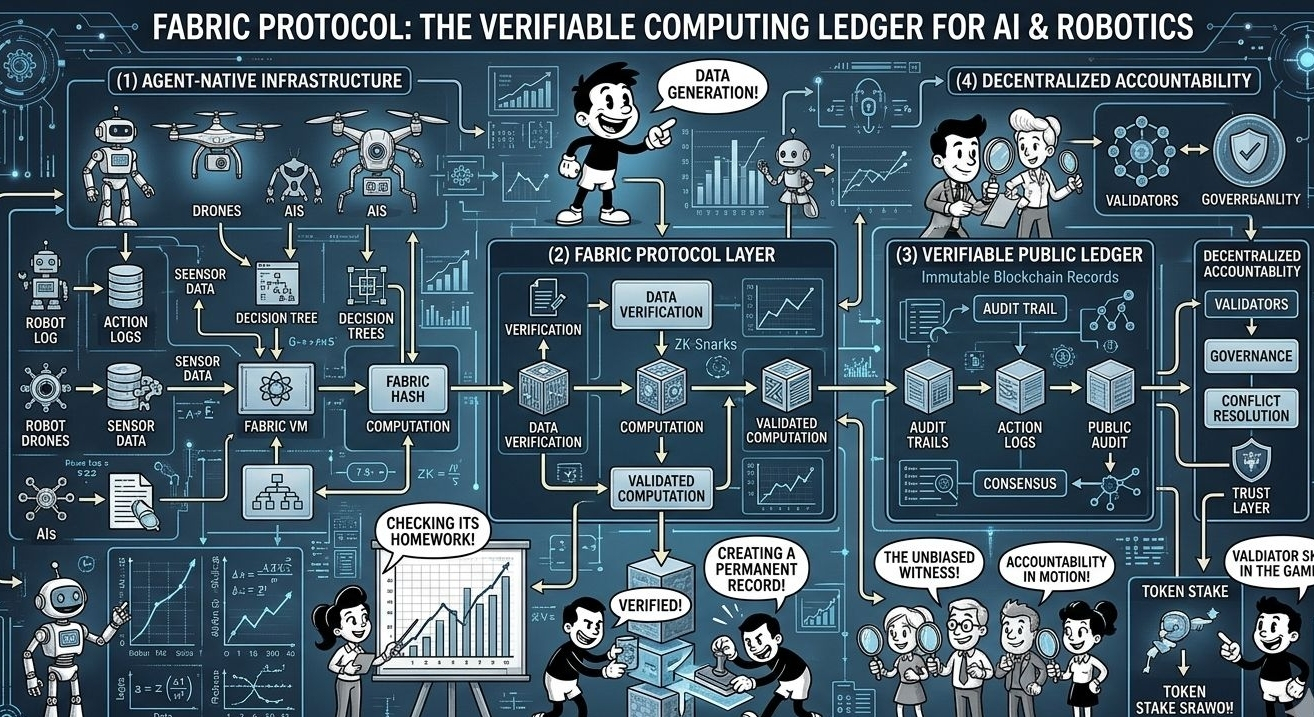
Fabric is using a public ledger to freeze that moment in time. They are creating a permanent record of what the robot saw, what it decided, and what it actually did. When a robot acts, we can verify that it followed the rules. We can prove it did not cheat. We can check its homework.
I say to myself, this is the only way humans will ever feel safe letting robots walk among us. Not because the robots are perfect. They will never be perfect. But because we can actually see what they did and hold someone accountable when things go wrong.
I remember working on a project years ago where we had two different AI models arguing about a simple transaction. One said ship the product. The other said hold it for fraud. We spent three weeks fighting about what actually happened. The logs were a mess. The data was all over the place. We sat in a room yelling at each other about who pressed what button and when. It was stupid and wasteful and we never really got to the bottom of it. If we had a neutral witness back then, something that just recorded the facts without emotion or bias, we would have solved it in ten minutes.
That is what Fabric is offering. They are the Switzerland of the robot wars. A neutral ground where facts can be checked and arguments can be settled.
Here is how I see the whole thing fitting together. The AI gives the robot a brain. It lets it think and adapt. The robotics gives it a body. It lets it move and touch and act in the physical world. The blockchain gives it a conscience. It makes it accountable for what it does. Take away that last piece and you have a powerful machine that can lie to you and you would never know. It could tell you it did the work. It could tell you it did not break anything. And you would just have to trust it.
I do not trust machines. Honestly, I do not even trust most people. But I trust math. I trust a public record that I can check for myself. I trust something that cannot be changed or erased after the fact. Fabric Foundation being a non-profit actually matters to me. It tells me they are trying to build a standard that everyone can use, not just a product they want to sell. They want this to be the rulebook that every robot plays by.
Now let me talk about the token, because I know that is what a lot of you are thinking about. If you are here because you think a robot coin is going to make you rich because robots are cool and the future is coming, I think you are looking at it wrong. I say to you, look at the token differently. Look at it as a stake in the truth. If you want to be someone who checks the robot's work, if you want to be a validator in this network, you have to put up some of that token. You have to have skin in the game. If you verify something false, if you sign off on a lie, you lose your stake. That is how the system stays honest. This is not a currency for buying robot parts. This is an insurance policy for the age of machines.
We are heading toward a world with more non-human workers than human workers. That is coming faster than most people realize. And when that happens, we need a way to keep order that does not require a human cop watching every single interaction. We need systems that enforce the rules automatically. Fabric is betting that a public ledger can be that system. That the blockchain can be the cop.
Look, I am still skeptical. Building hardware is brutally hard. Getting robot companies to agree on anything is like herding cats. This could take ten years. It could fail completely. But for the first time in a long time, I see a project that is not just slapping a crypto sticker on a robot vacuum and calling it innovation. They are solving the hard problem. The boring problem. The problem of verification and accountability and trust.
They are building the court system before the crime wave starts. And to me, that is worth paying attention to. Let us see if they can actually pull it of.