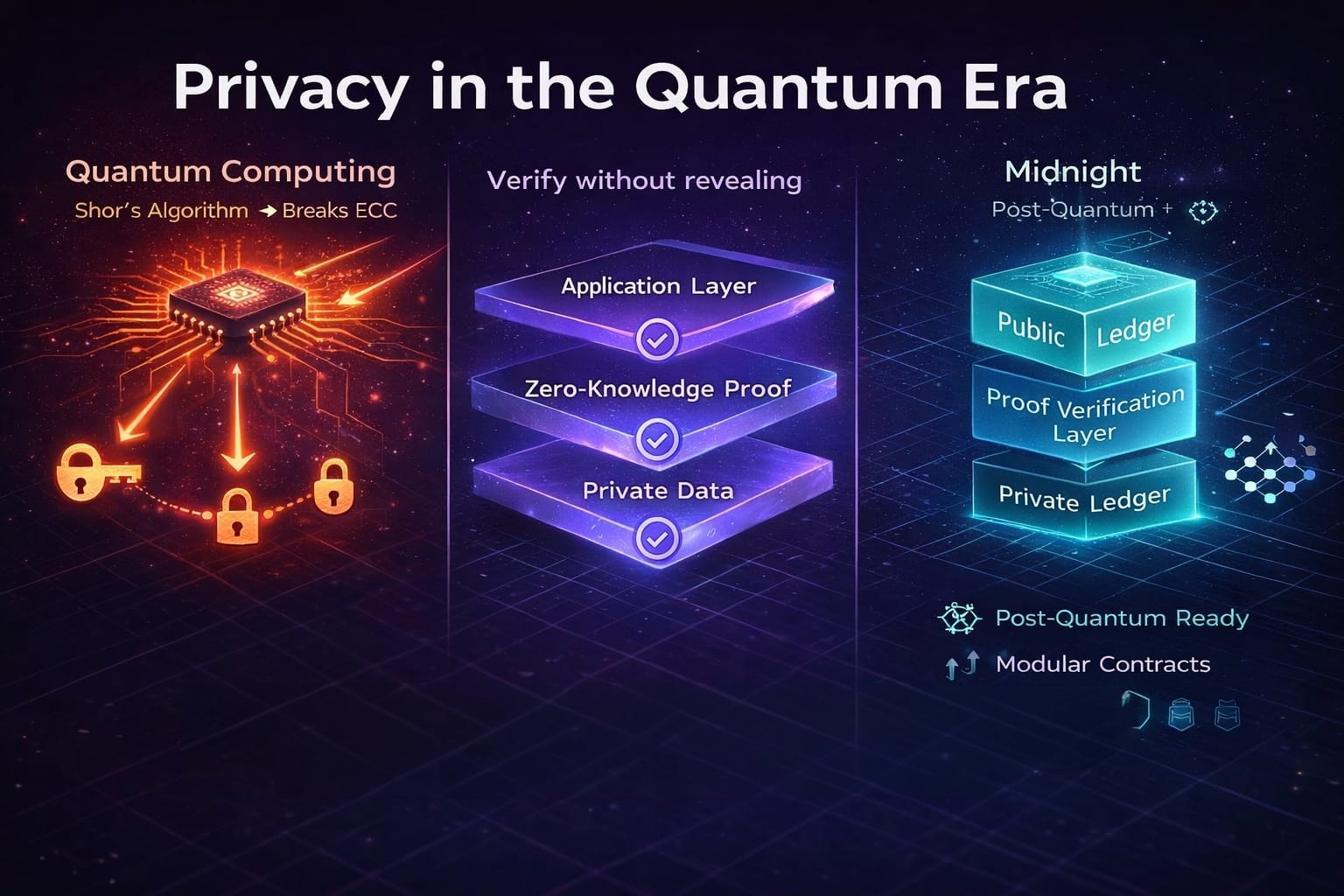
I keep coming back to a simple question whenever I think about the future of blockchain infrastructure. Will the systems we build today still protect people when the cryptography landscape changes tomorrow? That question is exactly what first drew my attention to @MidnightNetwork because it seems to focus on something many projects rarely discuss seriously: what happens to privacy when quantum computing arrives?
When I look at current security discussions, one concern appears again and again. Attackers can harvest encrypted data today and store it until quantum computers become capable of breaking it. Shor’s algorithm, once implemented at scale, could weaken the elliptic-curve cryptography used by most blockchains today, including systems that support zero-knowledge proofs. I’m aware that practical quantum attacks may still be years away. But technological shifts rarely wait for infrastructure to catch up. From my perspective, preparing early simply makes engineering sense, and Midnight appears to approach the problem with that mindset.
When I think about zero-knowledge proofs, I often return to a simple analogy: proving you are over twenty-one without showing your ID. In other words, you can prove something is true without revealing the underlying information. What I find interesting is how Midnight builds on this idea through what it calls rational privacy, where users control exactly what information is shared and when. What keeps pulling my attention back to Midnight is its architecture. I see a design where a public ledger and a private one work together so applications can verify sensitive information through cryptographic proofs without exposing the underlying data. Even if cryptographic standards evolve in a post-quantum world, the proof systems themselves can adapt without revealing private state. When I look deeper into the system design, I also notice the modular approach. That means cryptographic components can evolve over time as new standards emerge. Possible paths include lattice-based cryptography and developing NIST post-quantum standards, suggesting the network is designed with long-term adaptability in mind. From where I sit, the bigger story here is not short-term price movements. What interests me more is whether infrastructure like this could support real-world systems that require both privacy and verification. Industries dealing with sensitive data, from healthcare to regulated enterprise environments, increasingly need technology that can prove compliance without exposing everything. That balance between privacy and verifiability is what really locked my curiosity around Midnight. The quantum threat may not arrive tomorrow, but infrastructure meant to last cannot wait for threats to appear. This is where Midnight stops looking like a feature and starts looking like a foundation. Because of that, I see Midnight not simply as another blockchain experiment, but as infrastructure designed to endure.