
been going through Midnight's NIGHT token properties and honestly? the non-expendable design is the most counterintuitive thing about this entire protocol 😂
every blockchain most people have used works the same way. you hold tokens. you make transactions. your balance goes down. gas fees leave your wallet permanently. the more you use the network the less you hold. this is so fundamental to how blockchains work that most people never even think to question it.
Midnight breaks this assumption completely.
what caught my attention:
the whitepaper states it directly in the NIGHT key features section — NIGHT is not expendable to execute transactions. holding NIGHT tokens and executing transactions on Midnight are completely separate economic activities. your NIGHT balance has zero relationship to your transaction volume.
this isnt a minor design detail. it restructures the entire economic relationship between network users and the native token.
on Ethereum, every transaction you execute depletes your ETH balance. heavy users of the network are continuously spending tokens. their economic incentive is to minimize transactions — every interaction has a direct cost that flows out of their wallet permanently. this creates friction. it creates uncertainty. it creates a budgeting problem for businesses trying to offer consistent services on-chain.
on Midnight, a holder with 10,000 NIGHT can execute unlimited transactions — bounded only by how much DUST their NIGHT generates and how frequently that DUST regenerates. their NIGHT balance at the end of a year of heavy network usage is identical to their NIGHT balance at the start.
the part that surprises me:
this design has a second-order effect that the whitepaper acknowledges but most discussions overlook. NIGHT is unshielded — wallet addresses and transaction history are publicly visible. but because NIGHT never leaves a wallet through normal usage, on-chain observers cannot infer network activity level from NIGHT balance changes. a wallet that transacts 10,000 times per year looks identical to a wallet that never transacts — both maintain the same NIGHT balance.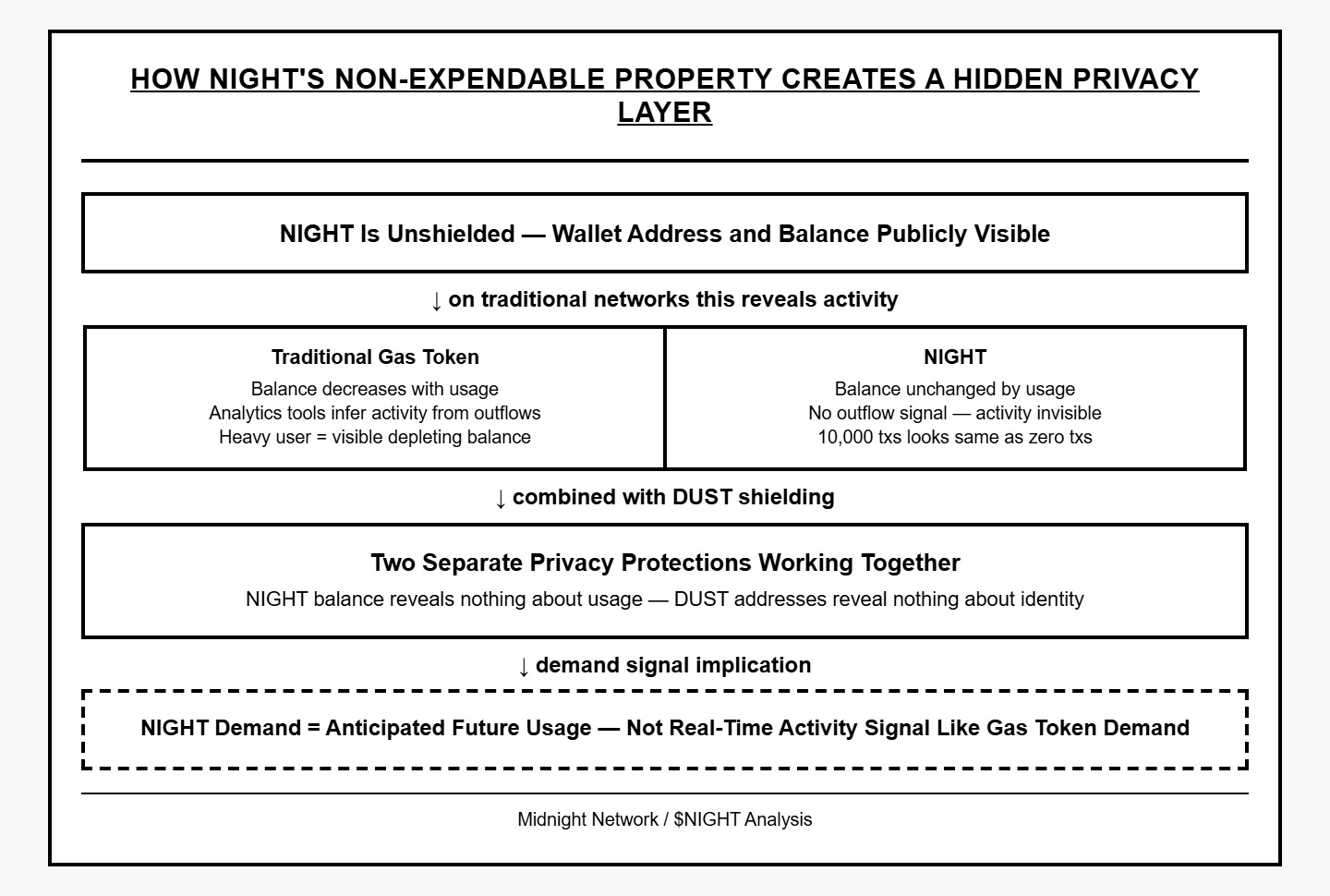
the usage signal that blockchain analytics tools rely on — watching token outflows to infer activity — doesnt work for NIGHT holders on Midnight. the non-expendable property and the DUST shielding layer together create a privacy protection that neither property achieves alone.
what they get right:
the operational cost predictability for businesses is genuinely significant. a DApp operator on Ethereum must continuously model ETH price and gas costs to budget their operational expenses. a DApp operator on Midnight holds a NIGHT balance and generates DUST indefinitely. their operational cost is determined by how much NIGHT they hold — a one-time capital allocation decision — not by ongoing token expenditure that fluctuates with network congestion and token price.
the whitepaper describes this as operational predictability — one of the four core pillars of Midnight's tokenomics design. NIGHT holders can execute transactions for as long as they hold enough tokens to generate the required DUST. the cost of using Midnight is the opportunity cost of holding NIGHT — not the direct cost of spending it.
my concern though:
the non-expendable design concentrates the economic burden of network access into the NIGHT acquisition decision rather than distributing it across ongoing usage. a new participant wanting to use Midnight must acquire sufficient NIGHT to generate adequate DUST for their intended usage level. this upfront capital requirement may be higher than the equivalent gas costs would be on a traditional network for light users.
and heres what i keep thinking about — if NIGHT is never spent in transactions, the primary demand driver for NIGHT is DUST generation capacity. holders acquire NIGHT to generate DUST, not to spend NIGHT. this means NIGHT demand is a function of how much network activity participants anticipate — a forward-looking demand signal rather than a real-time usage signal.
on networks where gas is spent, token demand responds immediately to current network activity. on Midnight, NIGHT demand responds to anticipated future activity. the demand signal is fundamentally different in timing and nature.
honestly dont know if the non-expendable design creates more stable long-term token demand from businesses building on Midnight — or whether the upfront capital requirement creates a higher barrier to entry for new participants compared to pay-as-you-go gas models.
watching: NIGHT holding distribution among active DApp operators vs passive holders at mainnet launch, whether DUST generation capacity becomes the primary metric operators use to evaluate NIGHT acquisition decisions, how the non-expendable property affects token velocity compared to traditional gas token networks 🤔
what's your take — most innovative network fee design in crypto because it decouples usage from token depletion, or a capital efficiency tradeoff that shifts costs from ongoing gas payments to upfront NIGHT acquisition?? 🤔
#night @MidnightNetwork $NIGHT
