There’s a quiet contradiction at the heart of the internet today: the more connected we become, the less control we seem to have over what we share.
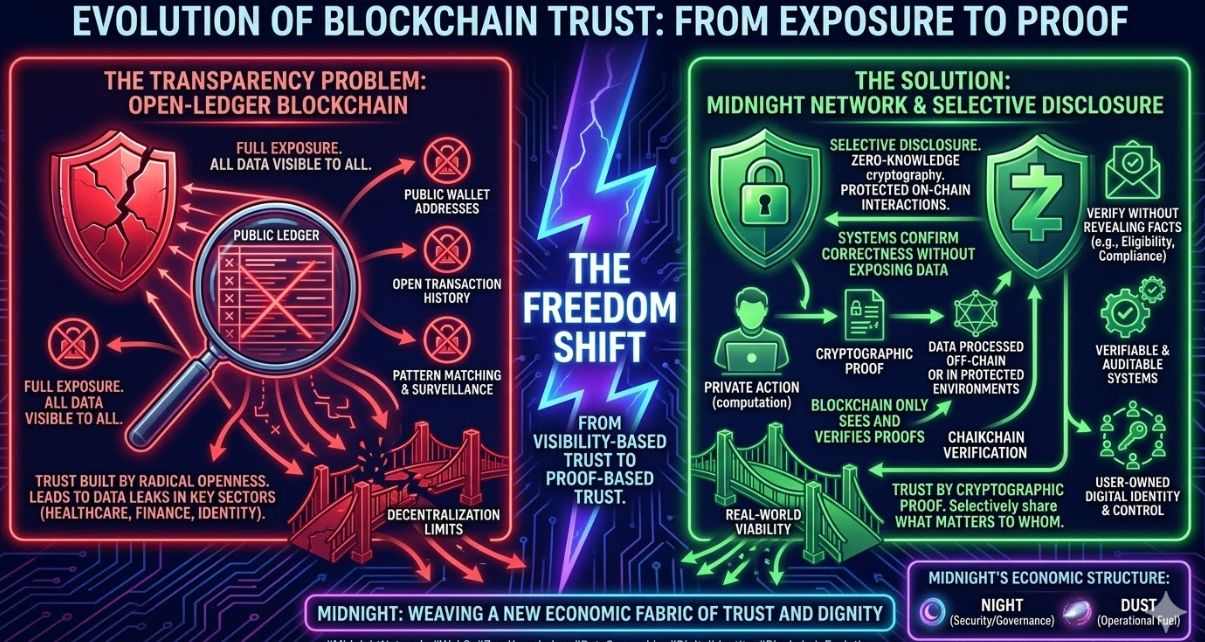
For a long time, blockchain was seen as the answer to broken trust online. It introduced a system where nothing needed to be hidden because everything could be verified. Every transaction, every interaction, recorded on a public ledger for anyone to see. It felt like a breakthrough, finally, a system where truth didn’t depend on institutions but on visibility.
But as time passed, that same strength started to reveal its limits.
Because in the real world, not everything is meant to be public.
Think about how we live our lives. We share different things with different people. We don’t hand over our full identity every time we prove something simple. We don’t expose our entire financial history just to complete a single transaction. Privacy isn’t secrecy, it’s structure. It’s control over what we reveal, when we reveal it, and to whom.
That kind of control has been missing from most blockchain systems.
The assumption was simple: transparency creates trust. And in many cases, it does. But when every piece of data is permanently visible, transparency stops feeling like trust and starts feeling like exposure. For individuals, it can feel uncomfortable. For businesses, institutions, and entire industries, it becomes a barrier they cannot ignore.
This is where a different idea begins to take shape, one that doesn’t reject decentralization, but refines it.
What if you could prove something without revealing everything behind it?
It sounds almost counterintuitive at first. We’re used to thinking that proof requires evidence, and evidence requires visibility. But advances in cryptography have shown that this isn’t always true. There are ways to confirm that something is valid without exposing the underlying details.
That idea sits at the center of what Midnight Network is trying to explore.
Instead of building a system where all data must be public to be trusted, Midnight takes a different approach. It allows information to stay private while still making it possible for the network to verify that everything is correct. It’s not about hiding activity, it’s about separating what needs to be known from what doesn’t.
In simple terms, it introduces the idea of selective disclosure.
You don’t show everything. You show enough.
Imagine being able to prove you meet certain requirements without handing over your full identity. Or confirming that a transaction follows the rules without exposing the details behind it. The system doesn’t need to see your data, it only needs to see proof that your data satisfies the conditions.
This is made possible through something known as zero-knowledge cryptography. While the name sounds technical, the impact is very human. It gives people and organizations a way to interact, verify, and participate without constantly giving away pieces of themselves.
And that changes how decentralized systems can be used.
For industries like finance, this matters deeply. Institutions need to prove compliance, but they cannot expose sensitive client data to the public. In healthcare, information is even more personal. Sharing it openly is not an option, yet verifying it can be critical. Even in digital identity, people need ways to confirm who they are without revealing more than necessary.
Until now, this balance has been difficult to achieve in decentralized environments.
Midnight’s approach suggests that it might be possible.
Behind the scenes, the system works by allowing computations to happen privately. Once those computations are complete, they produce a proof, a kind of cryptographic confirmation that everything was done correctly. The network verifies the proof, not the data itself. The result is trust without exposure.
It’s a subtle shift, but it has wide-reaching implications.
Because once you remove the requirement to make everything public, a whole new set of possibilities opens up. Decentralized systems can start to move into areas that were previously out of reach. They can begin to support real-world processes that depend on confidentiality, nuance, and controlled information sharing.
But technology alone isn’t enough. For a system like this to work, it also needs an economic structure that supports it.
Midnight introduces a model where participation and usage are treated differently. The NIGHT token connects to governance and long, term involvement in the network, while a separate resource, DUST, is used to power transactions and private computations. It’s a design choice that reflects the unique demands of privacy-focused systems, where computation isn’t just about moving data, but about protecting it.
This separation may seem small, but it points to a deeper understanding: not everything in a network should be driven by the same incentives.
Still, like any emerging technology, this path isn’t without challenges.
Privacy-focused systems are more complex to build. The underlying cryptography can be resource-intensive, and making these tools accessible to developers takes time. There are also broader questions about regulation and accountability. A system that protects data must also ensure it can operate within real-world legal and ethical frameworks.
None of this is simple.
But the direction itself feels important.
For years, the internet has grown by collecting more data, storing more information, and making more of our lives visible to systems we don’t control. That model created powerful platforms, but it also left people with a growing sense that something was missing.
Control.
Not just over money or assets, but over information, over the details that define who we are and how we interact with the world.
Decentralization was meant to give some of that control back. But without privacy, it only solves part of the problem.
What Midnight and similar projects are exploring is the idea that ownership and privacy are connected. That true participation in digital systems shouldn’t require constant exposure. That trust doesn’t have to come from seeing everything; it can come from proving what matters.
And maybe that’s the real shift happening here.
Not a move away from transparency, but a move toward something more balanced. A world where systems are open enough to be trusted, but private enough to be human.
Because in the end, the future of the internet won’t just be defined by how much we can share, but by how wisely we choose what to keep.
@MidnightNetwork #night $NIGHT