
Blockchain Invisible to Every Single User
just stumbled across the most underappreciated design feature in Midnight's entire tokenomics architecture and honestly? most people building on blockchain have no idea this is possible...
every Web3 application built on existing blockchains faces the same onboarding problem. users need tokens. users need wallets. users need to understand gas fees. the moment a non-crypto user encounters a MetaMask popup or a gas fee notification, a significant percentage of them leave. the user experience gap between Web2 and Web3 is largely a fee payment gap.
Midnight's DUST sponsorship model is a direct architectural solution to this problem.
the part that surprises me:
the whitepaper describes three categories of DUST beneficiaries. NIGHT holders who generate their own DUST. DUST recipients who receive DUST from a NIGHT holder designation. and DUST sponsees — users whose transactions are covered entirely by a DUST holder without the sponsee ever touching a token.
the sponsee model is the one that changes everything. a DUST sponsee does not receive DUST. they dont hold NIGHT. they dont even need to know that a blockchain exists underneath the application they're using. the application handles the entire process on their behalf.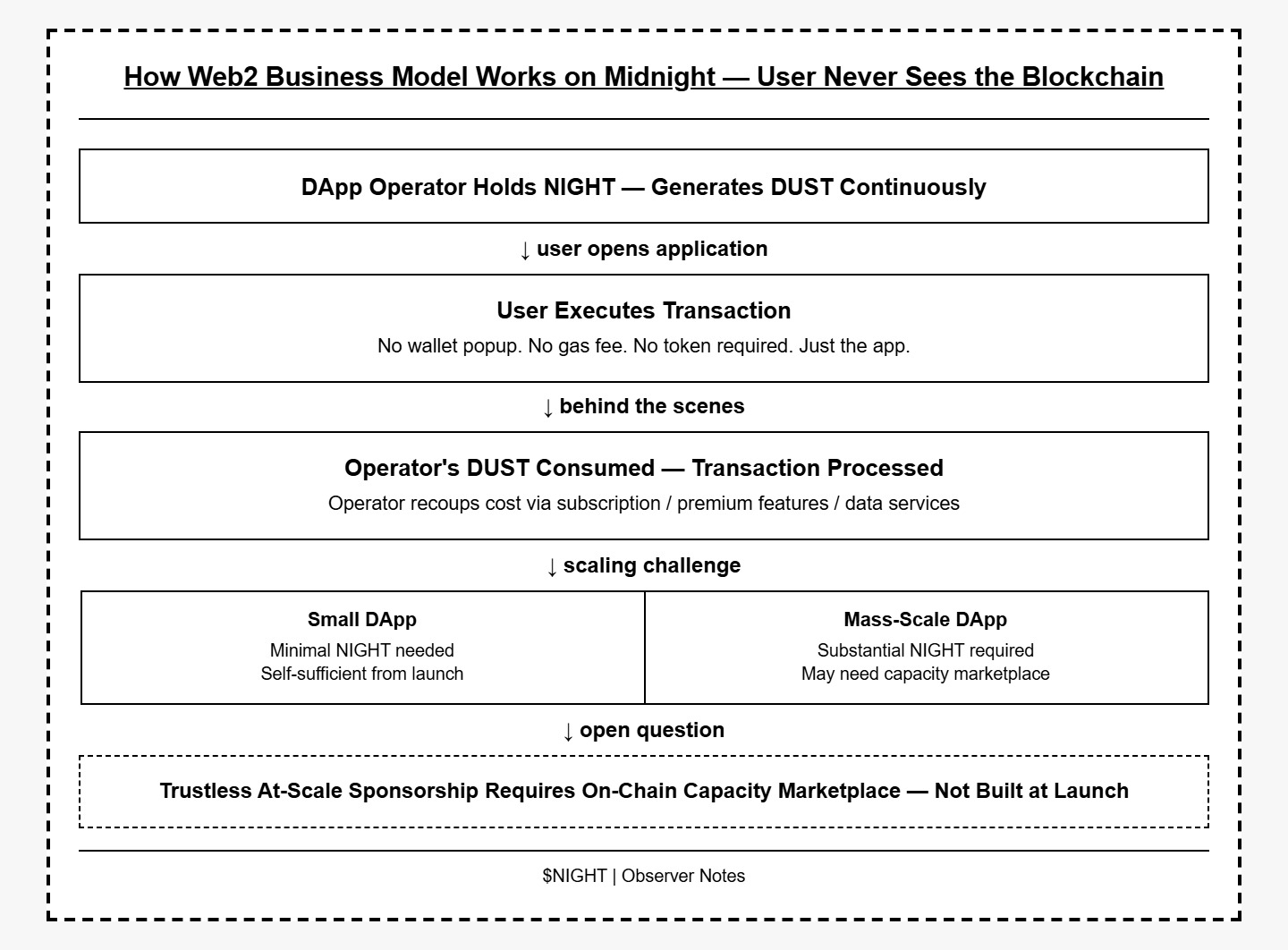
the whitepaper makes this explicit — DUST sponsees do not even need to know that there is a blockchain, as the application can handle the entire process on their behalf.
what caught my attention:
this is structurally identical to how Web2 business models work. when you use Google Maps, you dont pay per API call. Google covers infrastructure costs and monetizes elsewhere. when you use a free mobile app, you dont pay transaction fees. the developer absorbs server costs and monetizes through advertising or premium features.
Midnight enables the same model for blockchain applications. a DApp operator holds NIGHT, generates DUST, and covers every user transaction cost. users interact with the application like any Web2 product. the operator builds their business model around the application — subscription fees, premium features, data services — not around requiring users to hold tokens.
the whitepaper gives a specific example. a decentralized e-commerce application can sponsor the usage of their application, covering the DUST cost of every customer who makes a purchase without the users ever being exposed to the complexities of Web3.
still figuring out if:
the sponsorship model requires DApp operators to hold sufficient NIGHT to generate adequate DUST for their entire user base. this is a capital requirement that scales with user volume. a DApp with 10 users needs minimal NIGHT. a DApp with 10 million users needs substantial NIGHT to generate enough DUST to cover all transactions.
the whitepaper describes a capacity marketplace where operators who need more DUST than they generate can lease capacity from NIGHT holders with excess generation. this marketplace exists in concept — it requires either trust-based off-chain arrangements or future protocol upgrades for on-chain atomic leasing.
so the sponsorship model at launch depends on either operators holding sufficient NIGHT themselves or accessing leased DUST through off-chain arrangements with trust requirements. the fully trustless version of mass-scale sponsorship requires protocol development that hasnt been built yet.
and heres what i keep thinking about — the sponsorship model inverts the token demand signal. in traditional gas models, more users means more gas token spending means more demand signal. in Midnight's sponsorship model, more users means more NIGHT held by operators means more demand signal — but the demand is concentrated at the operator level not the user level. retail users never need to touch NIGHT at all.
this creates a fundamentally different token holder profile. instead of millions of individual users each holding small NIGHT amounts, you get a smaller number of DApp operators each holding large NIGHT balances. concentration of NIGHT demand shifts from retail to institutional.
honestly dont know if operator-concentrated NIGHT demand creates more stable long-term token economics — or whether concentrating demand in a small number of large operator wallets creates new governance and supply dynamics that retail participants dont fully understand.
what do you think — the feature that finally makes blockchain invisible to mainstream users, or a sponsorship model that shifts token concentration from retail to institutional and changes network economics in ways nobody is discussing?? 🤔
#night @MidnightNetwork $NIGHT
