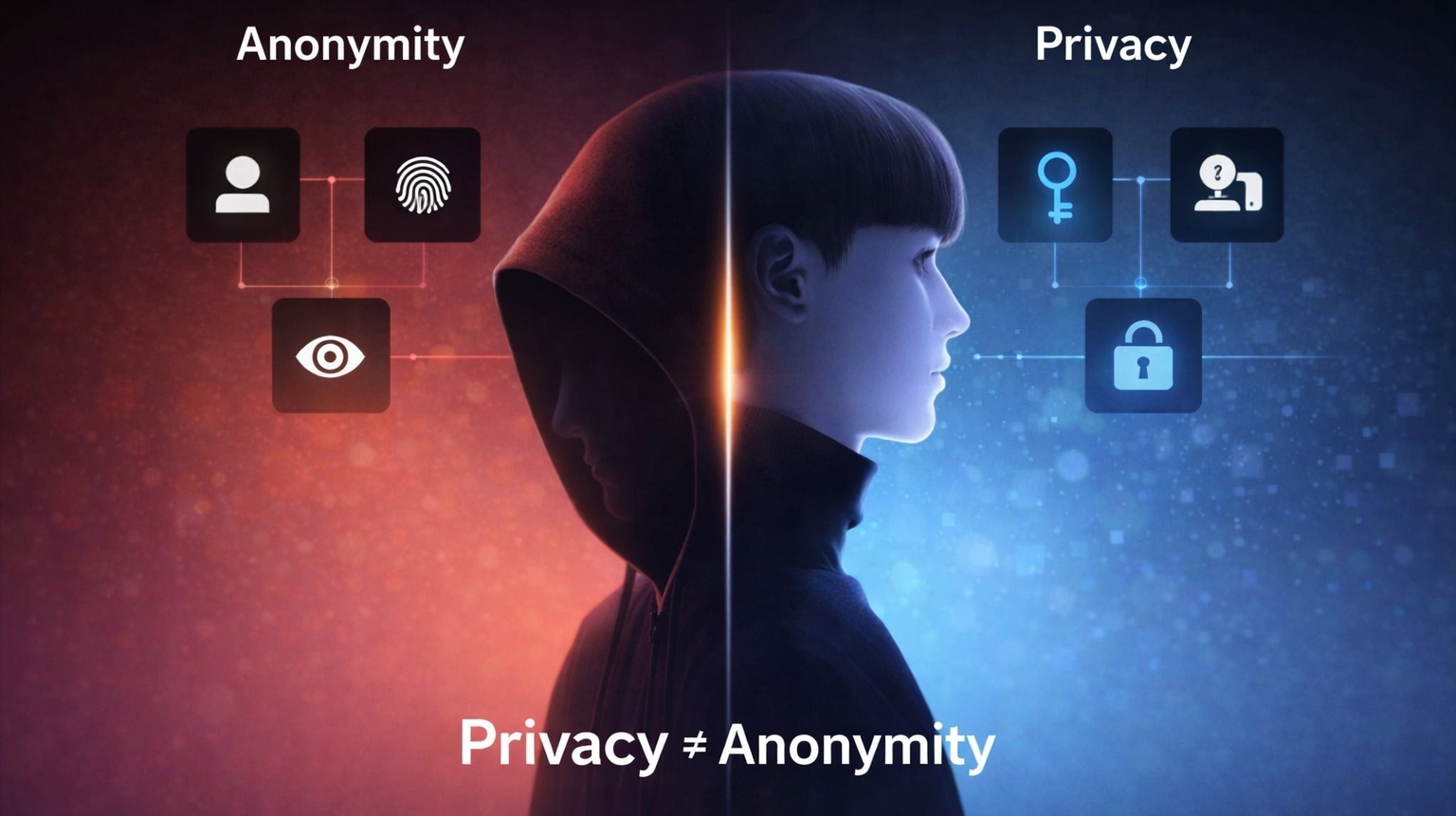
I caught a mistake in my own writing last week and I want to be honest about it. Most people think Midnight is anonymous. That misunderstanding alone could limit its adoption before it even begins.
When I went back and reread my previous articles about @MidnightNetwork I noticed something that genuinely bothered me. I kept using privacy and anonymity like they pointed to the same idea. And when I started thinking about what that confusion actually costs Midnight in the real world, I realized this is not a small language issue. It could quietly limit the project's biggest opportunities before the network gets a fair chance.
Let me walk you through what I now understand properly.
Anonymity means nobody knows who you are. The system makes you completely unidentifiable to everyone, including people with legitimate reasons to know.
Privacy means something different. You are not hidden. You are in control of what is revealed, to whom, and when.
That second idea is what Midnight actually builds. And when I look at how most community content describes Midnight, including things I wrote myself, I see people applying the first definition to a project designed around the second. Midnight is not an anonymity focused blockchain. It is a compliance compatible privacy network.
What caught my attention when I went deeper into Midnight's architecture is how deliberately this distinction is built into the system. Midnight uses selective disclosure enabled by zero knowledge proofs. Your transaction data sits on the private ledger, shielded by default. But you hold a viewing key that can reveal specific information to a specific party when you decide to share it. To an auditor reviewing your records.To a regulator if legally required. To a business partner verifying one payment.You control the party, the scope, and the timing.
When I think about what that actually means technically, I find it more precise than pure anonymity. This is exactly what zero knowledge architecture enables. You prove precisely what needs to be proven and nothing more.
That design choice matters in four very specific ways.
The first thing I think about is exchange listings. When I look at what happened to Monero across Binance, Kraken, Bittrex and other major platforms, a major reason behind those delistings was the same problem. Anonymous transactions make compliance extremely difficult because no reliable mechanism exists to identify users when legally required. Midnight's viewing key system changes that equation. Disclosure becomes possible under legitimate conditions. That is the architectural difference between a project exchanges feel pressure to remove and one they can realistically support.
The second thing is enterprise adoption. When I think about the industries Midnight is actually trying to reach, healthcare, financial services, supply chain, regulated environments, every single one has a compliance team making the final decision. From my perspective that team asks one question before anything else. Can we prove compliance to a regulator if audited. Anonymous systems make that answer no and the conversation ends immediately. Private systems with selective disclosure make that answer yes and the conversation can actually continue. I think the entire enterprise opportunity for Midnight lives inside that single distinction.
The third area is regulatory positioning and this is the one I find most important right now. When I look at what happened to Tornado Cash, the issue was not simply privacy. The problem was the absence of any disclosure mechanism under any circumstances. Midnight's design is structurally different. Compliance pathways exist by design. Users hold their own keys. Disclosure happens when the user decides it should, including when legitimately required by law. This is the line between being regulated, restricted, or removed entirely.
The fourth thing I keep coming back to is developer confidence. When I think about someone building a healthcare application or an identity system on Midnight, they need to know the platform can satisfy real legal requirements without exposing everything. Selective disclosure gives them that confidence in a way pure anonymity never could.
What I find genuinely interesting when I look at Midnight's overall philosophy is the phrase the project uses. Rational privacy. It describes privacy as a user controlled spectrum rather than a simple on or off switch.
Ethereum puts everything visible to everyone. Monero prioritizes default anonymity, with limited and less flexible disclosure mechanisms compared to Midnight's selective disclosure design. Midnight sits in a more deliberate position where the user controls the exact level of disclosure for each interaction, each party, and each moment.
That is not a small refinement on existing privacy technology. It is a fundamentally different philosophy about what privacy should mean in a system designed for real world adoption.
Looking back at my own articles I described Midnight alongside Monero in ways that made them sound philosophically similar. That framing was wrong and it matters that I correct it clearly. Midnight was not built for users who believe privacy is absolute with zero exceptions. It was built for people, businesses, and institutions that need privacy as the default and compliance as an option when the world legitimately requires it.
Those are different products with different regulatory profiles and genuinely different adoption ceilings.
From my perspective the community describing Midnight as an anonymous blockchain is not just being imprecise. It is attaching a regulatory label built around a different philosophy to a project whose entire value depends on being understood as something architecturally different.
What I understand now that I did not fully appreciate before is that the architecture is already correct. Midnight already built the right system. The harder job right now is making sure the words we use to describe it are equally precise.
If Midnight gets this positioning right early, it could become the first privacy network that institutions adopt without hesitation.
Midnight does not have an architecture problem. It has a positioning problem. If the narrative stays wrong, adoption will follow it in the wrong direction.
Privacy is not anonymity. For Midnight, that difference is everything.