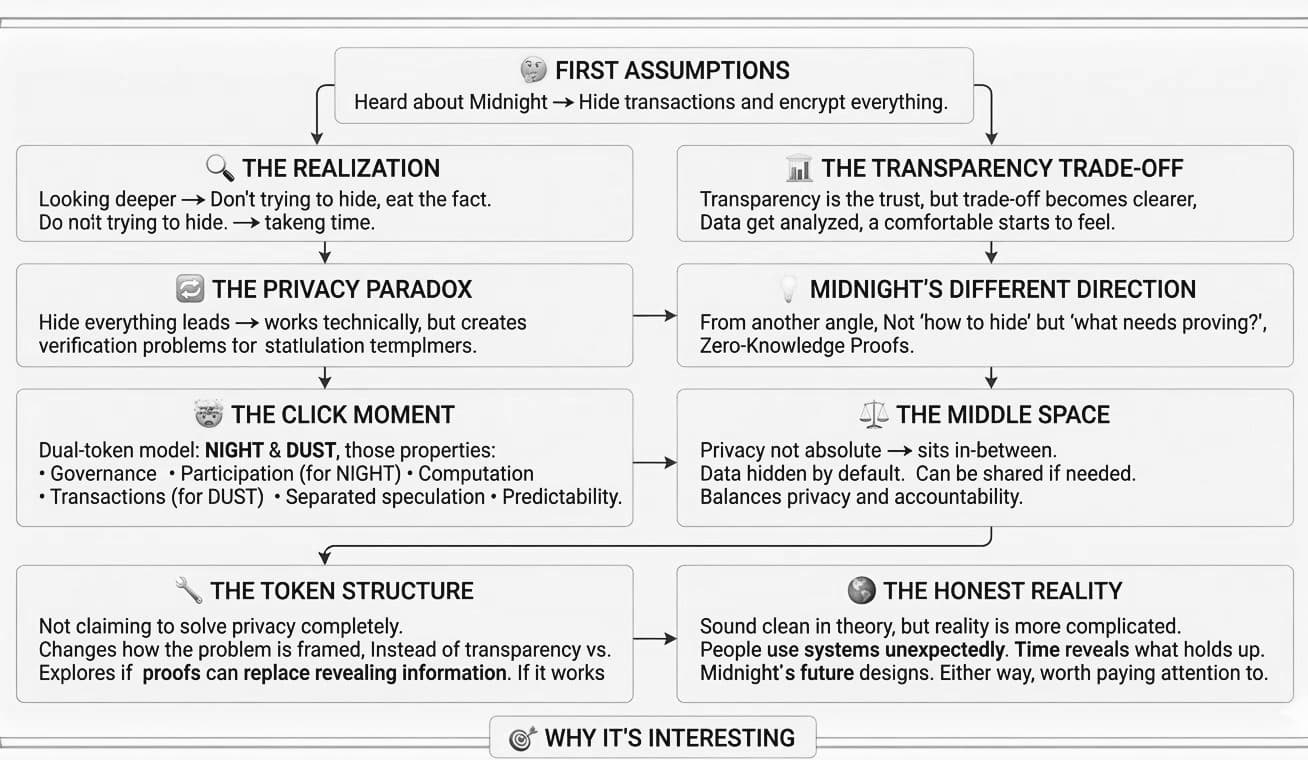
When I first started reading about Midnight, I didn’t expect much. Privacy in crypto has been discussed so many times that most explanations start to sound the same after a while. Usually it’s about hiding transactions or encrypting everything. So at the beginning, I assumed this would follow a similar path.
But the more I looked into how Midnight is actually designed, the more I realized it’s not really trying to hide data in the usual sense. It’s doing something slightly different. It questions whether all that data needs to be visible at all.
It took me a bit to actually notice that difference.
Blockchains have always relied on transparency. Anyone can verify transactions, and that openness is what makes the system trustworthy. But there’s also a trade-off that becomes clearer over time. When everything is public, it doesn’t just stay as raw data. People analyze it, connect patterns, and slowly build a picture of activity.
I’ve spent some time just exploring transaction histories out of curiosity, and at first it feels interesting. Then it starts to feel a bit uncomfortable. You realize how much can be inferred just by observing behavior over time.
That’s usually where privacy discussions begin.
Most solutions try to solve that problem by hiding information completely. And technically, that works. If the data isn’t visible, it can’t be analyzed. But that approach creates another issue. Systems that hide everything can be difficult to trust, especially for institutions that need some level of verification.
Midnight seems to approach this from another direction.
Instead of asking how to hide data, it focuses on what actually needs to be proven.
This is where zero-knowledge proofs come in, and I’ll be honest, this part took me a bit longer to understand. Normally, proving something means showing the evidence. That’s how we’re used to thinking.
Here’s where things start to feel a bit unusual. Instead of showing the actual data, the system proves that certain conditions are met, and that proof alone is enough for the network to verify it.
At first, that feels strange. Almost backwards.
I had to reread that part a couple of times before it made sense.
But then it starts to click. In many situations, the system doesn’t need the full data. It just needs confirmation that a rule was followed.
Another thing I noticed is that Midnight doesn’t treat privacy as something absolute. It’s not really about making everything private or completely open. It sits somewhere in between.
Data can stay hidden by default, but there are moments where it can still be shared if needed. That might sound like a small detail, but it actually matters a lot when you think about real-world use cases. Systems outside crypto don’t just need privacy they also need accountability.
Balancing those two is not easy.
The dual-token model also caught my attention. NIGHT and DUST initially look like a typical multi-token setup, but there’s a bit more going on. NIGHT is tied to governance and participation, while DUST is used for computation and transactions.
After thinking about it for a while, it started to feel like an attempt to separate usage from speculation. In most networks, those two are tightly connected, and it can make costs unpredictable. This design seems to be trying to reduce that effect.
Whether it actually works like that in practice… that’s something we’ll only know later.
One thing I’ve learned from following blockchain projects is that ideas often sound clean in theory. Reality is usually more complicated. People use systems in unexpected ways, and over time you start to see what really holds up.
Midnight still feels like it’s in that stage.
What makes it interesting, at least to me, is not that it claims to solve privacy completely. It’s that it changes how the problem is framed. Instead of choosing between transparency and secrecy, it explores whether proofs can replace the need to reveal information at all.
If this actually works in real usage, it could change how people approach data on blockchains.
Or it might just influence future designs.
Either way, it’s something worth paying attention to as this space evolves.