

I have been reading Sign and, frankly speaking, it is an arrow towards the issue that a majority of us have begun to tolerate. It not only does not correct it, but makes us accept it.
Let's be honest. The blockchain trust is a mess today. The verification steps are repeated in every project. They are provided with the same allow lists, the same anti-fraud checks, and spreadsheets are associated with smart contracts that fail frequently. It is monotonous, time-consuming, and at times it is painful to the user in a manner that users do not notice. It's a big problem.
Sign is seeking to fill that divide, but not as an identity layer emerging as one. They are concerned with reusable claims.
Reusable Claims and Attestations
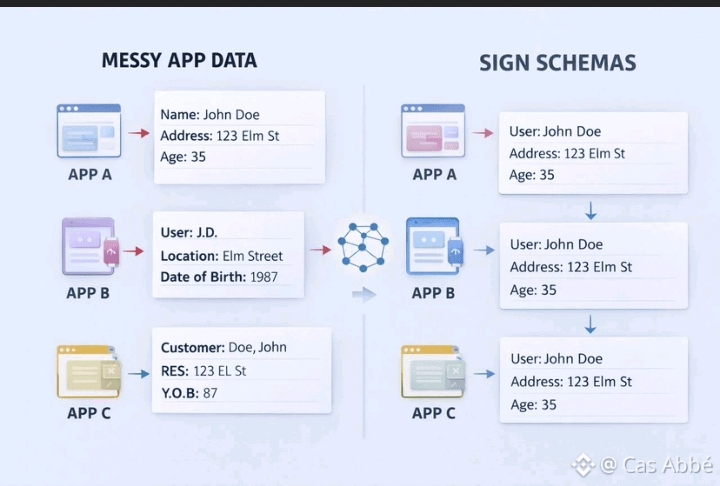
Consider attestations. A wallet might be verified. A user may be permitted to do anything. What a contributor could have done was a significant job. This data is typically stored in different locations such as Discord roles, databases, or random APIs. Under Sign Protocol, such information is stored in an unambiguous, blockchain (or multi-chain) format that can be read by other apps. They can use it over and over.
I was the one that got my head on.
This is not the actual issue of checking something once. It is rechecking it in each product. That wastes developer time and is a bad user experience. Systems do not communicate with each other, and we continue on asking users to authenticate the same thing repeatedly.
Sign changes that. When there is a credential, then it is able to move around, be utilized by a code, and provide operations with other pieces. You no longer re-check and simply consult it.
This is a huge plus to the developers.
TokenTable and Distribution Layer
They did more. Their distribution layer is TokenTable. It appears that it is merely a tool of vesting. However, when you have had to deal with token allocation at large scale, you will realize that it can get unruly, spreadsheets, scripts, odd edge cases. People get wrong amounts. Unlock schedules fail. It's chaos.
TokenTable will aim to standardize the entire process including allocations, vesting, and claims, with a connection to verified credentials. Instead of stating “give tokens to this list as you say,” you state, give tokens based on proven eligibility. It is a little bit but a lot.
Omni-Chain and Privacy Layer
Also take note of the fact that they construct it as an omni-chain system and not confined to a single ecosystem. They apply encryption and zero-knowledge proofs, which is significant to sensitive data. No one desires an entirely open identity network. That would be a nightmare in terms of privacy.
Final Thought
But I'm still thinking. The layer of shared truth has good theory. Fewer duplications, fewer systems, improved UX. It can only be useful when a large number of projects have the same standards. Otherwise, it's another little separate layer, a little better, but still divided.
I like the direction. It solves a real problem. It is as real as infrastructure.
Will they be used or will developers continue to recreate the same broken steps of verification just by habit?