
It is actively building it.
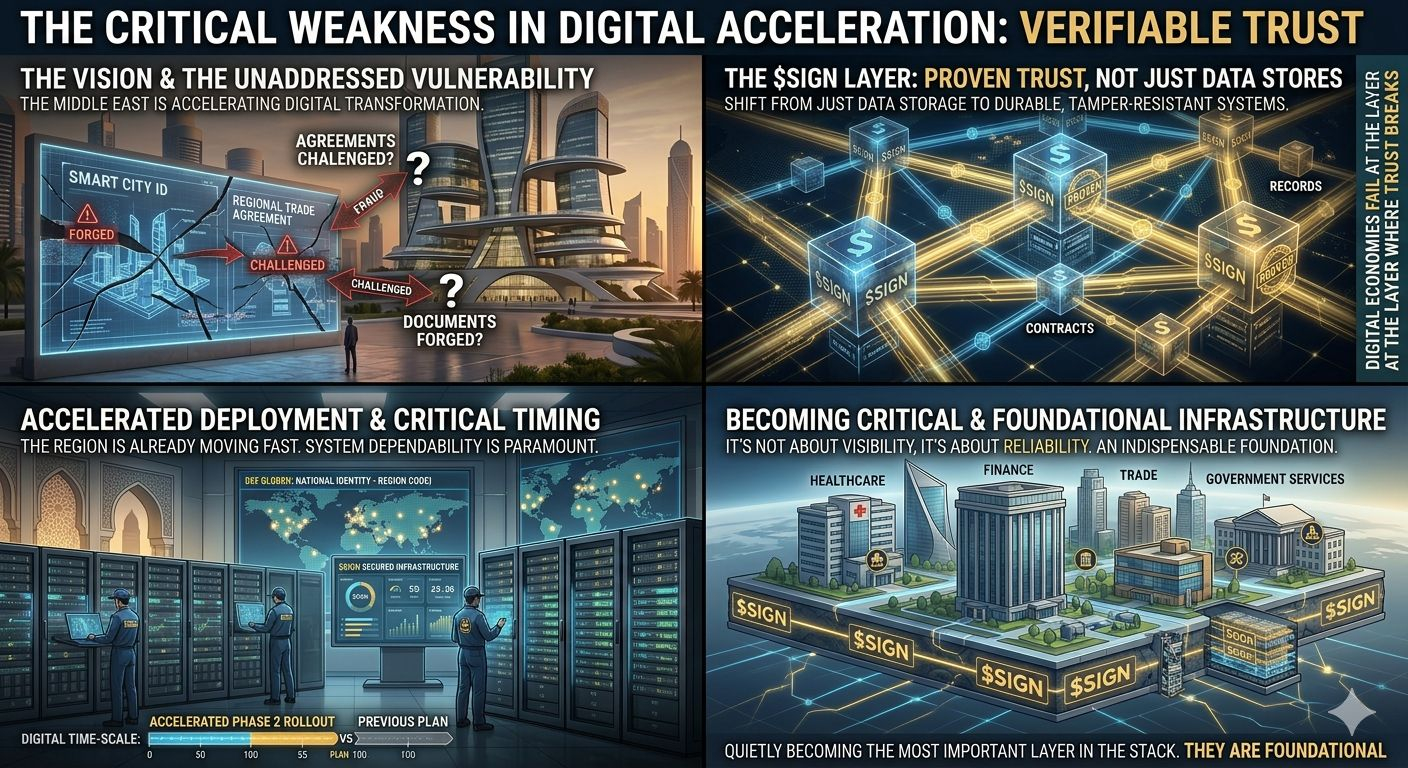
Across the region, governments are committing billions toward smart cities, national identity frameworks, and fully digital economies. From infrastructure to governance, the ambition is clear: move entire systems on-chain, automate trust, and reduce friction at scale.
But underneath that ambition, there is a problem that does not get enough attention.
Trust at the infrastructure level is still weak.
Documents can be forged.
Agreements can be disputed.
Identity systems are often fragmented, outdated, or incomplete.
For billions of people globally, digital identity is not something they truly own-it is something they borrow from institutions that may or may not be reliable.
That gap becomes even more critical when economies start digitizing at scale.
Because once systems move online, every weakness becomes easier to exploit.
This is where $SIGN starts to make sense.
@SignOfficial is not built around hype cycles or short-term narratives. It is focused on a much harder problem: how to create digital systems that can actually be trusted without constant verification from third parties.
At its core, the idea is simple.
Documents, identities, and agreements should not just exist digitally-they should be provable.
Not “trusted because a system says so,” but verifiable in a way that cannot be altered, forged, or quietly manipulated. Once recorded, they remain intact. Once verified, they can be relied on without needing to re-check the entire chain of custody every time.
That changes how institutions operate.
Legal agreements become enforceable without endless back-and-forth validation.
Identity becomes something individuals can carry and prove, rather than repeatedly rebuild.
Records become permanent in a way that removes ambiguity instead of creating it.
This is not theoretical anymore.
Deployments have already started at a government level. National-scale identity systems are being tested and implemented. More countries are exploring how this kind of infrastructure can fit into their own digital strategies.
And the timing matters.
The Middle East is moving aggressively into a digital-first future. But speed alone is not enough. Without reliable infrastructure, fast systems simply scale existing problems.
What is needed is a layer that ensures integrity.
That is where projects like SIGN position themselves-not as applications, but as foundational infrastructure.
And infrastructure is rarely exciting at first glance.
It does not trend. It does not move with hype cycles. It builds quietly in the background while attention is focused elsewhere.
But over time, it becomes the part everything else depends on.
Because once economies, governments, and institutions start relying on a system for identity, contracts, and verification, it stops being optional.
It becomes essential.
That is the shift happening here.
Not just digital transformation-but the rebuilding of trust at the system level.
And that is a much bigger story than most people realize.
#SignDigitalSovereignInfra @SignOfficial $SIGN
