
Most blockchain projects launch with grand promises about decentralized governance. token holders vote. proposals pass. the community decides. in practice, those systems take years to build properly — and in the meantime, someone has to make decisions.
Midnight is honest about this. at launch, governance will be federated. not decentralized. a select committee of stakeholders with equal governance powers will submit and vote on proposals. a specific threshold of combined approvals will be required for any governance action to pass. this threshold is enforced through a multisig mechanism — meaning no single committee member can act alone, and a minimum number of signatures are required before anything changes.
From what i understand, the committee hasnt been fully identified yet. the whitepaper says it is expected to be composed of various entities that have yet to be identified or formed. what is known is what theyll be responsible for — and the scope is significant. updating Midnight-related parameters on the Cardano network, including governance committee members and federated block producers. updating the Midnight protocol itself — version upgrades, hard forks, core parameters like block size and ledger parameters.
That last point is worth sitting with. the federated committee can change block size. they can initiate hard forks. they can update the governance committee membership — including, theoretically, themselves. these are not minor administrative decisions. these are the kinds of powers that, on a mature chain, would require broad community consensus. at launch, they sit with a multisig committee.
This is not unusual for early-stage blockchain networks. bootstrapping decentralized governance from day one is genuinely hard — the tooling doesnt exist yet, the community isnt large enough to make votes meaningful, and the stakes are too high to risk poorly designed governance in the critical early period. the federated structure is a pragmatic bridge.
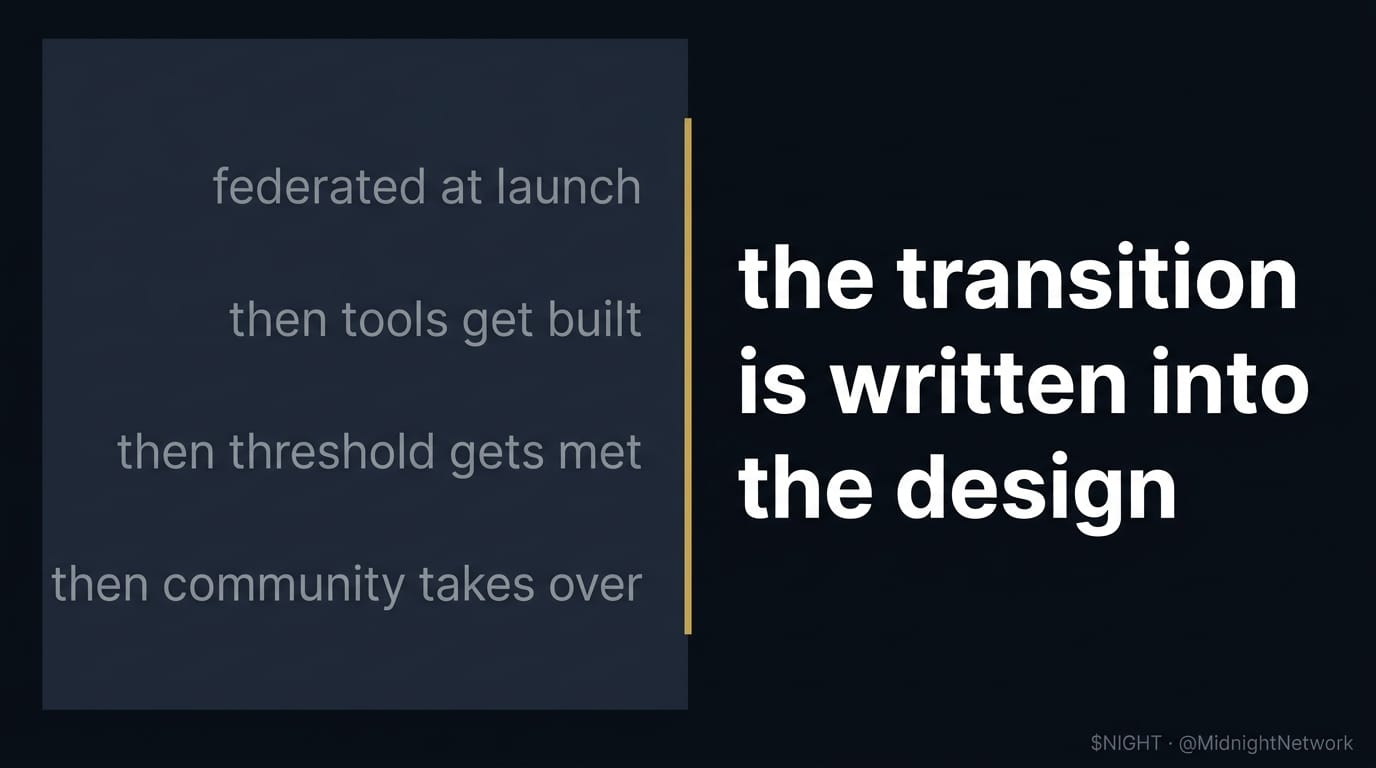
What makes Midnight's approach notable is that the transition path is written into the design. the whitepaper is clear that as the network matures, all components including monetary policy may become subject to change through on-chain governance, provided a predefined voting threshold is met. the federated structure isnt meant to be permanent. its a starting point with an expected end state.
The on-chain Treasury and NIGHT-based governance voting are both explicitly listed as future developments — not available at mainnet launch. neither governance via NIGHT nor Treasury access will be available initially. the tools to replace the federated committee with community governance have to be built first.
What this means practically is that early participants are trusting the committee — not the protocol — for certain decisions. the protocol enforces the multisig requirement so no single party acts unilaterally. but the committee itself is the decision-making layer, not the token holders.
Thats a real distinction. and its worth knowing going in.
If you had to design the transition from federated to decentralized governance, what would you set as the threshold for when that switch should happen?
#night #NIGHT $NIGHT @MidnightNetwork
