Timing in markets and in machine systems is not that different. I think that delays and missed opportunities are not flaws but part of coordination itself. In my view when a robot waits for confirmation to prove its action it is not wasted time but the cost of achieving scalable reliability.
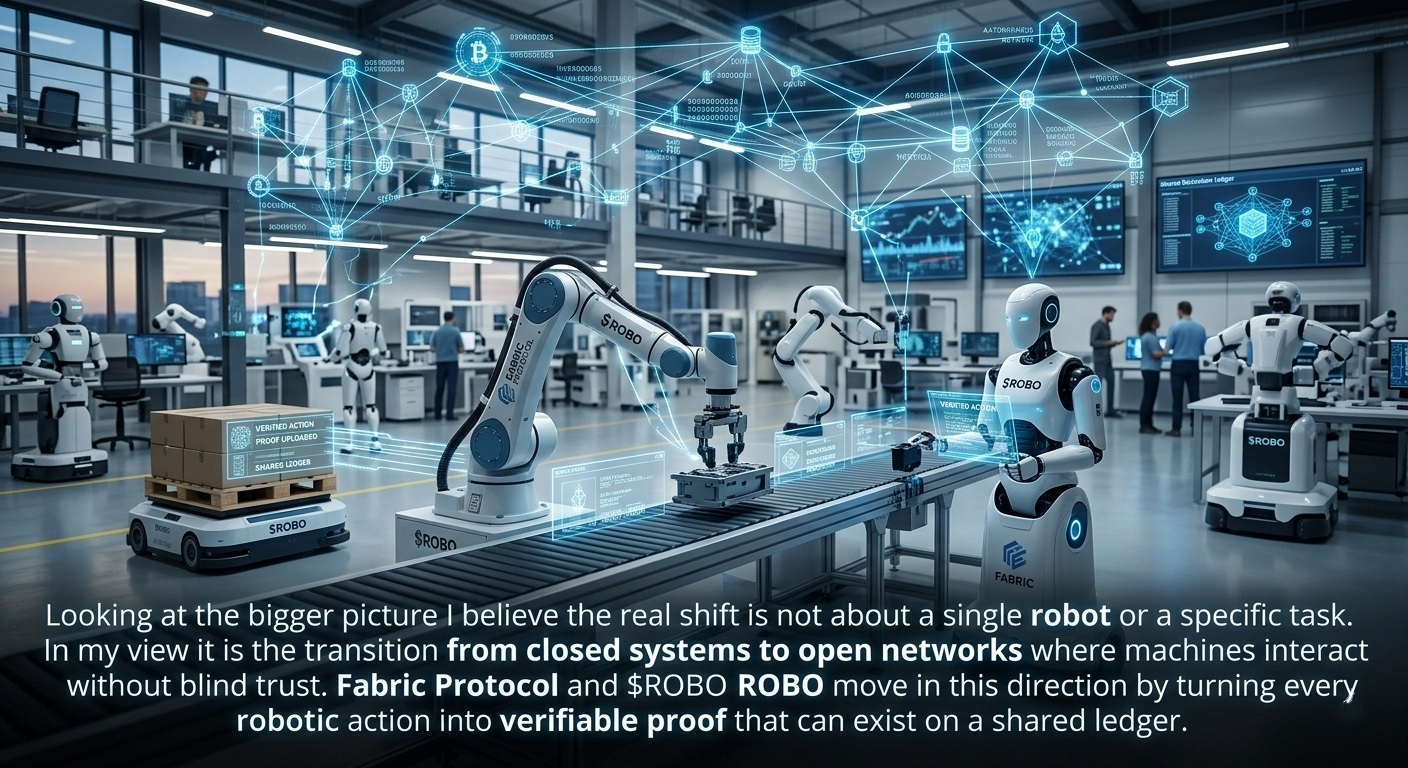
Looking at the bigger picture I believe the real shift is not about a single robot or a specific task. In my view it is the transition from closed systems to open networks where machines interact without blind trust. Fabric Protocol and $ROBO move in this direction by turning every robotic action into verifiable proof that can exist on a shared ledger.
What matters most to me is how value is directly tied to verified work. I think $ROBO is not just a token but a coordination layer where fees staking and rewards are connected to real activity. This creates a system that can sustain itself without relying on a central authority.
The real world is messy and I believe this is the hardest challenge. Sensors fail data arrives late and environments constantly change. In my view this is exactly why structured trust built on proof matters because it does not require perfection only enough reliability to keep the system running.
In the end I think what makes this idea powerful is not complexity but how it quietly changes our perception of trust. In my view if Fabric delivers on this vision we are not just talking about robots but about a foundation where machines can coordinate verify and create value in a world that has always been imperfect.