
Somewhere along the way, I stopped getting excited about crypto.
Not suddenly. Not in a dramatic, disillusioned kind of way. It was slower than that. More like watching the same movie play over and over, just with different actors, different names, slightly improved visuals.
You start to notice the patterns.
There was a time when each new idea felt like a door opening. DeFi felt like it might actually rebuild finance. NFTs felt like ownership might finally make sense online. Then AI got pulled in, then RWAs, each one arriving with the same tone of inevitability.
This is it. This is the one.
And maybe each of them did matter, in some way. But the repetition wears on you.
Same structure. Same excitement curve. Same quiet fade into something more complicated than the original story.
After a while, you stop reacting.
You scroll past most things without even realizing it.
And then, occasionally, something makes you pause. Not because it’s loud, but because it doesn’t try to be.
That’s roughly how SIGN shows up.
It doesn’t present itself as a new category, or a new financial layer, or something that’s going to “unlock” everything else.
It starts from a smaller place.
Verification.
Which, on the surface, feels almost too ordinary to matter.
But the more you sit with it, the more it starts to feel like one of the few problems that hasn’t actually been solved.
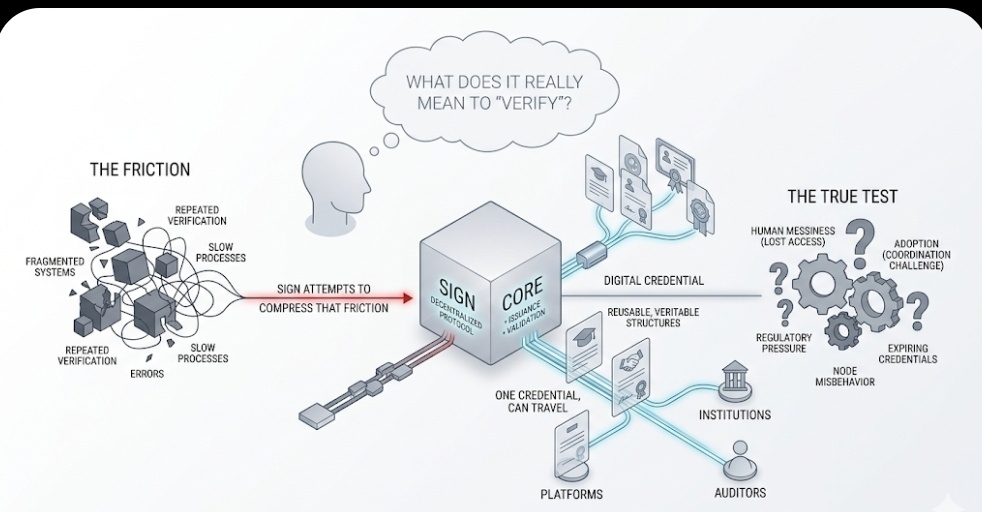
SIGN, in simple terms, is trying to turn claims into something structured and verifiable across different systems. Instead of relying on screenshots, databases, or trust in a single platform, it allows data, things like identity, eligibility, approvals, to exist as attestations that can be checked across blockchains.
Bingx Exchange
A kind of shared evidence layer.
Not an app. Not a product you necessarily interact with directly. More like infrastructure that sits underneath other things.
Sovereign Infrastructure
And maybe that’s why it feels different.
It’s not trying to impress you.
If you step back, a lot of what we deal with in crypto, and honestly on the internet in general, comes down to one simple issue.
We don’t know what’s real.
Or more precisely, we don’t have good ways to prove that something is real without relying on someone else to tell us.
A wallet is “eligible” for an airdrop.
A user is “verified.”
A document is “signed.”
An identity is “trusted.”
These are all just claims.
And most of them live in isolated systems that don’t talk to each other.
SIGN is trying to make those claims portable. Something that can be created once, verified anywhere, and understood across different environments.
Gate DEX
That idea carries weight.
Because if you’ve been around long enough, you start to notice how fragile the current setup is.
A lot of it runs on assumptions.
And assumptions don’t scale well.
But this is where the pause turns into questions.
Because the idea makes sense.
The world it has to exist in does not.
Verification sounds like a technical problem, but it isn’t, not entirely.
It’s a trust problem.
SIGN can make attestations verifiable. It can standardize how they’re created and shared. It can even make them portable across chains, which is not trivial in itself.
Gate DEX
But it cannot decide what is true.
And it cannot decide who should be trusted to say something is true.
That part still belongs to people, institutions, systems that already exist.
So you end up in a familiar place.
If a government issues an attestation, you trust it because it’s a government.
If a company issues one, you trust it because you trust the company.
And if you don’t trust either, the fact that the data is on-chain doesn’t suddenly fix that.
It just records it more transparently.
Which is useful.
But not sufficient.
There’s also the question of where this actually gets used.
Crypto has a habit of building infrastructure in advance of demand.
Sometimes that works. Ethereum did not have clear use cases at the beginning.
But more often, the infrastructure sits there, waiting for something to justify its existence.
SIGN comes out of a more grounded starting point. It began with document signing, trying to replicate and improve something that already exists in Web2.
MEXC Blog
That’s a reasonable entry point.
But the ambition extends far beyond that.
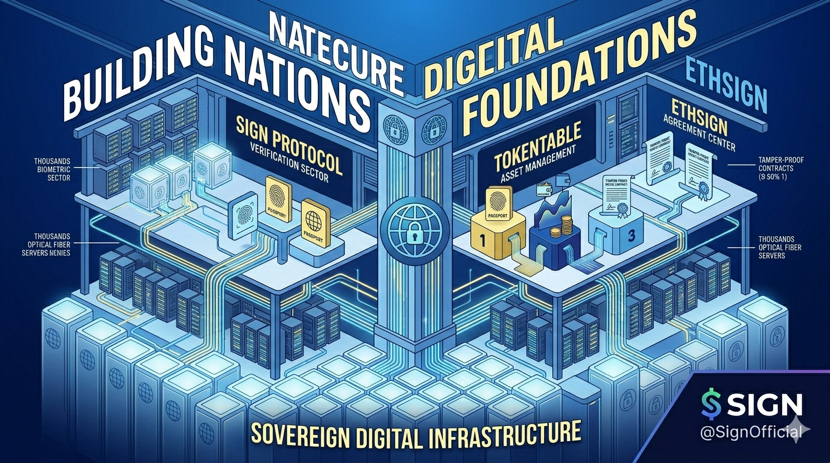
Identity systems. Token distribution. Government infrastructure. Even national-level systems for money and capital are part of the broader vision.
Sovereign Infrastructure
And that’s where things start to feel heavier.
Because those domains move slowly.
They are not driven by developer curiosity or market cycles.
They are shaped by regulation, politics, and long-term institutional trust.
Which is not something crypto has historically navigated well.
Then there’s the cross-chain aspect.
On paper, it makes sense.
The ecosystem is fragmented, and any system that tries to unify data across chains feels like it’s moving in the right direction.
SIGN positions itself as an omni-chain protocol, meaning these attestations can exist across multiple blockchains and still be verified.
Bingx Exchange
But cross-chain systems tend to come with trade-offs.
More complexity. More assumptions. More potential points of failure.
And when the system you’re building is about verification, even small uncertainties can feel amplified.
Because the whole point is to reduce doubt.
Not introduce new forms of it.
The token is another layer that’s harder to ignore.
Because at some point, every infrastructure project has to explain why it has a token.
In SIGN’s case, the token is tied to governance, incentives, and network operations.
Bitget
That’s expected.
But it doesn’t automatically make it necessary.
There’s always this tension.
On one hand, tokens can coordinate behavior. They can reward participation and create a shared stake in the system.
On the other hand, they introduce speculation.
And speculation changes how people interact with the project.
Instead of asking, does this system work, the question becomes, what will the token do.
Price becomes the signal.
Usage becomes secondary.
And in something like verification infrastructure, where clarity and trust are supposed to be central, that shift feels… uncomfortable.
Not fatal, but noticeable.
Still, it’s difficult to dismiss the underlying idea.
Because if anything, the problem SIGN is addressing feels more relevant now than it did a few years ago.
Information is easier to generate than ever.
But proving its authenticity is getting harder.
Deepfakes, synthetic identities, manipulated records. These are no longer edge cases.
They are part of the baseline environment.
In that context, systems that focus on verifiable data, on creating a shared layer of evidence, start to feel less like experiments and more like necessary components.
SIGN is not alone in this space.
But it approaches it from an infrastructure angle, rather than trying to wrap it in a narrative.
And maybe that’s why it lingers.
Not because it’s exciting.
But because it’s hard to ignore the question it’s pointing at.
How do you verify anything in a system where trust is fragmented?
And more importantly, what happens when different groups disagree on what counts as valid proof?
SIGN offers one possible structure.
A way to record, share, and check claims across systems.
But it doesn’t resolve the deeper tension.
It just makes it more visible.
Maybe that’s enough.
Or maybe it isn’t.
It’s hard to say from here.
Crypto has a way of taking ideas that feel grounded and pulling them into the same cycle as everything else.
Narrative, attention, token, speculation, drift.
SIGN could follow that path.
Or it could quietly become something useful, sitting underneath systems people use without ever thinking about it.
And maybe that’s the more interesting outcome.
Not something you notice.
But something that works.
For now, it’s just one of those rare projects that doesn’t immediately blur into the background.
Not because it demands attention.
But because it leaves a question hanging a little longer than most.
#SignDigitalSovereignInfra @SignOfficial
