The zero‑knowledge sector has matured past the phase where simply saying “ZK” commands attention. Today, the question is not whether proofs are elegant. It is whether they reduce structural friction in live systems.
Midnight is approaching that line.
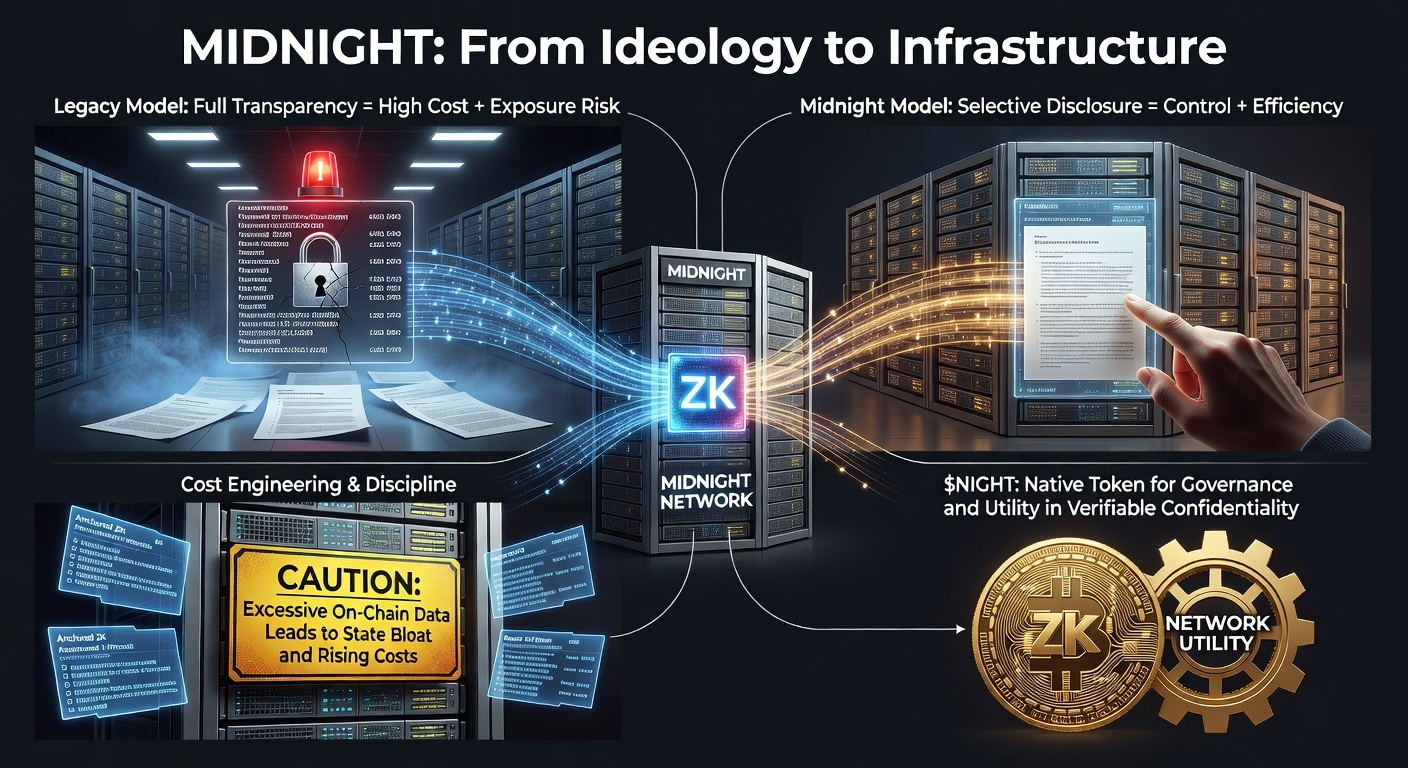
A lot of blockchain design has historically treated transparency as the default setting. Everything is visible, permanently stored, and publicly auditable. That model works for certain financial primitives, but it becomes awkward when real businesses, regulated entities, or sensitive operational data are involved. Exposure is not neutral. It carries cost.
@MidnightNetwork positions Midnight around a different premise: verification should not require overexposure. Through zero‑knowledge mechanisms, the network aims to separate validation from disclosure. Instead of revealing full datasets onchain, participants can prove specific claims while retaining control over the underlying information.
This is where cost engineering enters the picture.
Storing large volumes of data directly on the base layer is not free. It compounds over time. Chains that normalize constant data expansion often discover later that scaling becomes expensive and inefficient. Midnight’s approach of anchoring proofs rather than raw data suggests a tighter model — validate what matters, avoid unnecessary state bloat.
If that structure works in practice, it addresses two pressure points at once: confidentiality and long‑term storage discipline.
Within this framework, $NIGHT functions as the native and governance asset of the ecosystem, tying participation to a network designed around verifiable confidentiality. If developers build applications that rely on selective disclosure rather than full transparency, the token’s role becomes integrated into actual network utility rather than speculative cycles.
But architecture alone does not secure adoption.
Zero‑knowledge systems can introduce computational overhead. Developer tooling must remain accessible. Enterprises evaluating such infrastructure will look for predictable costs, compliance alignment, and operational stability. Many blockchain projects appear coherent until production load reveals hidden complexity.
Midnight is moving toward that proving ground.
If it can demonstrate that selective disclosure reduces friction instead of adding it, the narrative around privacy shifts from ideology to infrastructure. If not, it risks blending into a crowded field of technically impressive but commercially quiet ZK projects.
For $NIGHT , the outcome depends less on how refined the pitch sounds and more on whether the network holds up under real usage. In infrastructure markets, discipline and usability ultimately matter more than slogans.