Digital transformation is often discussed in terms of apps, payments, and user growth. But beneath every scalable digital economy sits something less visible and far more critical: credential infrastructure.
The Middle East has accelerated its investment in digital systems, from smart government platforms to fintech expansion and cross‑border economic initiatives. Yet as economies digitize, the need for verifiable identity and trusted credential distribution becomes structural. Without reliable verification rails, digital growth introduces friction instead of efficiency.
This is where @SignOfficial positions its thesis.
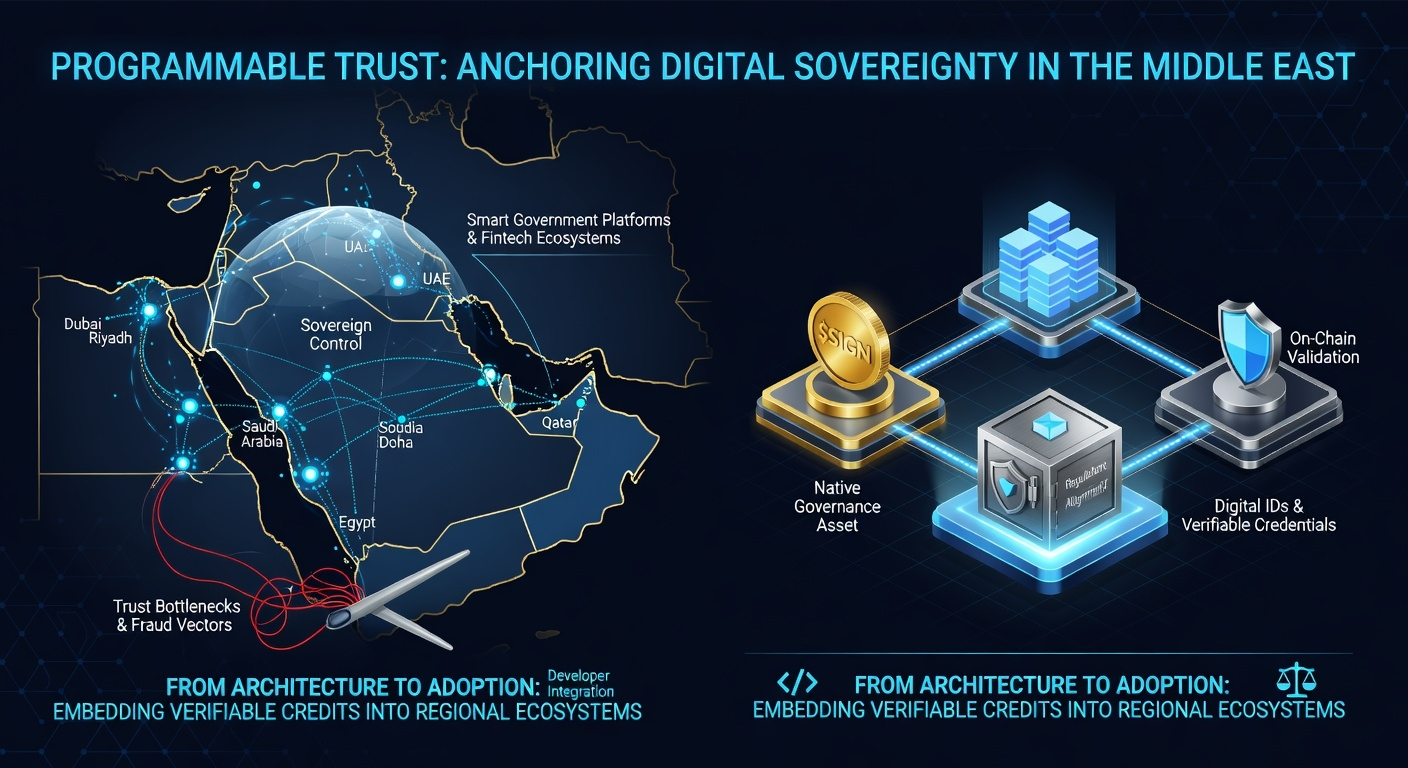
Sign is designed as global infrastructure for credential verification and token distribution. Rather than focusing solely on transactional throughput, the network addresses a more foundational layer — how identities, certifications, and permissions are issued, verified, and recognized across systems. In emerging digital economies, this layer determines whether innovation scales smoothly or stalls under trust bottlenecks.
Consider the shift happening across the Gulf region. Governments are investing heavily in digital IDs, regulatory sandboxes, and blockchain experimentation. However, interoperability and verifiable credential standards remain uneven. A protocol layer that enables secure issuance and on‑chain verification can reduce duplication, limit fraud vectors, and streamline compliance workflows.
Within this architecture, $SIGN operates as the native and governance asset supporting the network’s coordination layer. If credential verification and token distribution become embedded in public and enterprise systems, the token’s relevance ties directly to infrastructure usage rather than speculative cycles.
The strategic angle is not abstract decentralization. It is digital sovereignty. When states and enterprises control how credentials are issued and validated within transparent yet secure frameworks, they reduce dependency on fragmented verification silos. That capability is especially relevant in regions aiming to position themselves as global innovation hubs.
Of course, infrastructure ambitions face practical challenges. Adoption depends on developer integration, regulatory alignment, and measurable efficiency gains over legacy systems. Sovereign‑grade systems also demand security resilience and operational stability. Without real usage, even well‑designed credential networks risk becoming theoretical exercises.
But if Sign succeeds in embedding verifiable credential rails into Middle Eastern digital ecosystems, it would represent more than another blockchain deployment. It would signal a shift toward programmable trust as a public good.
In digital economies, trust is not optional — it is infrastructure. The question for Sign, and for $SIGN, is whether that infrastructure can move from architecture to adoption at regional scale.