
In the rapidly expanding world of Web3, the ability to verify information without compromising security has become a paramount challenge. The SIGN token, the native cryptocurrency of the SIGN Protocol, stands at the forefront of this transformation, serving as the essential fuel for a decentralized ecosystem built on "verifiable trust."
The Vision: Beyond Trustless Networks
While blockchain technology is inherently "trustless" meaning it doesn't require a central authority to function it has historically struggled with fragmented data and the difficulty of verifying real world credentials across different networks. The SIGN Protocol addresses this by providing an omni chain attestation framework. This allows users to issue and verify "attestations" secure, signed statements that prove something is true, such as a degree, a contract, or even a simple age verification.
The protocol's mission is ambitious: to act as a "supranational infrastructure". By moving essential public records and digital identities onto the blockchain, SIGN aims to provide governments and institutions with a "digital lifeboat" that ensures administrative continuity even if centralized systems fail.
The SIGN Ecosystem: A Four Pillar Foundation
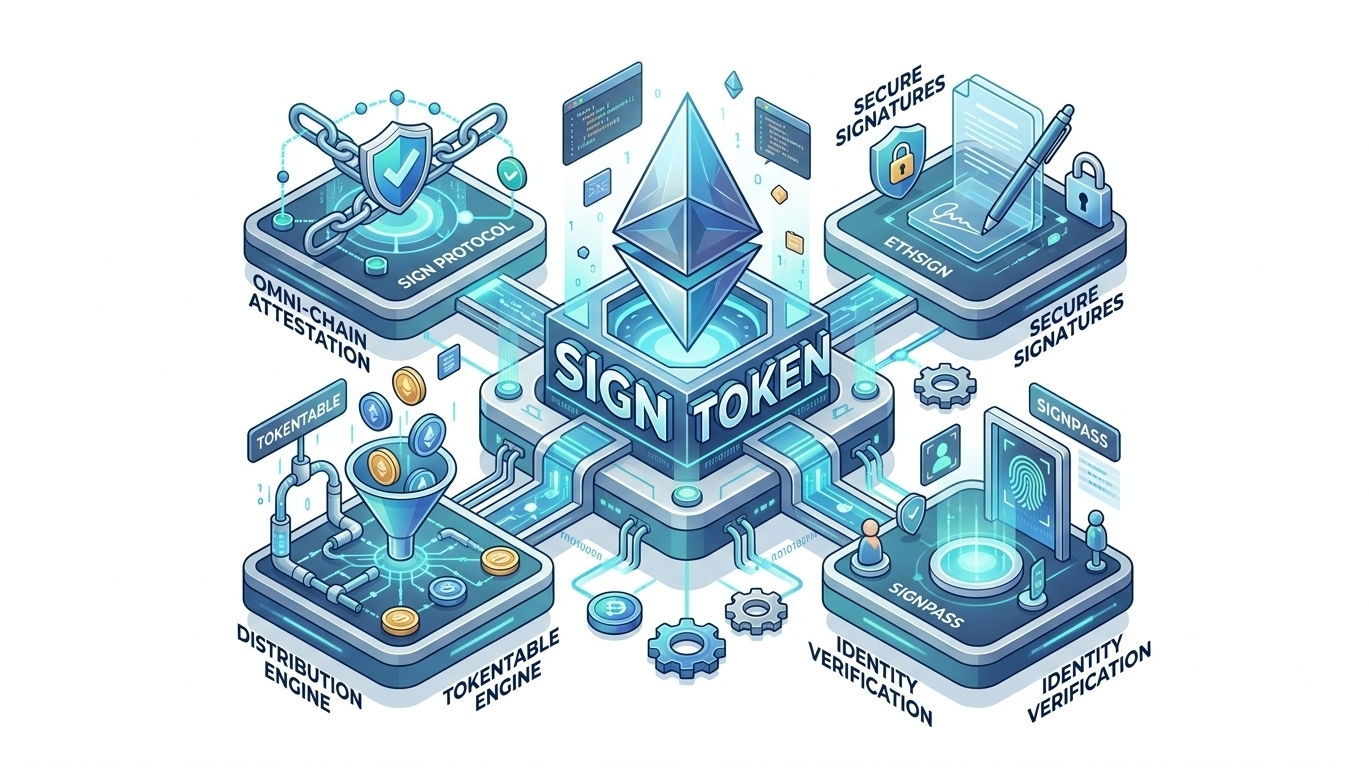
The protocol’s real world utility is delivered through four core products that are already seeing significant adoption:
Sign Protocol: The foundational layer that enables the creation of verifiable credentials across multiple blockchains, including Ethereum, Solana, and TON.
TokenTable: A sophisticated distribution engine that has managed over $4 billion in token assets for more than 40 million users, streamlining complex airdrops and vesting schedules.
EthSign: The ecosystem's first major application, providing a decentralized, legally compliant e-signature platform that stores tamper proof contracts directly on chain.
SignPass: An identity verification system that allows users to register and prove their status across various protocols without revealing unnecessary personal data.
Tokenomics and Utility
The SIGN token (ticker: SIGN) is the heartbeat of this economic model. With a maximum supply capped at 10 billion tokens, it serves several critical functions:
Universal Utility: It powers all protocol operations, acting as the "fuel" for creating and verifying attestations.
Governance: Token holders can participate in DAO voting, helping to shape the strategic direction and technical evolution of the network.
Incentives and Rewards: A substantial 40% of the total supply is dedicated to community incentives, rewarding long term participants and developers who build on the protocol.
Market Momentum and Future Outlook
The project's credibility is backed by $32 million in funding from premier investors like Sequoia Capital and YZi Labs. Notably, the project achieved a revenue milestone of $15 million in 2024, proving that there is genuine market demand for its infrastructure beyond mere speculation.
As we move through 2026, the roadmap for SIGN is focused on deep sovereign integration. With current deployments already active in countries like the UAE and Sierra Leone, the protocol is scaling to support over 20 nations with on chain identity systems. This focus on "on chain countries" positions SIGN not just as another crypto asset, but as a fundamental building block for the next era of global digital civilization.
Conclusion
The $SIGN token represents more than a financial instrument; it is the key to unlocking a future where truth is easily provable and data is truly sovereign. By bridging the gap between technical blockchain standards and real world legal needs, the @SignOfficial is building the infrastructure necessary for the mass adoption of decentralized trust.