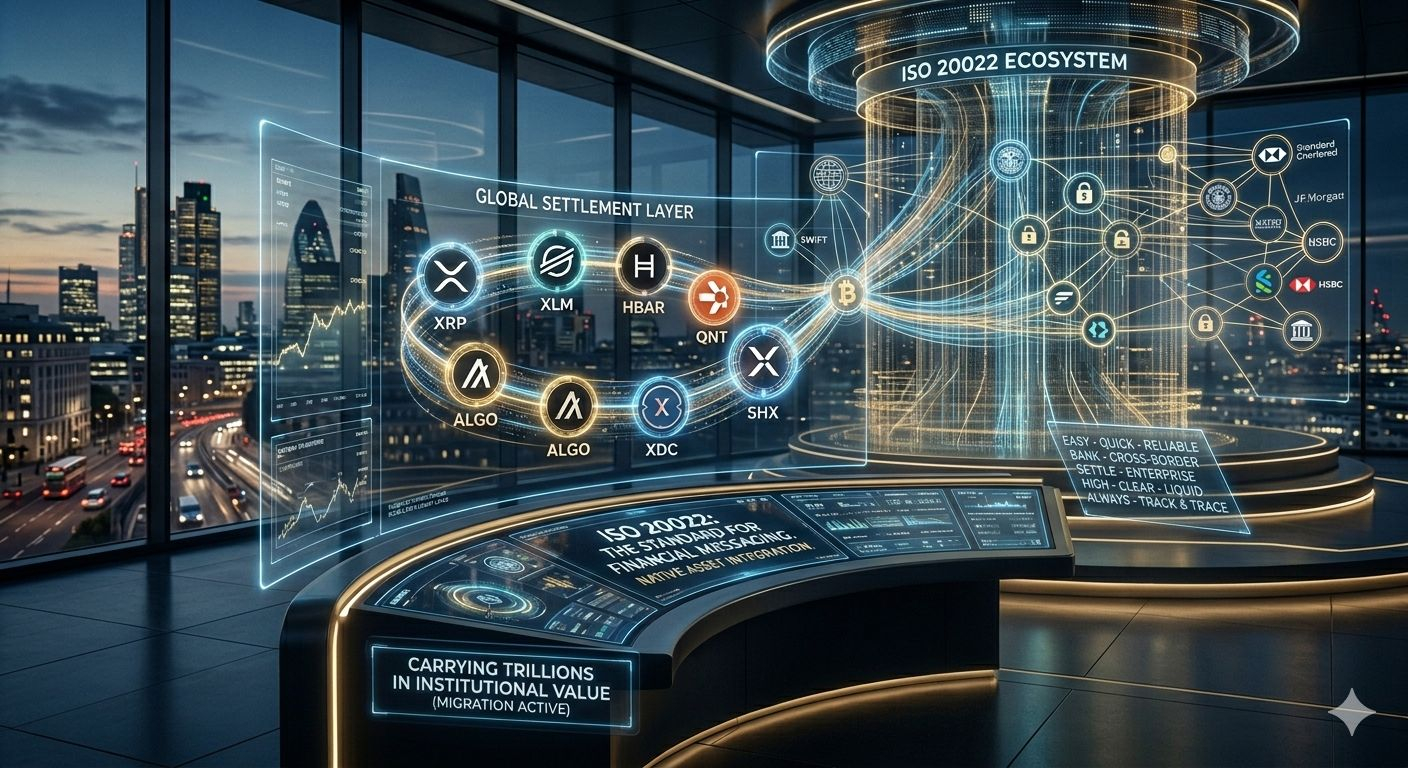
🪷$BTC The narrative is shifting. We have moved beyond the "pilot" phase and entered a period of systemic integration. The global financial system is fundamentally modernizing, with financial giants like HSBC and Citigroup actively re-engineering their core payment rails to align with the ISO 20022 standard, which is mandatory by 2026.
The era of slow, opaque messaging is ending. We are moving into the era of structured, rich financial data, and these distinct cryptographic assets are not just spectators—they are the built-for-purpose infrastructure.
The New Architecture of Value: Key Participants
These assets represent the intersection of enterprise demand and decentralized capability:
$XRP (Ripple): Engineered for on-demand liquidity (ODL), designed to bridge liquidity gaps between fiat currencies instantly. It is optimized to move large volumes of value globally, serving as the settlement engine for the new standard.
$XLM (Stellar): A network focused on interoperability, allowing existing financial institutions to issue digital representations of real-world assets and move them at near-zero cost. It provides the low-cost on-ramps required for mass participation.
$HBAR (Hedera): Offering enterprise-grade performance and security through its unique consensus mechanism. It is tailored to handle the immutable event logging and high throughput needed for complex, high-frequency institutional transactions.
$QNT (Quant): Addressing the fragmentation of the digital landscape. Quant’s Overledger is not a blockchain itself, but rather the crucial abstraction layer that allows different blockchains and legacy banking systems to communicate seamlessly.
$ALGO (Algorand): Designed for institutional efficiency, Algorand provides a finality-focused protocol. It is optimized for sophisticated applications like asset tokenization and national digital currencies (CBDCs) where transaction speed and cryptographic security are paramount.
$XDC (XDC Network): Targeting the critical $19 Trillion trade finance sector. XDC is built specifically to handle specialized, standardized documentation like electronic Bills of Lading (eBL), integrating directly into the regulated financial ecosystem.
$FLR (Flare): Providing the essential "oracle" function for this new ecosystem. Flare allows decentralized applications to access high-integrity, real-time data from other blockchains and the traditional financial markets, enabling robust smart contracts.
$SHX (Stronghold): Focused on compliance-driven payment solutions. Stronghold’s ecosystem, including its clearing network, is designed to give banks the regulatory assurance they require when settling value digitally.
Looking Toward 2026
The impending full migration in 2026—when all financial traffic must be native ISO MX messages—removes the final friction point. By adopting the same rigorous data standard as SWIFT and major central banks, these protocols have ensured they are compatible with the next generation of global money flow.
They aren't just compliant with the new rules; they are the protocols designed to operate the new system. 🤝
#XRP #ISO20022 #kanwalimran #XRPCommunity #HBAR #XLM #XRPCommunity #HBAR #XLM #DigitalFinance