
I used to open whitepapers with a kind of quiet anticipation.
Not because I believed everything, but because there was still a chance something unexpected might be there. A new primitive, a different way of thinking about ownership or coordination. Something that didn’t feel like a remix.
That feeling has faded.
Now, when a new project shows up, I don’t rush to understand it. I scan it. I place it somewhere in a mental archive that has grown over the years, DeFi summer, NFT cycles, play to earn experiments, AI tokens that felt more like branding than substance, and now this newer wave, identity, infrastructure, real world assets.
Different language, similar rhythm.
So when I came across SIGN, I didn’t feel excitement.
But I did pause.
And that pause felt… familiar in a different way.
The repetition beneath the surface
Every cycle seems to rediscover the same underlying problem.
Trust.
Not in the abstract sense, but in the practical, everyday sense. Who is this wallet? What has it done? What should it be allowed to receive?
Crypto was supposed to remove the need for trust, but instead it redistributed it. Now it sits awkwardly between code, communities, and external systems.
That is where projects like SIGN emerge.
They are not trying to build the next application. They are trying to build the layer underneath, something closer to infrastructure. A system for verifying credentials and distributing value based on those credentials.
Binance
On paper, it sounds almost too reasonable.
Which is probably why it doesn’t immediately trigger skepticism, or excitement.
Just a kind of cautious attention.
What SIGN is actually trying to do
At its core, SIGN revolves around a simple structure.
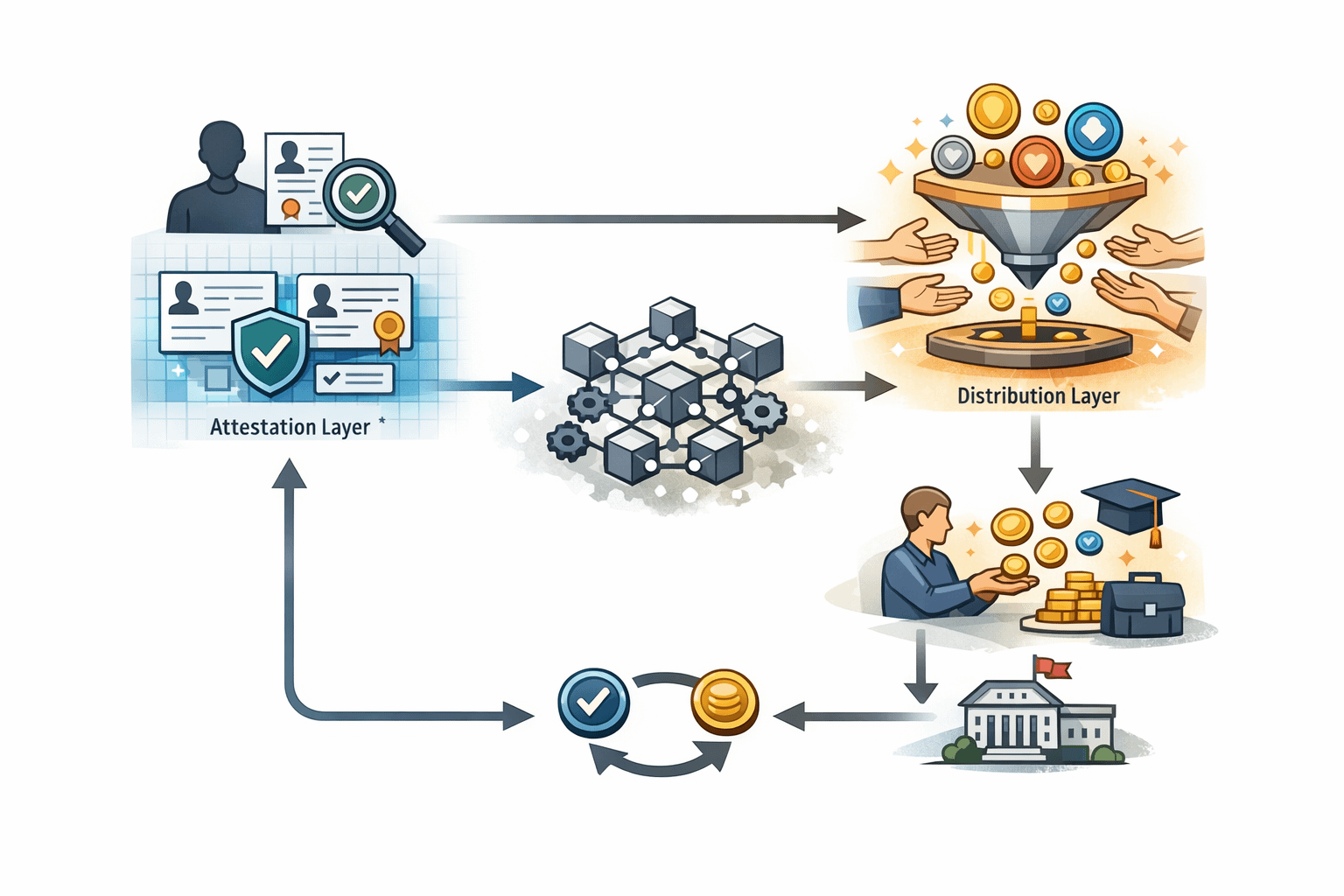
There is an attestation layer, where information, identity, ownership, actions, can be recorded and verified across blockchains.
CoinMarketCap
And there is a distribution layer, where tokens or other forms of value can be allocated based on those verified conditions.
Together, it forms a loop:
Someone proves something
That proof is recorded
The system acts on it
It sounds clean when reduced like that.
The idea of verifiable credentials itself is not new. It has existed in various forms for years, digital records that can be issued, held, and verified without relying on a central authority.
Wikipedia
SIGN is essentially trying to bring that idea into a blockchain-native environment, and then extend it into economic coordination.
Which is where things start to get more interesting.
The problem that keeps resurfacing
Crypto has always had a distribution problem.
Airdrops are the obvious example. They are meant to reward early users, contributors, or communities. In practice, they often reward whoever can simulate activity most effectively.
Bots, sybil wallets, loosely defined criteria.
SIGN’s TokenTable claims to have processed billions of dollars in distributions across tens of millions of wallets.
Binance
That scale suggests something is working.
But scale alone doesn’t answer the deeper question.
Did it actually make distribution fairer, or just more structured?
Because fairness is not something you can fully encode.
It depends on assumptions. On definitions of value. On who gets to decide what counts as a meaningful contribution.
And that brings us back to credentials.
Why the idea matters, at least in theory
If you take the idea seriously, it extends far beyond airdrops.
You can imagine:
Universities issuing verifiable degrees on-chain
Governments attaching credentials to digital identities
DAOs rewarding contributors based on provable work
Platforms filtering access based on reputation rather than speculation
SIGN has already explored some of these directions, including integration with public sector infrastructure in multiple countries.
Binance
That’s where the concept starts to feel heavier.
Less like a crypto experiment, more like something that might interact with existing systems.
And that’s where my hesitation usually begins.
Where things start to feel complicated
Verification is not neutral.
It implies authority.
Even in decentralized systems, someone has to issue the credential. Someone has to define the schema. Someone has to decide what counts as valid.
The moment you introduce credentials, you introduce gatekeeping.
Not necessarily in a malicious way. Sometimes it’s just necessary. But it changes the nature of the system.
Instead of open participation, you move toward conditional participation.
And then there is privacy.
Attestations can be designed to protect it, to reveal only what is necessary. But in practice, systems tend to drift toward more data, not less.
Because more data makes coordination easier.
It also makes surveillance easier.
That tension doesn’t go away just because it’s on-chain.
Adoption is the quiet bottleneck
Even if SIGN works exactly as intended, there is another layer that feels harder to solve.
Will people actually use it?
Not in the sense of interacting with the protocol directly. Most users won’t even know it exists.
The question is whether applications built on top of it can abstract away the complexity.
Because managing credentials is not something most people want to think about.
Crypto already struggles with user experience. Adding another layer of identity and verification risks making things heavier, not lighter.
For SIGN to succeed, it would have to become invisible.
And invisibility is difficult in a system where everything is designed to be explicit.
The token question, again
Then there is the token.
There is always a token.
SIGN is used for governance, incentives, fees, and coordination across the ecosystem.
Gate AU
Which is expected.
But after enough time in crypto, the presence of a token raises a different kind of question.
Is the token helping the system function?
Or is the system shaped in a way that justifies the token?
It’s not always easy to tell.
Tokens can align incentives. They can also distort them.
They can bootstrap participation. They can also attract short-term attention that has nothing to do with the underlying problem.
And infrastructure projects are particularly vulnerable to this.
Because they require patience.
While tokens often reward momentum.
Something that doesn’t feel entirely dismissible
Despite all of this, SIGN doesn’t feel easy to ignore.
Partly because it is already being used.
Millions of attestations, large-scale token distributions, partnerships with governments and projects.
Binance
Those are not trivial signals.
They don’t guarantee success.
But they suggest that the system is interacting with reality, not just existing in theory.
And that matters.
Even if the outcome is uncertain.
The pattern that repeats, and maybe evolves
I’ve seen enough cycles to know that most infrastructure narratives don’t fully play out.
They either get absorbed into larger systems, or they fade as attention shifts.
But occasionally, something persists.
Not because it was hyped.
But because it solved a small part of a real problem, quietly, consistently, over time.
I don’t know if SIGN is that kind of project.
It might be too early.
Or it might be too ambitious.
Trying to solve identity, verification, and distribution all at once feels like trying to compress several hard problems into one system.
And crypto has a history of underestimating how difficult that is.
Sitting with the uncertainty
Maybe that’s why the feeling isn’t excitement.
It’s something closer to cautious curiosity.
A recognition that the problem is real.
A suspicion that the solution might be incomplete.
And an awareness that most things in this space don’t resolve cleanly.
SIGN is trying to structure something that has always been messy.
Trust.
Who deserves what, and why.
That’s not just a technical question.
And I’m not sure it ever will be.
So I find myself watching from a distance.
Not expecting clarity.
Just noticing whether, over time, something here starts to feel less like a concept and more like a habit people actually adopt.
Or whether it quietly joins the long list of ideas that almost worked.
@SignOfficial #SignDigitalSovereignInfra
