
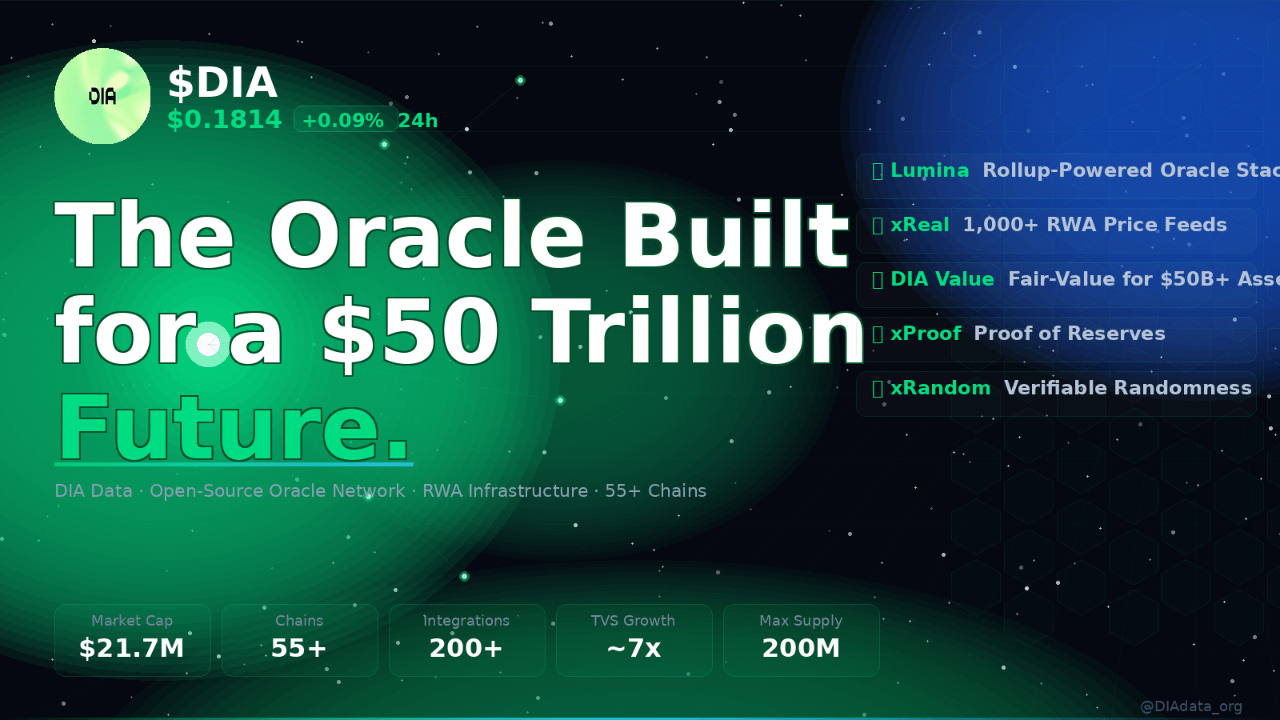
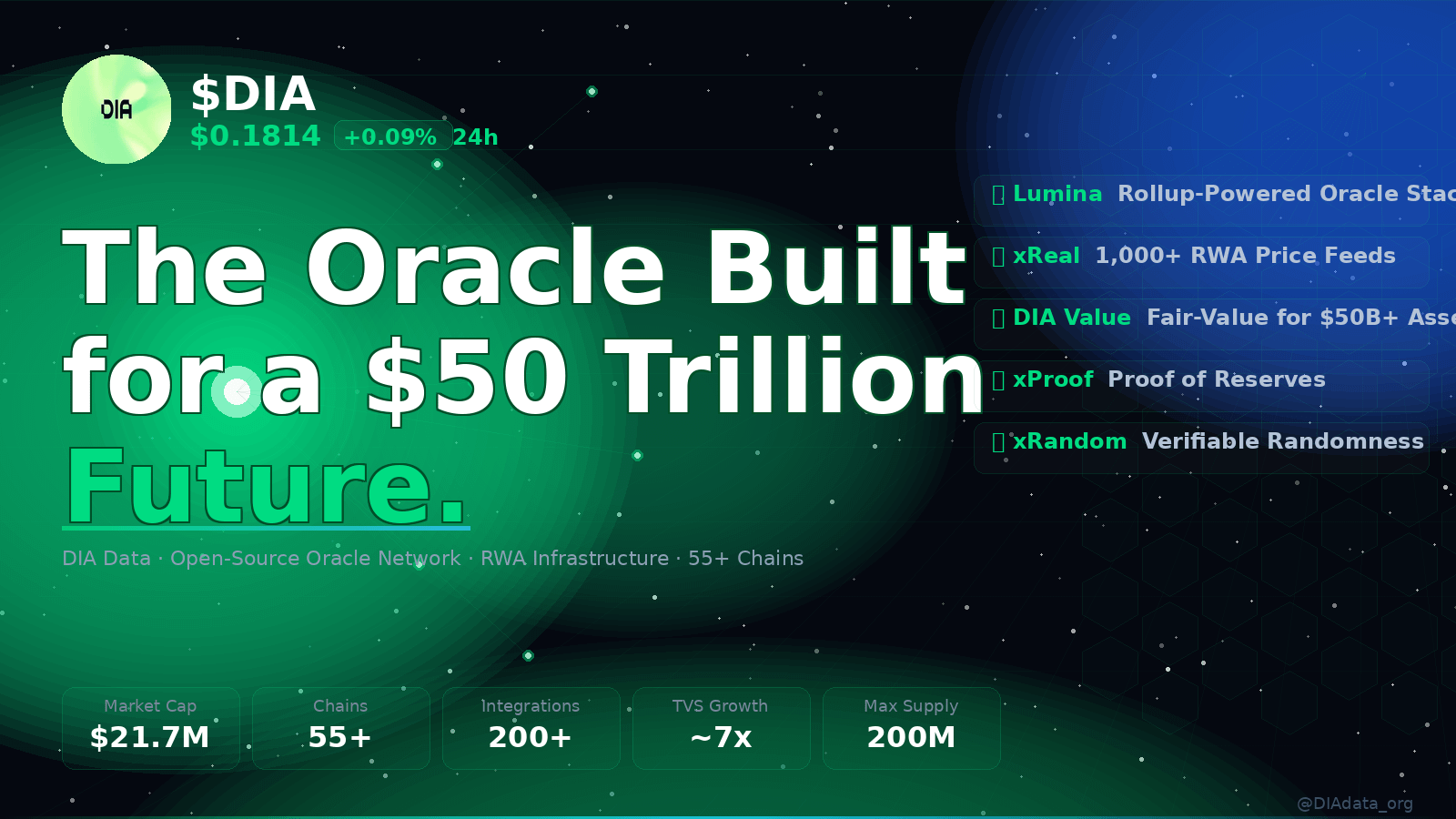
 The product is live. The integrations are real. The market just hasn't priced it in yet — but it will.
The Quiet Infrastructure Play No One Is Talking About
Every cycle, there's a token that does the hard work while the market sleeps on it.
In 2020, it was Chainlink — derided as "just an oracle" — before DeFi exploded and the world realized you can't run a financial system without reliable data feeds. In 2023, it was Pyth — dismissed until Solana roared back, and hundreds of protocols needed ultra-low-latency price data.
In 2025 and 2026? The quiet builder is DIA Data ($DIA).
At the time of writing, $DIA trades at $0.1814 — a $21.7M market cap for a protocol that:
Powers 55+ blockchains
Supports 200+ dApps, including Euler, Morpho, Silo, and Hydration
Grew Total Value Secured (TVS) ~7x to over $300M (DefiLlama)
Just launched the first fair-value oracle for $50B+ in institutional onchain assets
Has a hard-capped supply of 200M tokens — no inflation, ever
This isn't speculation. This is infrastructure.
What Is DIA, Really?
DIA (Decentralised Information Asset) is an open-source oracle network built for the next generation of DeFi—one where assets are priced not just in ETH and BTC but also in tokenized US Treasuries, real estate, fund shares, yield-bearing tokens, and the full spectrum of Real World Assets (RWAs).
While Chainlink and Pyth built oracles for crypto-native assets that trade on liquid markets, DIA built something different: an oracle stack that can price anything — even assets that never trade on an exchange.
This distinction is everything. And the market hasn't figured it out yet.
The Product Suite: More Than Just Price Feeds
🔷 Lumina — The Core Oracle Infrastructure
Lumina is DIA's rollup-powered verifiable oracle computation layer, built on Lasernet — DIA's own L2 mainnet that went live in June 2025.
What makes Lumina different from every other Oracle solution:
Transparency by design. Every data point, every source, every calculation is verifiable on-chain. No black boxes. No trust assumptions. You can audit exactly where the price came from, how it was computed, and whether it matches the underlying reality.
Custom scrapers. DIA doesn't rely on third-party aggregated APIs. It builds custom scrapers that pull data directly from primary sources — DEXes, CEXes, on-chain contracts. This means fresher, more accurate, harder-to-manipulate data.
Rollup-powered efficiency. By building on Lasernet, DIA achieves the throughput needed to serve 55+ chains simultaneously without compromising on latency or cost.
🔷 xReal — 1,000+ RWA Price Feeds
xReal is DIA's dedicated Real World Asset oracle product, delivering over 1,000 live price feeds covering:
Equities — stocks, ETFs, indices
Fixed income — bonds, treasuries, government debt
FX pairs — 150+ currency pairs
Commodities — gold, oil, agricultural products
Tokenized RWA indices
This isn't a roadmap item. xReal is live, serving protocols that need to price real-world collateral onchain.
As the RWA market expands from its current ~$25B into hundreds of billions — and eventually trillions — every protocol holding, lending against, or trading tokenized real-world assets will need a data layer. xReal is that layer.
🔷 DIA Value — The Institutional Game-Changer
This is the announcement that changes the thesis entirely.
DIA Value is the world's first oracle solution for assets that don't have a market price — and it just went live with integrations from Euler, Morpho, and Silo already in production.
Here's the problem it solves:
Traditional market oracles work by aggregating trade prices from exchanges. But what happens when you're trying to price:
A tokenized US Treasury fund that only redeems at NAV once per day?
A fund share token whose value is determined by the fund's net asset value?
A yield-bearing token that accrues value through a smart contract mechanism rather than market trading?
A reserve-backed stablecoin that needs proof of its underlying collateral?
Market-based oracles cannot price these assets. They have no trade data to aggregate.
DIA Value solves this with five methodologies:
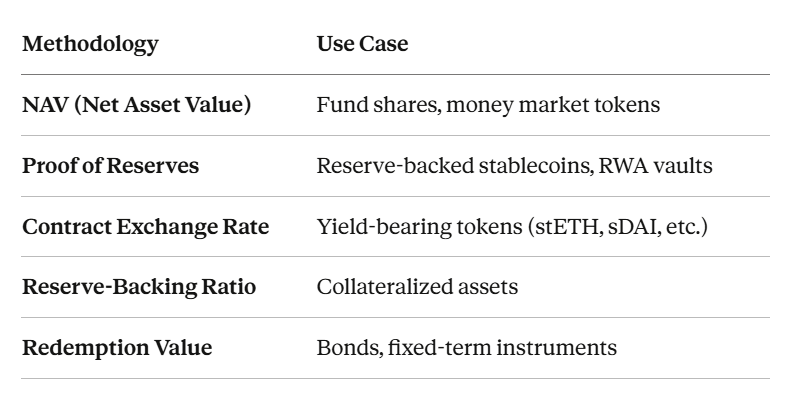
The total addressable market here? Conservatively $50B+ today, growing to trillions as institutional capital flows onchain.
Euler, Morpho, and Silo didn't integrate DIA Value because it looked good on paper. They integrated it because it solves a real problem that their users face every day: how to safely lend against assets that don't have a live market price.
🔷 xProof — Proof of Reserves
As more protocols hold real-world assets as collateral, the question "but can you prove the reserves actually exist?" becomes critical. xProof provides on-chain verification of off-chain reserves — essential for any protocol that wants institutional credibility.
🔷 xRandom — Verifiable Randomness
DIA's verifiable random function (VRF) product serves gaming, NFT, and lottery protocols that need provably fair, manipulation-resistant randomness. Another product, another revenue stream, another reason protocols integrate the DIA stack.
The Multi-Chain Footprint: 55 Chains, 200+ Protocols
Here's what makes DIA's moat so wide: it's not just deployed on one chain. It's infrastructure across the entire multi-chain landscape.
Highlights include:
Euler Finance — one of the most sophisticated lending protocols in DeFi, running DIA Value feeds in production
Morpho — the capital-efficient lending layer with billions in TVL
Silo Finance — isolated lending markets, DIA feeds live
Hydration (Polkadot) — DIA provides native oracle services for the leading Polkadot DeFi hub
Bifrost (Polkadot) — liquid staking protocol using DIA feeds
Plume Network — the leading RWA-native L2, deeply integrated with DIA
AlphBanx — RWA lending protocol
AltLayer — Rollups-as-a-Service platform with DIA oracle feeds baked directly into new rollup deployments
The AltLayer integration deserves special attention. When any team deploys a rollup on AltLayer's infrastructure, they automatically get access to DIA's oracle stack from day one. That's compounding distribution — every new rollup that launches on AltLayer is a potential new DIA integration, without DIA needing to actively sell it.
Staking: Live on Lasernet, Supply Going Off the Market
DIA staking is live on Lasernet mainnet (launched June 24, 2025).
Why does this matter?
Supply reduction. Every $DIA staked is supply that's locked and off the market. With a hard cap of 200M tokens and ~119.67M in circulation, staking creates genuine scarcity pressure.
Yield for holders. Stakers earn rewards for securing the network and participating in governance. This creates a long-term holding incentive — rational actors stake rather than sell.
Network security. Staking aligns token holders with the network's integrity. If validators act maliciously, they lose staked tokens. Skin in the game makes the oracle more trustworthy — which makes it more attractive to protocols — which drives more demand for $DIA.
Compounding flywheel. More stakers → more secure network → more protocol integrations → more fee revenue → more staking rewards → more stakers.
Tokenomics: Hard Cap, No Inflation, Deflationary Pressure
Let's talk about supply dynamics, because they're quietly exceptional.
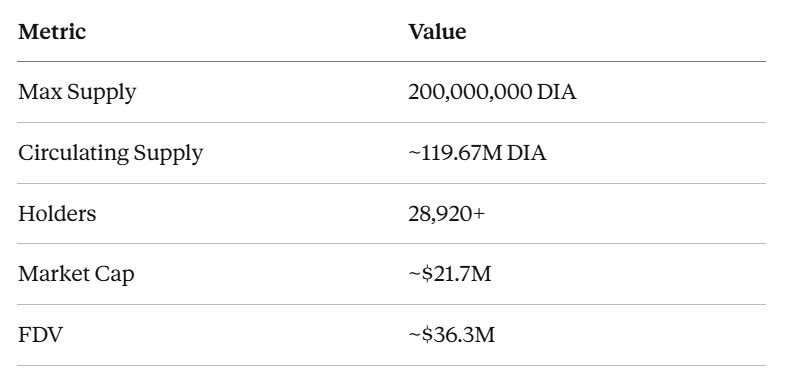
Hard cap of 200M. There will never be more than 200 million $DIA tokens. No inflation. No "team needs more tokens" dilution.
FDV vs Market Cap gap. The fully diluted valuation of $36.3M versus a $21.7M market cap tells you that remaining tokens aren't all dumping — they're locked in staking, vesting, or ecosystem development. This isn't a "FDV trap" situation.
Staking demand is growing. As more protocols require staked $DIA for access to premium feeds, the circulating supply available for trading continues to shrink.
Volume-to-market-cap ratio of 5.66%. Healthy, organic trading activity relative to market cap — this isn't an illiquid micro-cap ghost. Real volume, real trading.
The RWA Narrative: Why This Is the Thesis of the Decade
Real World Assets onchain is not a trend. It's the structural transformation of global finance.
Numbers that put this in perspective:
Global bond market: $130 trillion
Global real estate market: $326 trillion
Global equity market: $100 trillion
Currently onchain as RWAs: ~$25 billion
We are at 0.004% tokenization of global financial assets. The journey to even 1% tokenization means 25x growth from here. The journey to full tokenization is, frankly, incomprehensible in scale.
Every single one of those tokenized assets needs a price feed. Every protocol that lends against them, trades them, or uses them as collateral needs reliable, verifiable data.
DIA is building the price infrastructure layer for this transition.
BlackRock is tokenizing funds. Franklin Templeton is issuing tokenized treasuries. Ondo Finance, Maple, Centrifuge — the institutional RWA ecosystem is exploding. All of them need oracle solutions that can handle assets without continuous market prices.
DIA Value isn't just a product launch. It's the foundation for an entirely new market that didn't exist 18 months ago.
Competitive Analysis: Why DIA Wins the RWA Oracle Race
vs. Chainlink
Chainlink is the dominant oracle for crypto-native assets, with a market cap ~100x DIA's. But Chainlink's architecture is optimized for high-volume, liquid market data. Its CCIP, automation, and data feeds are battle-tested — but they're designed for a world where assets trade constantly on exchanges.
For RWAs that use NAV-based pricing, redemption values, or reserve verification? Chainlink doesn't have a purpose-built solution. DIA does.
The opportunity: DIA doesn't need to beat Chainlink at crypto prices. It needs to own the RWA pricing layer. At 1/100th the market cap, even capturing 5% of Chainlink's market position means a 5x from here on valuation alone.
vs. Pyth
Pyth is excellent at ultra-low-latency price feeds for liquid markets, built on Solana and now multi-chain. It's the go-to for perpetual DEXes that need millisecond price updates.
But Pyth, like Chainlink, is fundamentally a market-price oracle. It can't tell you what a tokenized Treasury fund's NAV is. It can't verify reserves. It can't compute the contract exchange rate for a yield-bearing token.
Different product, different market. DIA and Pyth are less competitors and more parallel infrastructure serving different needs — but as RWAs grow, DIA's TAM expands faster.
vs. Band Protocol, API3, Tellor
These protocols serve similar markets to DIA but with smaller footprints, fewer integrations, and less differentiated product offerings. DIA's multi-methodology RWA approach (xReal + DIA Value) creates a moat that generic oracle providers can't easily replicate.
The differentiation: Open-source transparency, custom scrapers, RWA-specific methodologies, and the staking mechanism create a defensible position that compounds over time.
Price Analysis: Where We Are and Where We're Going
Current Setup (March 2026)
$DIA is trading at $0.1814 — a significant pullback from the $0.70–$0.89 range seen in mid-2025. From a pure technical standpoint
Support zones:
$0.178–$0.182 — current range, holding as a base
$0.155–$0.165 — strong historical support, demand zone
Resistance levels:
$0.22–$0.25 — first meaningful resistance, prior consolidation
$0.35–$0.42 — major resistance from late 2025 structure
$0.70–$0.90 — the mid-2025 peak zone
Pattern: The current price action looks like a base-building phase — compressed volatility, declining volume, multiple tests of the $0.178–$0.182 support. This is the kind of setup that precedes significant moves, not further deterioration.
On-chain signal: Volume at $1.21M/24h with 28,920 holders suggests genuine accumulation. This isn't a ghost coin. Real people are holding and building position here.
Price Targets: Three Scenarios
Conservative Case — $1–$2 (5–10x)
A return to mid-2025 highs and continuation to modest new highs. This requires no new catalysts beyond continued protocol integrations and market recovery. Given the current product completeness, this seems like the floor for a full bull cycle.
Timeline: 6–12 months
Base Case — $5–$8 (Pyth-parity)
Pyth Network's market cap has ranged from $800M to $2B+. If DIA captures similar market positioning in its RWA-oracle niche — where it has arguably a stronger product-market fit — a Pyth-equivalent valuation places $DIA at $5–$8 per token.
This requires: continued RWA market growth, 2–3 major tier-1 protocol integrations, and broader market awareness of DIA's differentiated position.
Timeline: 12–24 months
Bull Case — $10–$20 (Chainlink adjacency)
Chainlink's market cap has historically been $8–15B during bull cycles. If $DIA captures even 10% of Chainlink's valuation — justified by owning the RWA oracle vertical as the market grows 25–100x — you're looking at $10–$20+ per token.
This requires: the RWA narrative hitting mainstream crypto consciousness, institutional protocols choosing DIA as their primary oracle stack, and staking significantly reducing liquid supply.
Timeline: 24–36 months (full cycle play)
DYOR. None of this is financial advice. Price targets are scenarios, not guarantees.
Why Right Now Is The Interesting Entry Point
Markets are forward-looking. The question isn't "what has DIA done?" — it's "what will the market price DIA at when the world realizes what it's built?"
Here's the timing argument:
1. The product is complete. Lumina, xReal, DIA Value, xProof, xRandom — this isn't a roadmap. It's live infrastructure. You're not betting on delivery; you're betting on recognition.
2. The RWA narrative is accelerating. Every week, another institution announces a tokenization initiative. BlackRock's BUIDL fund, Franklin Templeton's FOBXX, Ondo's USDY — these are real assets that need real oracle solutions. DIA Value is purpose-built for exactly this.
3. Staking is live. Supply is leaving the market. The staking flywheel has started spinning. The longer it runs, the tighter the float gets.
4. Price is at a historical discount. At $0.18, $DIA is trading near its lowest levels since before the 2025 bull run. The fundamental picture has dramatically improved since then (Lumina live, DIA Value launched, more integrations) while the price has gone backward. That divergence doesn't persist forever.
5. Market cap leaves room for multiples. $21.7M is an absurdly small market cap for a protocol with this level of technical completeness and real-world adoption. For context:
Random L2s with no users: $50M–$500M
Meme coins with no utility: $100M+
DIA, with 200+ dApp integrations and live RWA infrastructure: $21.7M
The market hasn't connected the dots yet. But it will.
The Bottom Line
DIA is not a bet on hype. It's a bet on infrastructure.
It's a bet that the trillions of dollars in real-world assets moving onchain over the next decade will need a pricing layer — and that the protocol that builds the most accurate, transparent, verifiable, and institutionally credible oracle stack will capture enormous value.
DIA has been building that stack quietly while the market looked elsewhere. Lumina is live. xReal is live. DIA Value is live. Staking is live. 200+ protocols are integrated. 55 chains are covered.
The narrative catch-up hasn't happened yet.
At $0.18, you're buying infrastructure at clearance prices.
The product is built. The adoption is real. The market hasn't priced it in yet.
But it will. 🧱
This article is for informational purposes only and does not constitute financial advice. Always do your own research before making investment decisions. $DIA price data sourced from CoinMarketCap, March 2026.