

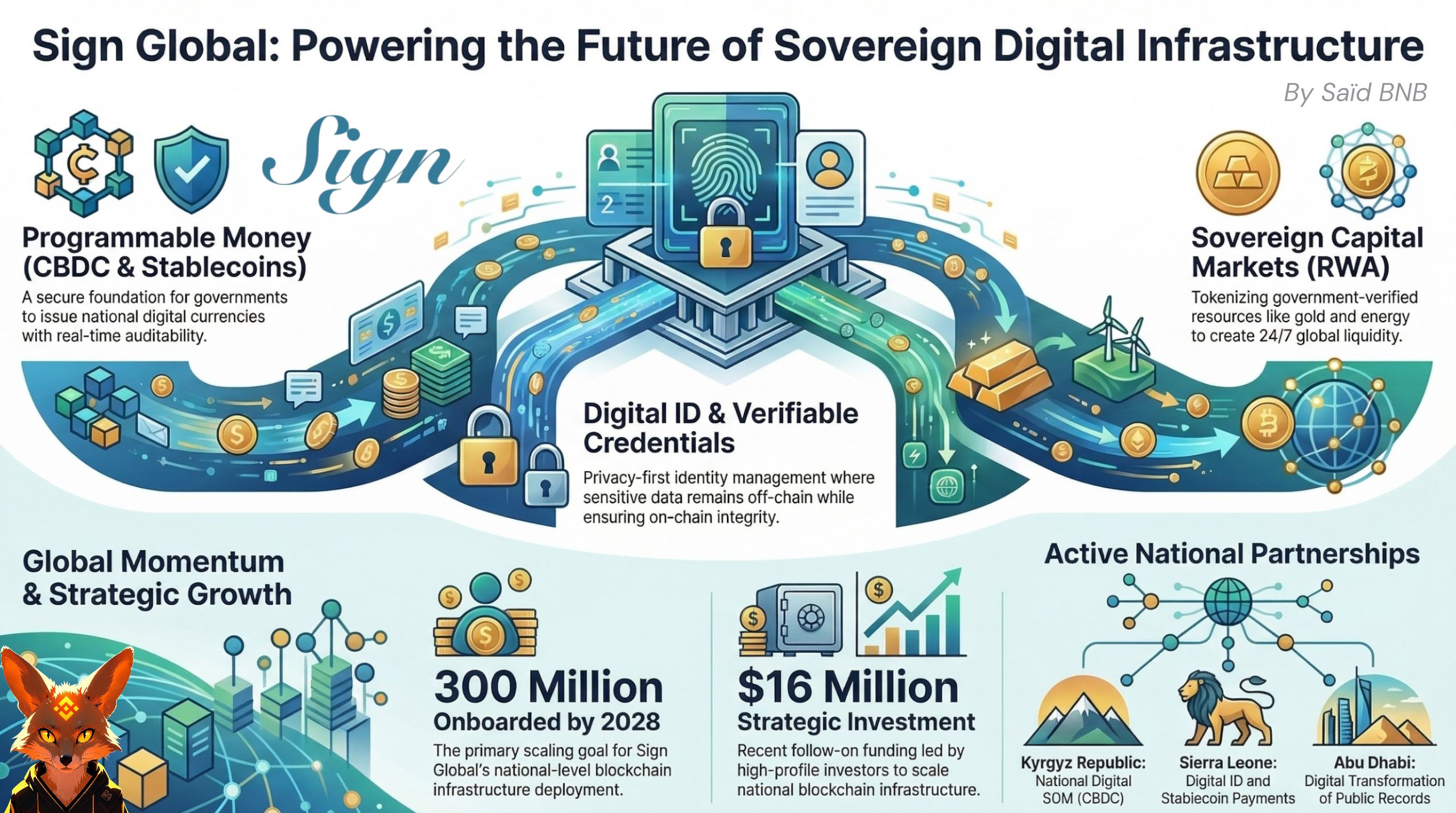

from Speculation to Sovereignty
for a decade, the narrative of blockchain was written in the language of volatility, retail speculation, and ephemeral "airdrops." To the casual observer, it was a casino; to the technologist, a playground. But beneath this noise, a seismic shift is occurring. Blockchain is graduating from a speculative tool for the few into the foundational plumbing of the state. It is transitioning from a niche financial experiment into "Sovereign Infrastructure for Global Nations."
At the vanguard of this transition is @SignOfficial (S.I.G.N.), an entity systematically dismantling the barriers between decentralized technology and national governance. By moving beyond crypto-native tools to build the digital backbone for central banks and ministries, Sign is proving that the next generation of nations will not be built on legacy databases, but on sovereign-grade ledgers. This article explores how Sign’s recent expansion is rewriting the rules of national digital systems.
beyond the Airdrop: the $16M Pivot to Sovereign Infrastructure
The capital markets have already signaled their confidence in this institutional pivot. A high-profile $16 million investment led by billionaire Binance founder CZ—complemented by a strategic follow-on investment from YZi Labs—has repositioned Sign from a "token airdrop service" to a powerhouse for national blockchain infrastructure. Crucially, this expansion is being scaled on the BNB Chain, providing the technical ecosystem necessary to handle the gravity of state-level data.
"Billionaire Binance founder 'CZ' jumps back into crypto with $16 million investment in token airdrop service Sign" — Fortune
Analysis: The involvement of major figures like CZ and VCs like YZi Labs marks the end of blockchain's "retail-only" era. They are not merely funding a platform; they are backing a strategic transition. By pivoting from consumer tools like TokenTable to sovereign-grade infrastructure for money and identity, Sign is capturing a market that is fundamentally "too big to fail." This is a calculated bet on the institutionalization of the ledger—where the value is derived not from trading volume, but from the integrity of a nation's foundational systems.
Kyrgyzstan and the "Digital SOM": CBDCs are No Longer Theoretical
The partnership between Sign and the National Bank of the Kyrgyz Republic is perhaps the most tangible evidence of this shift. Together, they have unveiled a National Digital Currency Program to develop the "Digital SOM." This Central Bank Digital Currency (CBDC) is designed to provide a secure, compliant, and auditable foundation for the country’s economy.
Analysis: This is a counter-intuitive victory for the blockchain sector. While early adopters once dreamed of "banking the unbanked" by bypassing the state, Sign has realized that real-world impact requires collaboration with the state. Geopolitically, this move is significant; for a Central Asian nation, choosing a decentralized, programmable infrastructure over a proprietary, closed-loop system from a foreign superpower is an act of technological self-determination. By adopting the Digital SOM, the Kyrgyz Republic gains programmable compliance and real-time auditability—features that legacy fiat systems simply cannot provide.
sierra leone blueprint: digital ID as a human right
In West Africa, Sign has formalized a Memorandum of Understanding (MoU) with Sierra Leone’s Ministry of Communication, Technology, and Innovation (@MoCTI_SL). The focus is twofold: a robust Digital ID system and integrated stablecoin payments. The goal is to build a secure and inclusive digital economy from the ground up.
Analysis: In many emerging markets, aid and welfare distribution are often hampered by "administrative black holes"—historical opacities that leave the most vulnerable citizens "invisible" to the state. Blockchain-based IDs replace this opacity with radical transparency. By providing verifiable credentials on-chain, Sierra Leone can ensure that financial inclusion is no longer a slogan but a coded reality. This isn't just about efficiency; it's about establishing identity as a verifiable human right that cannot be erased by bureaucratic whim.
"The partnership aims to build blockchain infrastructure that strengthens transparency, inclusion, & innovation, advancing the vision for a secure & inclusive digital economy." — @MoCTI_SL
privacy: The Missing Piece for Government Adoption
The primary hurdle for state-level blockchain adoption has always been a paradox: how can a government utilize a transparent public ledger without exposing sensitive citizen data to foreign adversaries? Sign CEO Xin addressed this in a Forbes feature, advocating for "Government Services On Blockchains With Privacy."
analysis: true digital sovereignty is impossible without privacy. A state that puts its internal records on a fully public ledger surrenders its security. Sign’s breakthrough addresses this by keeping sensitive data off-chain while using on-chain proofs to guarantee integrity. This "Privacy-First" architecture is the specific catalyst required for mass adoption. It allows a nation to enjoy the immutability of the blockchain while ensuring that citizen healthcare records or tax filings remain shielded from unauthorized eyes.
"The World Is Ready For Government Services On Blockchains With Privacy" — Forbes
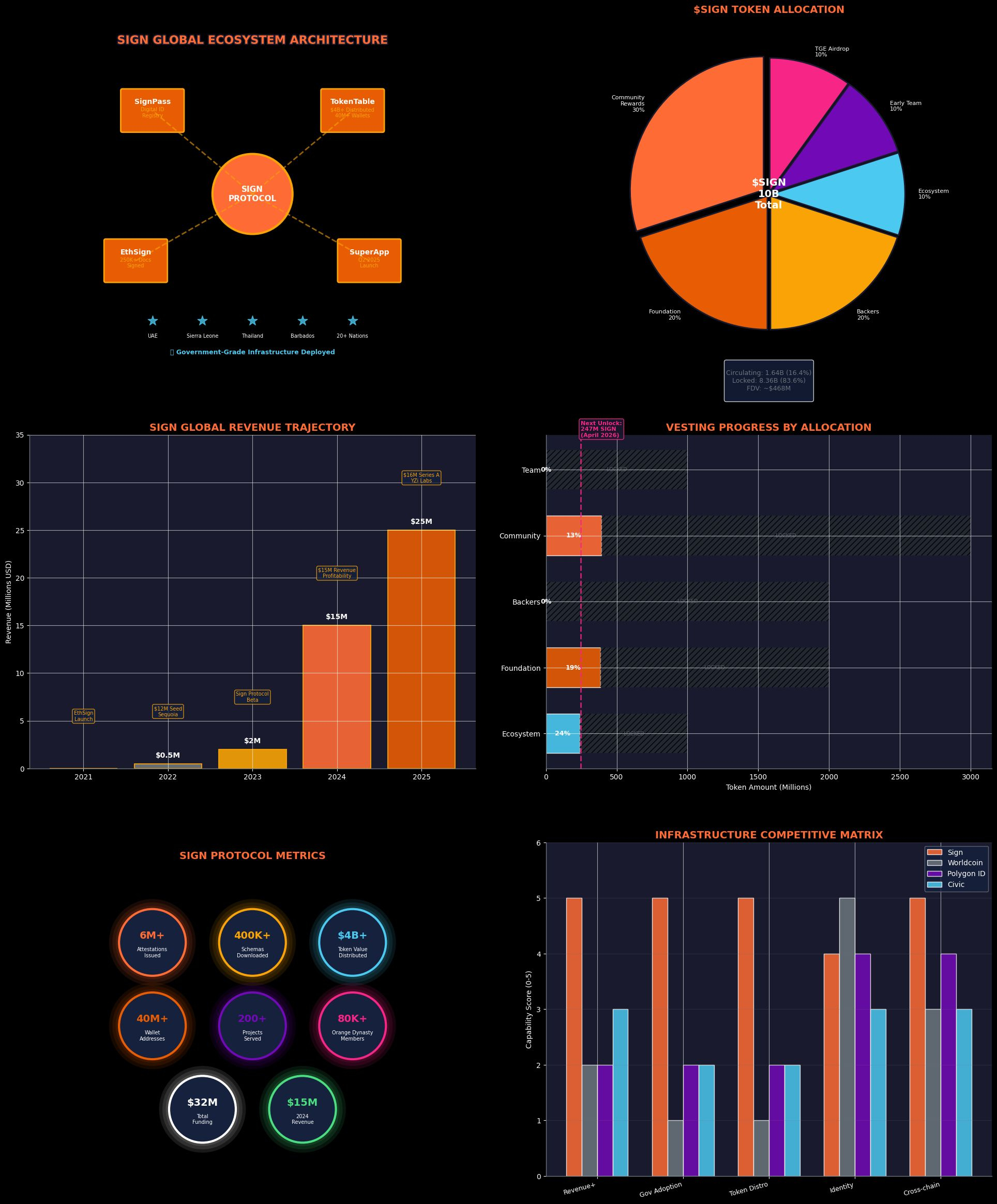
tokenizing the Nation’s Balance Sheet (RWA)
Sign is weaponizing the concept of Sovereign Capital Markets by tokenizing Real World Assets (RWAs). this process turns a nation’s physical resources into liquid, 24/7 programmable assets.
Sign’s infrastructure facilitates the tokenization of:
Gold and Commodities: Secure on-chain representations of national reserves.
Energy and Natural Resources: Programmable markets for power and raw materials.
Land Ownership: Ownership deeds and certificates anchored to the blockchain.
analysis: this is the ultimate upgrade for a nation’s balance sheet. By utilizing titles, trusts, or Special Purpose Vehicles (SPVs) for legal enforceability, Sign ensures these digital assets are not just "tokens," but legally binding instruments. This allows for protocol applications like lending, staking, or yield generation on decentralized platforms. When land and mineral rights are anchored to a blockchain with legal backing, a nation gains instant access to global liquidity that was previously trapped in illiquid, paper-heavy systems.
300 Million User Vision: A New Global Standard
Sign has set a staggering benchmark: to have 300 million people onboarded by 2028. Central to this ambition is a strategic partnership with the Blockchain Centre Abu Dhabi. As a nodal point for cybersecurity and decentralized transformation, this collaboration is specifically designed to transform how the public sector handles digital records.
analysis : This scale is not achievable through retail app downloads; it is only possible through the "wholesale" onboarding of populations via sovereign infrastructure. By focusing on how the public sector manages its records—from land titles to identity—Sign is moving blockchain from a niche interest to a global utility. Abu Dhabi serves as the perfect launchpad for this international standardization, acting as a gateway between the traditional financial world and the decentralized future.
as a conclusion to my overview, the evolution of Sign from a token service to a builder of "Sovereign Infrastructure" marks the maturation of the entire blockchain industry.
we are no longer just talking about digital gold, we are talking about the digital plumbing of nations.
money is becoming programmable, identity is becoming verifiable, and national assets are becoming globally liquid.
as we approach the 2028 milestone of 300 million users, the lines between national identity and digital credentials will blur.
the question for policymakers and citizens alike is no longer whether this technology is viable, but whether your nation will be a leader in this new sovereign digital economy or a laggard. in five years, will your currency and identity be secured by the transparency of the ledger, or will you still be operating on the opaque systems of the past?
share your opinions below 👇