
SIGN has been sitting on my screen for a while now, and I keep circling back to it without fully committing to an opinion. I’ve been in this market long enough to recognize when something is trying to position itself as “infrastructure,” and that word alone makes me cautious. It usually means long timelines, unclear adoption, and a lot of dependence on other people actually using it correctly. But at the same time, I can’t ignore that the problems it’s targeting are real, and they’ve been quietly damaging the space for years.
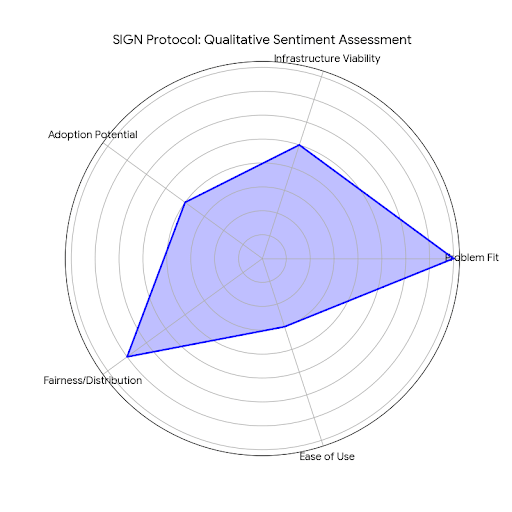
The idea of credential verification in crypto sounds clean on paper, but in reality it’s messy and full of trade-offs. People want privacy, but they also want fairness. They want access, but they don’t want to prove too much. I’ve seen projects struggle with this balance again and again, either becoming too restrictive or too easy to game. SIGN is trying to sit in that middle ground, where verification exists without turning everything into a rigid system. That’s not easy to pull off, and most attempts either overcomplicate things or get ignored completely.
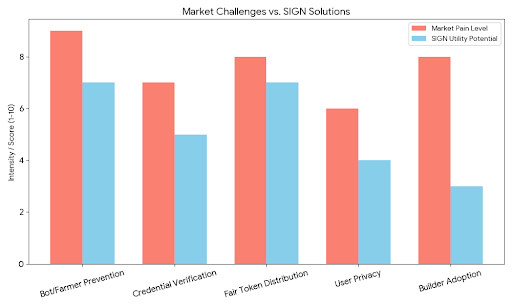
What makes me pause a bit longer is the token distribution angle. That part feels more grounded in actual market pain. I’ve watched too many launches where the numbers look good at first, but later you realize most of it was artificial participation. Bots, farmers, insiders—everyone knows it happens, but nobody really fixes it. If SIGN can genuinely improve how tokens get distributed, even slightly, that’s already more useful than a lot of louder narratives out there. Not perfect distribution, just less broken—that alone would matter.
Still, I don’t take it at face value. I’ve seen how quickly good ideas lose relevance when they depend on behavior that doesn’t match reality. Builders don’t want extra steps unless those steps clearly save them time or protect them from risk. Users don’t care about infrastructure unless it directly affects their experience. So the real test isn’t whether SIGN works in theory, it’s whether it becomes something people actually choose to use when they don’t have to.
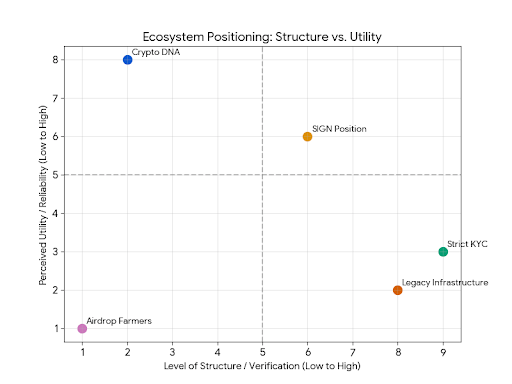
There’s also this underlying question I can’t shake—does the ecosystem truly want this level of structure? Crypto has always leaned toward openness, even when that openness creates problems. Trying to introduce verification and controlled distribution into that environment feels necessary, but also slightly against the grain. That tension doesn’t disappear just because the design looks solid.
So I stay somewhere in the middle with it. I don’t see it as noise, but I’m not convinced it’s essential yet either. It feels like one of those projects that could quietly become part of the background if it works, or just as easily drift away if it doesn’t find real traction. I’ve learned not to rush conclusions with things like this. Sometimes the projects that matter don’t look impressive at first, and sometimes the ones that sound right never really land.
For now, I’m just watching it the same way I watch anything that claims to fix something fundamental—carefully, with a bit of doubt, and without assuming the market will reward it just because the idea makes sense.