

This isn’t just another geopolitical flare up.
It’s a global liquidity event disguised as an oil crisis.
And markets are already reacting, not to what’s happening, but to what could break next.
🛢️ The 20% Problem the Market Can’t Ignore
Nearly 20% of global oil supply flows through the Strait of Hormuz.
That’s not a statistic.
That’s a single point of systemic fragility.
Even a partial disruption involving Iran or regional escalation forces:
Immediate oil repricing
Shipping insurance spikes
Preemptive supply hoarding
Markets don’t wait for closure, they price the risk of closure.
📉 This Isn’t an Oil Shock. It’s an Inflation Reset
Higher oil doesn’t stay in النفط, it spreads:
Freight costs rise
Food inflation follows
Manufacturing margins compress
Now central banks in the United States and European Union face a familiar trap:
Fight inflation → kill growth
Support growth → fuel inflation
There is no clean policy path, only trade offs.
💸 Capital Isn’t Leaving. It’s Rotating Aggressively
In crises, capital behaves predictably:
In:
Gold
US Dollar
Defense-linked equities
Out (or under pressure):
Risk assets
Import heavy economies
Countries like Pakistan don’t just feel this, they absorb it via:
Currency depreciation
Expensive energy imports
Fiscal tightening
War acts like a hidden tax on weaker balance sheets.
₿ Crypto’s Real Test: Trust, Not Volatility
Crypto doesn’t hedge war.
It hedges confidence breakdown in traditional systems.
During stress:
Liquidity thins
Volatility spikes
Narratives shift toward neutrality
Platforms like Binance see rising activity but also rising scrutiny.
The real question isn’t:
“Will crypto go up?”
It’s:
“Will people trust state systems less?”
That’s where asymmetric upside begins.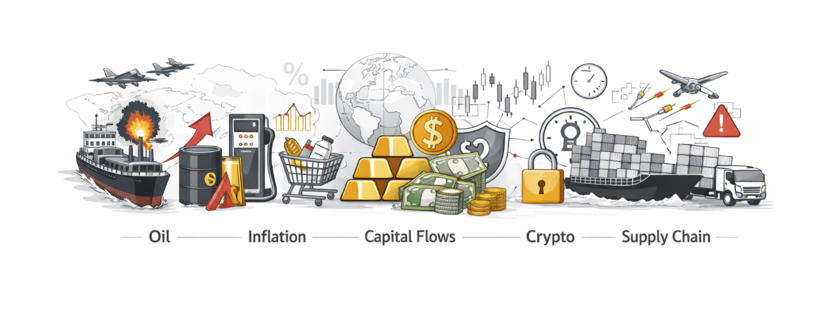
🚢 Supply Chains Are Quietly Breaking Again
This is the underpriced layer.
Red Sea route instability
Higher cargo insurance premiums
Delayed shipments across energy and goods
We’re not seeing collapse.
We’re seeing friction.
And friction compounds.
⚖️ The Structural Shift Has Already Started
This conflict is accelerating long term changes:
Energy diversification away from Middle East dependency
Sustained global defense spending cycles
Fragmentation of trade and alliances
The global economy isn’t reacting anymore. It’s reorganizing.
🧠 Final Take: The Market Is Pricing Fear as a System Variable
This war may or may not escalate further.
But economically that almost doesn’t matter anymore.
Because:
Uncertainty itself is now being priced as a permanent condition.
Not a spike.
Not a phase.
A baseline.
This isn’t a war driven oil shock. It’s a slow motion global liquidity squeeze.