
Something bothered me when I first started seriously reading Midnight's protocol documentation. Every privacy blockchain I had studied before operated on a single ledger with varying degrees of visibility. You either saw the transaction or you did not. Midnight kept describing something different and it took me a while to understand why the architecture felt fundamentally unlike anything I had encountered before. Midnight does not choose between a public ledger and a private ledger. It runs both simultaneously and the relationship between those two states is where the real innovation lives.
Midnight's network maintains what the protocol calls a dual-state architecture. There is a public state — transparent, auditable, visible to every participant on the network exactly the way a conventional blockchain works. And there is a private state — shielded through Midnight's zero-knowledge proof system, visible only to the parties directly involved in a transaction. These two states are not separate chains running in parallel. They are components of the same Midnight network, interacting with each other through cryptographic proofs that allow information to move between public and private states without the private information ever becoming readable to outside observers.
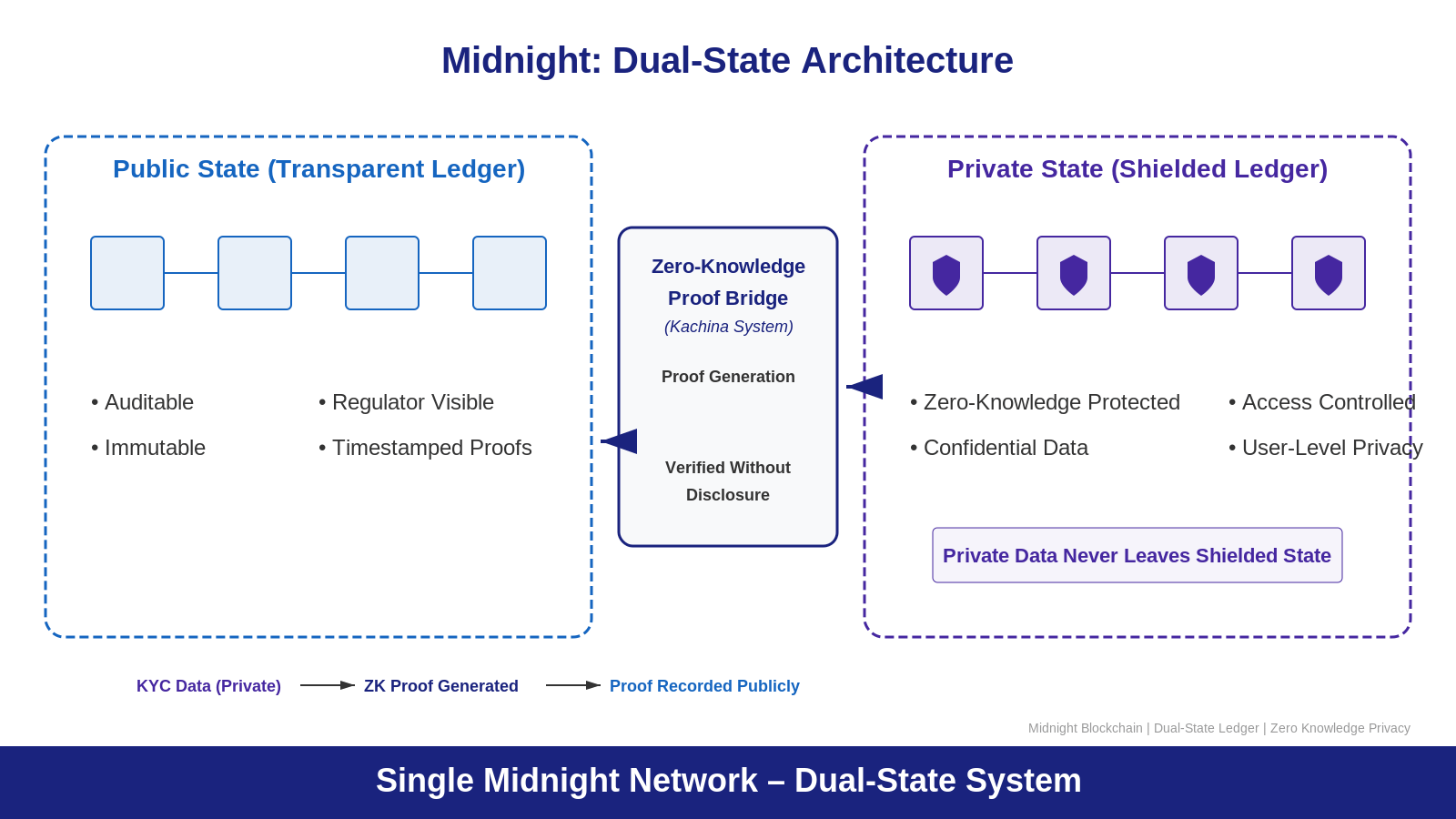
Why does that matter? Because every real-world compliance use case that Midnight is targeting requires both states to exist at the same time. A financial institution running KYC verification on Midnight needs the proof of verification to be publicly recorded — auditable by regulators, timestamped, immutable. But the underlying customer data that generated that proof needs to stay in Midnight's private state, shielded from competitors, bad actors, and anyone without explicit authorization to see it. On a fully transparent chain, you cannot have that. On a fully private chain, you cannot have that either. Midnight's dual-state architecture is the only design that satisfies both requirements simultaneously without compromise.
NIGHT is trading at $0.04476 on Binance, down 6.18 percent on the day that Midnight crossed one billion dollars in USDT volume for the first time — 22.95 billion NIGHT tokens traded in a single session. EMA(20) sits at $0.04594, EMA(50) at $0.04644, both above price. RSI at 44.68, MACD just turned negative. The price dropped on the highest volume day in Midnight's history, which tells me this is serious repositioning around mainnet, not panic selling from retail.
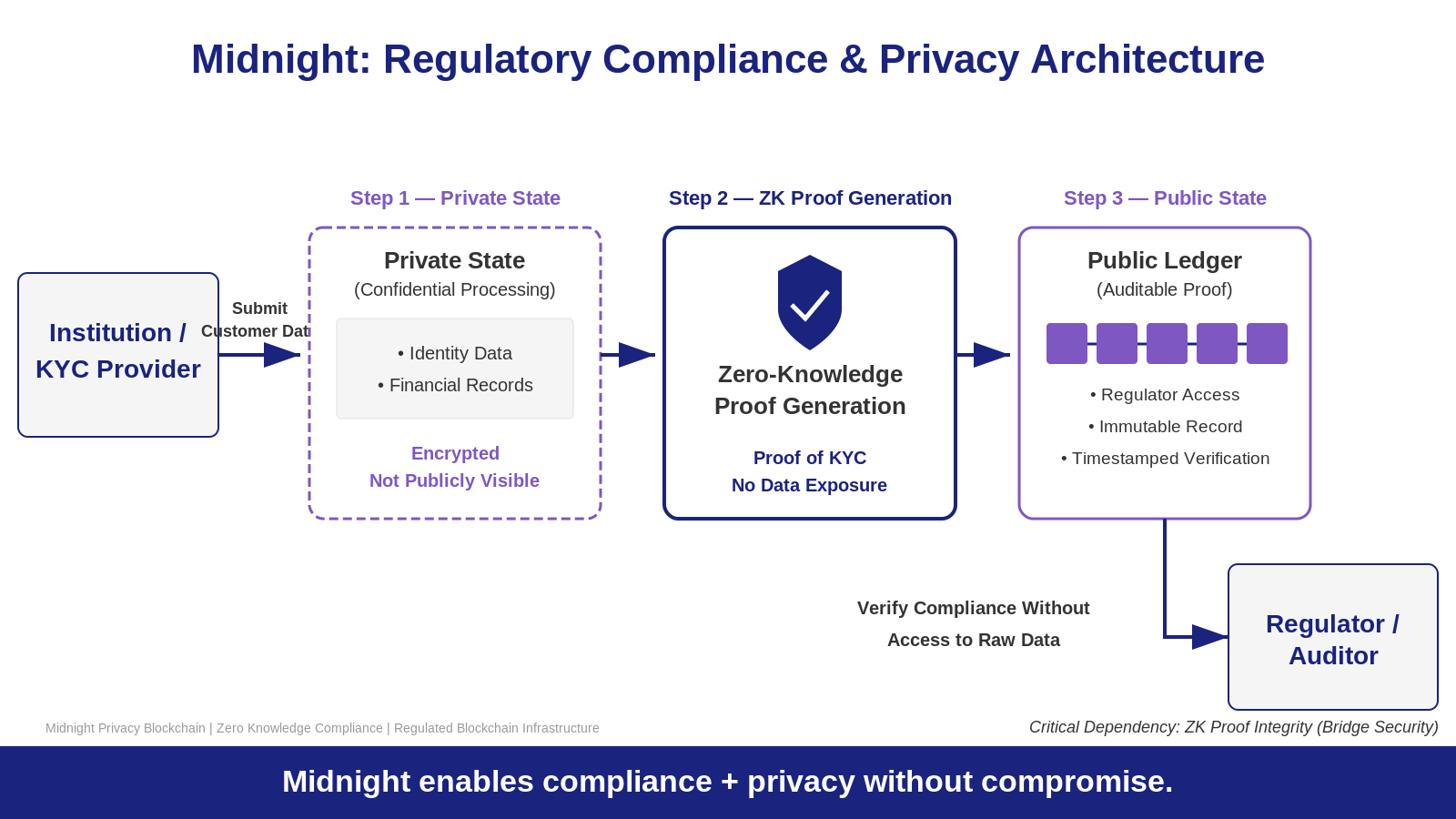
The thing I keep sitting with about Midnight's dual-state design is how it changes the conversation with regulators entirely. Every regulator who has pushed back against blockchain adoption in regulated industries has made the same argument — we cannot allow institutions to operate on infrastructure we cannot audit. Midnight's public state answers that objection directly. The proof that a transaction occurred, that it followed the correct rules, that it was processed at a specific time — all of that lives in Midnight's public state permanently. What stays in Midnight's private state is everything the regulator does not need and the institution cannot legally share. That separation is not a workaround. It is a design decision that makes Midnight the only privacy network that can have a productive conversation with a banking regulator without asking them to abandon their oversight mandate.
The risk I would not ignore is that Midnight's dual-state architecture places enormous responsibility on the zero-knowledge proof system that bridges the two states. Every time information moves from Midnight's private state into a public proof, that transition relies entirely on the mathematical soundness of Midnight's Kachina-based proof system. A vulnerability in that bridge does not just expose private data. It potentially allows invalid private state transitions to generate legitimate-looking public proofs, which would mean Midnight's public ledger could record proofs of events that never actually occurred in the private state correctly. That is not a theoretical concern to dismiss. It is the most critical security assumption in Midnight's entire architecture and it deserves independent verification from cryptographers outside the core team before institutions commit production workflows to the network.
Watch how Midnight communicates its dual-state architecture to non-technical audiences after mainnet. That communication is the first real test of whether Midnight can bridge the gap between what its protocol does and what a compliance officer can explain to their board.
@MidnightNetwork #night $NIGHT
