
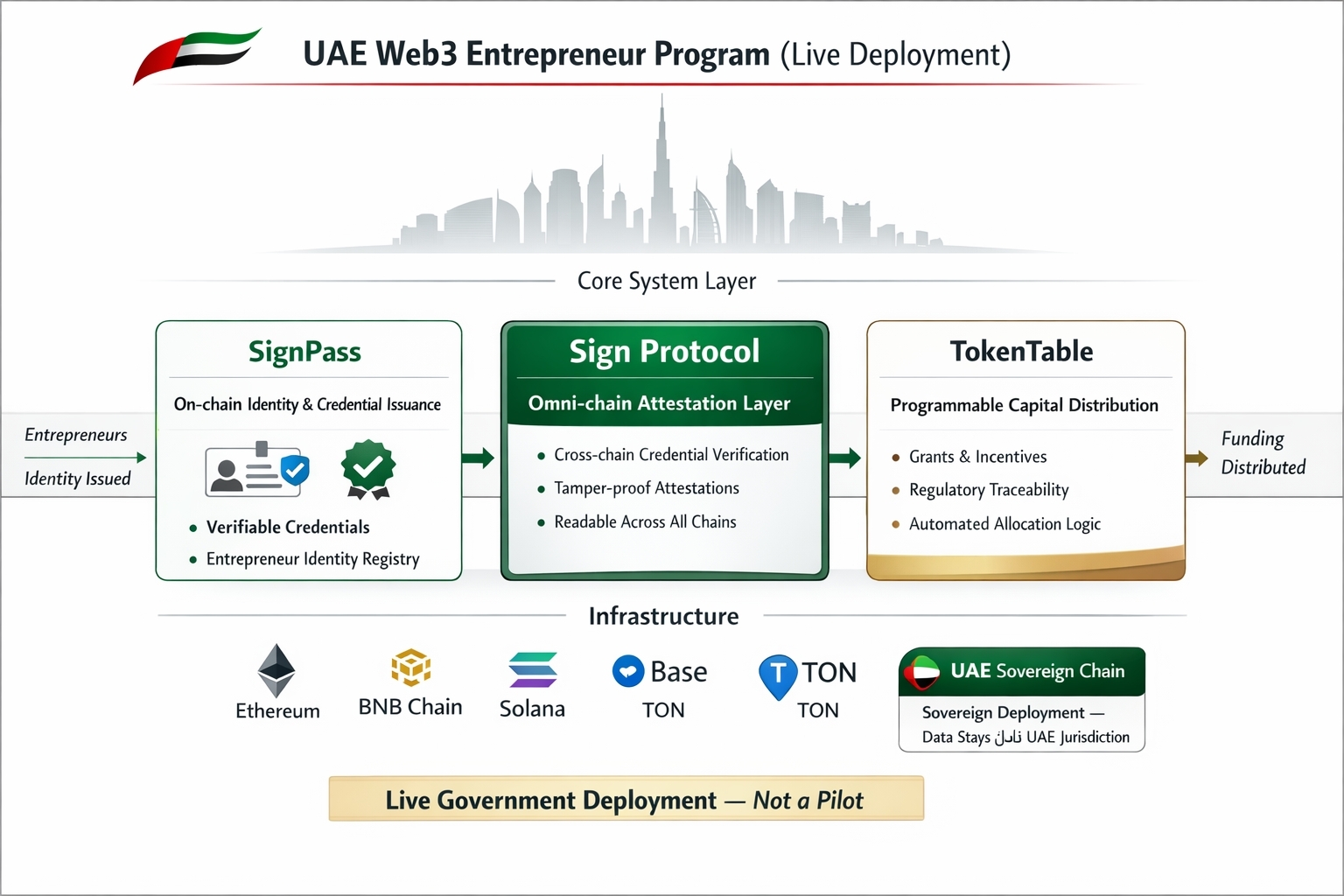
I have been tracking Sign Network's Middle East footprint for weeks and most people are still missing what is actually confirmed on the ground. Sign Protocol did not just enter the UAE as an idea or a partnership announcement. Sign Protocol is the infrastructure powering the UAE government's Web3 Entrepreneur Program right now — processing real verifiable credentials, anchoring real on-chain identities through SignPass, for real entrepreneurs inside one of the world's most advanced digital government ecosystems. That deployment is live. It is confirmed. And the implications for Sign Network's position across the entire Middle East go far beyond one program.
The UAE chose Sign Protocol for a specific reason that I think reveals everything about why Sign Network is positioned differently from every other blockchain infrastructure company targeting the Middle East. Sign Protocol is the world's first omni-chain attestation solution — meaning it creates verifiable credentials that work seamlessly across Ethereum, BNB Chain, Solana, TON, Base, Starknet, and Move-based networks simultaneously without rebuilding the verification layer for each chain. SignPass, Sign Network's on-chain identity system, deploys locally on sovereign chains to meet each country's regulatory compliance requirements specifically — so UAE government data stays under UAE jurisdiction, Saudi government data stays under Saudi jurisdiction, and credentials remain interoperable across borders through Sign Protocol's attestation standard without raw data ever crossing regulatory lines. That architecture is not a feature the Middle East wants. It is the architecture Middle Eastern governments are legally required to demand. Every GCC country has data sovereignty requirements written into its digital transformation strategy. Sign Protocol is the only omni-chain attestation infrastructure that satisfies those requirements by design.
What makes Sign Network's UAE deployment the beginning of a regional story rather than a single-country deployment is how Sign Protocol actually compounds inside government ecosystems. Sign Network's S.I.G.N. framework — Sovereign Infrastructure for Global Nations — is built around three foundational systems: a digital money system for programmable CBDCs and regulated stablecoins, a digital identity system for verifiable credentials issued and recognized across agencies, and a capital distribution system for government subsidies, benefits, and grants executed through TokenTable. When Sign Protocol enters a government through one system — like the UAE Web3 Entrepreneur Program using SignPass for identity — it demonstrates all three layers simultaneously to every other agency watching that deployment perform. The UAE Central Bank, watching Sign Protocol's credential verification run inside an active government program, is making real-time observations about Sign Network's readiness for Digital Dirham infrastructure. That compounding dynamic is how Sign Network moves from one UAE program to a national-scale sovereign deployment — not through cold procurement pitches, but through demonstrated performance inside live government systems.
TokenTable deepens Sign Network's Middle East positioning in ways specific to how GCC governments actually distribute money. Saudi Arabia's government distributed over $30 billion in Vision 2030 subsidies and welfare payments in 2024 through legacy banking infrastructure that cannot audit itself in real time and cannot verify recipient eligibility dynamically at the point of distribution. TokenTable's programmable distribution engine — with its Unlocker module for complex release logic, its Merkle Distributor for gas-efficient mass distribution, and its Signature Distributor for socially verified high-frequency distributions — handles every one of those distribution scenarios with full regulatory traceability built in at the protocol level. TokenTable has already processed over $4 billion in distributions across more than 40 million wallet addresses. Sign Network is offering Middle Eastern governments a distribution engine that is not theoretical. It has processed more capital than most regional fintech companies have touched in their entire operating history.
The price today is $0.03200, down 24.72% on the session with volume spiking to 576.11 million SIGN — the highest volume in Sign Network's recent trading history. RSI sits at 15.72, one of the most extreme oversold readings possible on the 14-period scale. Every EMA — the 20-period at $0.04291, the 50-period at $0.04549, and the 200-period at $0.04147 — sits significantly above current price. The MACD is deeply negative at -0.00218. The chart is reflecting broad crypto market pressure and aggressive $SIGN selling. What the chart cannot reflect is that Sign Protocol's UAE government deployment did not go offline today, that TokenTable's $4 billion in processed distributions did not reverse, and that Sign Network's confirmed position as the infrastructure layer for the UAE Web3 Entrepreneur Program did not change because $SIGN dropped 24%.
The risk I want to be direct about is Sign Network's pace of converting UAE presence into broader GCC sovereign contracts. Sign Protocol being inside the UAE Web3 Entrepreneur Program is a genuine first-mover position — but the Middle East procurement landscape is competitive, well-funded, and relationship-driven. R3, ConsenSys, and regional fintech incumbents with existing central bank relationships are all targeting the same GCC digital infrastructure opportunity. Sign Network's technical advantage — omni-chain attestation deployable on sovereign chains, with TokenTable's distribution engine and SignPass's identity registry operating as one integrated stack — is real and differentiated. But technical advantage in B2G markets converts into contract wins through institutional relationships and demonstrated sovereign-scale performance, not through architecture elegance alone. Sign Network needs to show that its UAE performance generates the next GCC contract before competitors establish equivalent footholds.
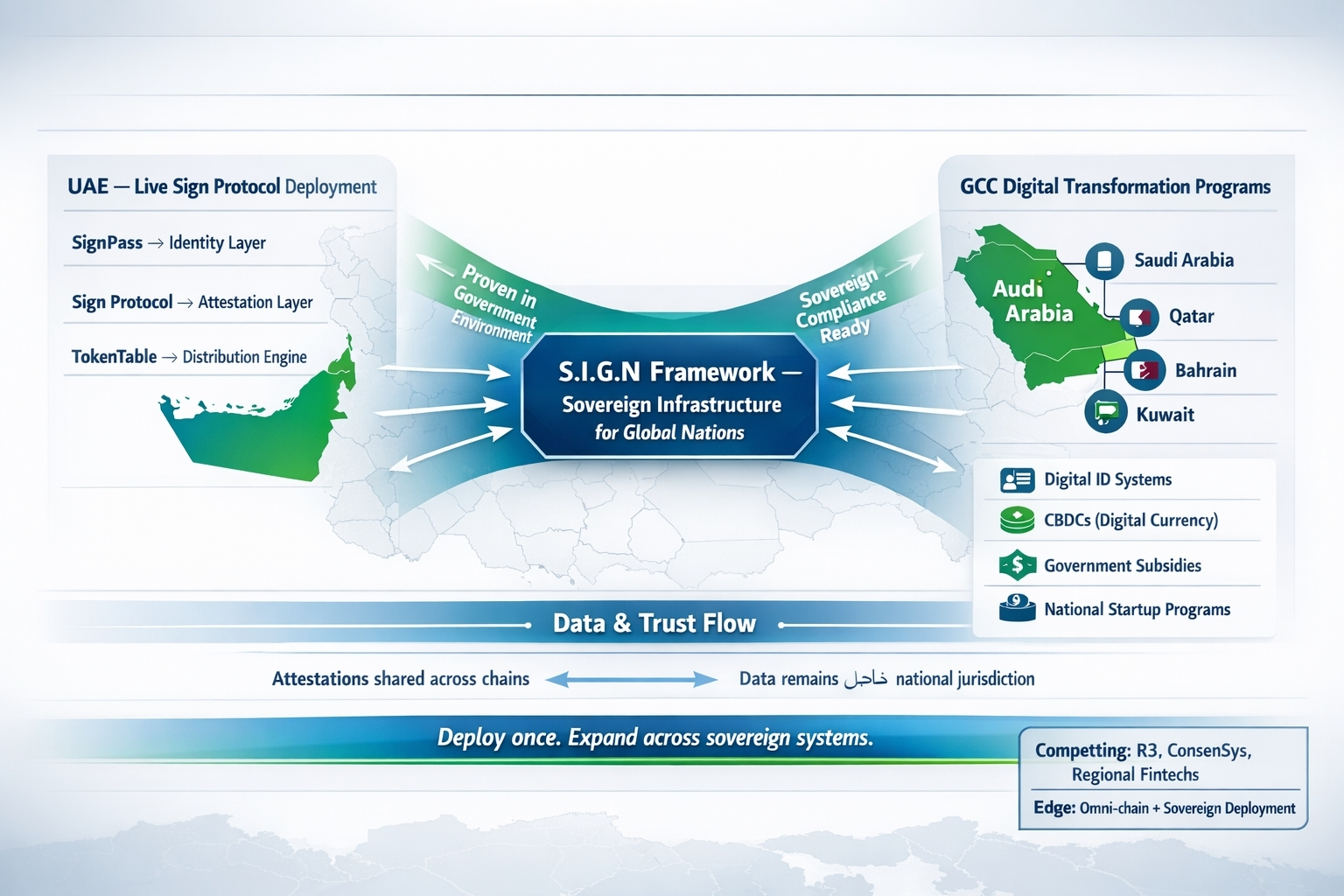
What I am watching specifically for Sign Network's Middle East thesis is whether the UAE Web3 Entrepreneur Program generates publicly visible scale — number of SignPass credentials issued, number of Sign Protocol attestations created, depth of integration into UAE government workflows — that makes the case for Sign Network's next sovereign contract in the region. I am watching whether Saudi Arabia's Vision 2030 digital identity initiatives, which are actively seeking blockchain infrastructure partners for national-scale credential systems, name Sign Protocol in any procurement announcement. And I am watching whether Sign Network's revenue growth in 2026 begins reflecting Middle East sovereign deployment income — because the gap between Sign Network's $15 million baseline revenue and the revenue implied by sovereign-scale UAE and GCC deployments is where the entire $SIGN rerating lives.
Sign Protocol is already inside the UAE government ecosystem. SignPass is issuing verifiable credentials through a live government program. TokenTable has the distribution track record to handle every GCC benefit payment program being digitized in 2026. Sign Network did not enter the Middle East by pitching. It entered by deploying. The rest of the GCC is watching what Sign Protocol does inside the UAE. And that audience watching is worth more to Sign Network's sovereign infrastructure thesis than any price recovery on any single trading session.