

I keep circling back to this idea of “infrastructure,” and how easily we throw the word around without really sitting with what it means. Roads, electricity, the internet—these are things we trust not because they’re perfect, but because they’ve become invisible in their reliability. So when I hear something like a “global infrastructure for credential verification and token distribution,” I instinctively pause. Not because it sounds impossible, but because it sounds like the kind of thing people say before reality pushes back.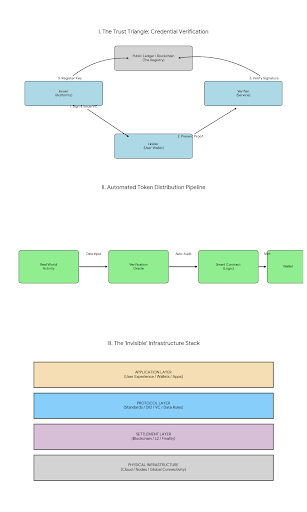
I’ve been trying to understand what problem this is really solving. On the surface, credential verification seems straightforward: prove who you are, prove what you’ve done, and let systems recognize it. But in practice, it’s messy. Degrees get forged, certifications expire, identities get stolen, and institutions don’t always agree with each other. There’s a quiet chaos underneath something that’s supposed to be simple. So I can see the appeal of a system that tries to unify all of that—something global, consistent, and maybe even tamper-resistant.
Still, I can’t help wondering whether we’re underestimating how human this problem actually is.
Credentials aren’t just data points. They carry context, reputation, and sometimes even bias. A degree from one place means something different than the same degree from somewhere else. A work history isn’t just a list—it’s a story, shaped by perception as much as by fact. Can a global system really flatten all that into something clean and universally accepted? Or does it risk oversimplifying things that were never meant to be standardized?
Then there’s the “token distribution” part, which feels like a whole other layer of complexity. Tokens—whether they represent value, access, or incentives—sound efficient in theory. You can automate rewards, align incentives, and remove intermediaries. But incentives are tricky. The moment you start assigning tokens to actions or credentials, you’re also shaping behavior. People adapt. They optimize. Sometimes in ways that weren’t intended.
I’ve seen systems where the metric becomes the goal, and once that happens, the original purpose gets diluted. If credentials become tied to tokens, do people start chasing the token rather than the substance behind the credential? It’s not a new problem, just a different form of it.
What keeps me thinking, though, is the trust layer. Any global infrastructure like this would have to answer a simple question: why should anyone believe it? Trust isn’t just about technology—it’s about governance, transparency, and accountability. Who runs the system? Who decides what counts as a valid credential? Who has the power to update, revoke, or challenge something?
I don’t think there’s an easy answer to that. Centralized systems struggle with trust because they concentrate power. Decentralized systems struggle because they distribute responsibility in ways that can feel unclear or even chaotic. Somewhere in between, there’s probably a balance—but it’s not obvious where that balance sits.
And yet, despite all this skepticism, I don’t dismiss the idea. There’s something compelling about trying to build a shared layer of truth for credentials. Not a perfect one, but a better one. Something that reduces friction without pretending to eliminate it. Something that acknowledges complexity instead of hiding it behind technical language.
Maybe what interests me most is not whether such a system can exist, but how it evolves if it does. Infrastructure isn’t built once—it’s shaped over time, by the people who use it and the problems it encounters. If a global credential system ever becomes real, it won’t look like the clean diagrams people imagine today. It’ll be uneven, contested, and constantly changing.
And maybe that’s the point.
I find myself thinking that the real challenge isn’t building the system—it’s living with it. Understanding its limits, questioning its assumptions, and resisting the urge to treat it as something more definitive than it actually is. Because at the end of the day, no matter how sophisticated the infrastructure becomes, it’s still trying to map something deeply human onto something fundamentally rigid.
And that tension doesn’t go away. It just shifts shape.