
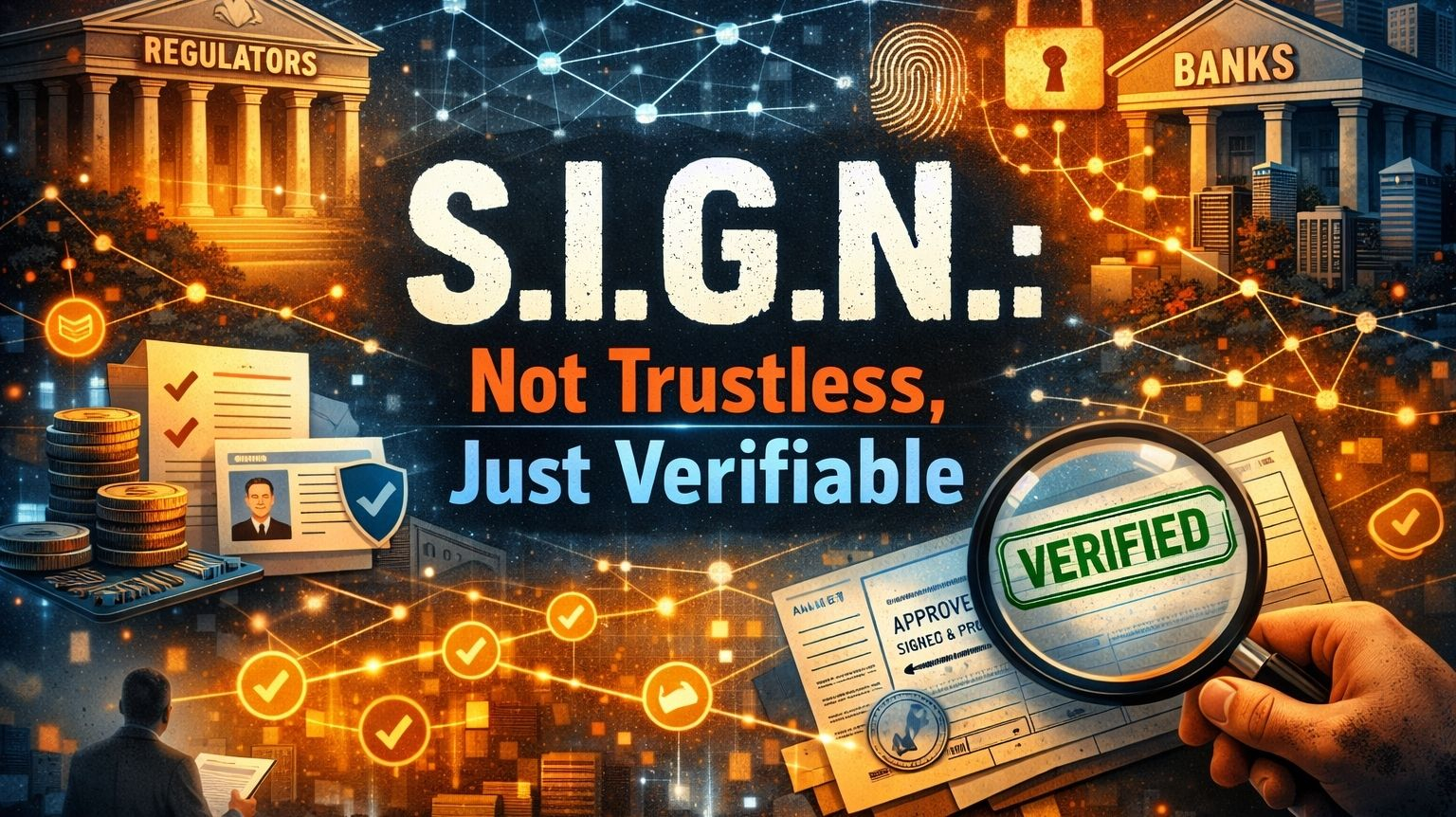
S.I.G.N. didn’t feel like that. Not immediately, at least. It felt like someone sat down and asked, “okay but what happens when this stuff is used by people who can’t afford bugs?” and then just followed that thread all the way down.
Anyway.
The line that stuck in my head was basically this idea that trust gets weird at scale. Fragile. And yeah, that checks out — crypto loves throwing around “trustless,” but the second you bring in governments or institutions, that word kind of falls apart. These systems don’t run on ideology. They run on proof, audit trails, accountability… boring stuff, but the kind that actually matters when money or identity is involved.
So S.I.G.N., at least how I’m reading it, isn’t trying to be another chain or app or whatever label is trending this week. It’s more like… the guts of how things actually talk to each other when money, identity, and distribution all collide.
And that’s the key thing: it doesn’t separate those pieces.
Which is interesting. And also slightly uncomfortable.
Because most systems today pretend those layers are independent. They’re not.
You’ve got money moving, identities behind it, and some logic deciding who gets what. S.I.G.N. just admits that and wires them together with one rule hanging over everything: if something happens, you should be able to prove it happened. Not narrate it. Not log it in some database no one trusts. Actually prove it.
Cryptographically. Ideally in a way that can be replayed later without ambiguity.
That’s the pitch, anyway.
—
The money side… yeah, it’s programmable money, but not in the “DeFi degen playground” sense. It’s more like: what if money had rules that regulators could actually see and enforce in real time?
Which, depending on your bias, is either the point or the problem.
You get things like controls, limits, approvals, emergency stops — all the stuff crypto usually tries to avoid. And S.I.G.N. just leans into it. No pretending. No “we’ll decentralize later” energy. It’s like, no, this is how institutions actually operate, so let’s build for that world instead of fantasizing about another one.
I’m not even sure I like that.
But I get it.
—
The identity piece is quieter, but honestly… probably more important than the money layer long term. And I don’t think most people will notice that at first.
Instead of shipping your entire identity every time (which is still how way too many systems work), they’re pushing this idea of proving small things about yourself without exposing everything. Like, “I meet this condition” without handing over your life story.
That sounds obvious. It isn’t.
If that part actually works cleanly — across systems, across jurisdictions — it changes how compliance works. It changes onboarding. It probably reduces a ton of friction we’ve all just accepted as normal.
But it’s also the kind of thing that looks great on paper and gets messy fast once different standards and governments start touching it.
So yeah, I’m cautiously interested there.
—
The capital distribution system is where it stopped feeling abstract for me.
Because this is where money actually leaks in the real world. Grants, subsidies, aid, incentives — all of it sounds good until you try to track where it went and why half of it disappeared or got misallocated.
S.I.G.N. basically says: tie distribution directly to identity, define the rules upfront, and leave a trail that can’t be argued with later.
Every payout has context.
Every decision has a record.
Everything can be traced back.
It’s less “smart contracts are cool” and more “can we stop losing money in systems that are supposed to help people.”
That’s a very different tone.
And honestly, this might be the part I think matters the most.
Not because it’s flashy — it’s not — but because it solves a problem that already exists at scale, right now, with real consequences.
—
All of this leans on one thing though, and if this part doesn’t hold, the rest kind of collapses.
Sign Protocol.
This is basically the evidence layer. The receipt machine. The thing that says: if something happened, here’s the proof, signed and structured in a way machines (and auditors) can actually use.
You define schemas — what kind of data you expect — and then you attach attestations to real events. Signed, verifiable, portable.
So instead of trusting a system’s output, you’re verifying its history.
And the flexibility here is doing a lot of heavy lifting. Some data lives on-chain, some off-chain, some in between with anchors tying it together. Which makes sense, because not everything belongs on a public ledger, especially when you’re dealing with identity or government-level stuff.
Still, it’s a balancing act. Flexibility can turn into fragmentation pretty quickly if standards aren’t tight.
—
What’s weird (in a good way, I think) is that S.I.G.N. doesn’t try to overthrow existing systems. It kind of accepts them. Governments want control. Regulators want visibility. Organizations need interoperability. Users still want some level of privacy.
So instead of fighting that, it builds around it.
Which is… pragmatic. Maybe too pragmatic for some people in crypto.
But probably closer to how things actually get adopted.
—
And yeah, there are obvious headaches here. Coordination across countries is slow. Standards take forever. Interoperability is always harder than it sounds. And leaning into regulation can just as easily box you in as it can open doors.
No clean answers there.
—
I keep coming back to this though: most projects are obsessed with removing control entirely.
S.I.G.N. is asking what happens if control stays… but everything becomes provable.
Not trustless. Verifiable.
And I don’t know if that’s the future people want — or just the one we’re actually going to get.
[3/27, 9:46 PM] Ahsan: Most crypto decks read the same. Faster blocks. Bigger numbers. A chart that only goes up (until it doesn’t).
So I skim. Usually.
But S.I.G.N. made me slow down a bit. Not because it’s louder. Because it’s aiming somewhere else entirely—and that’s rarer than people admit.
It’s not pitching “another chain.”
It’s poking at something uglier: how systems lie to each other, politely.
⸻
The piece that stuck
Attestations.
Yeah, sounds dry. Almost bureaucratic. Like paperwork, but digital.
But here’s the twist—S.I.G.N. isn’t using attestations as a side feature. It’s treating them like plumbing. Invisible. Everywhere. Hard to rip out once installed.
A claim. Signed. Checkable later.
That’s the clean version.
The messy version?
A trail of who did what, under which rulebook, and whether that rulebook itself was legit at the time. Not vibes. Evidence.
⸻
Let me ground this
Because otherwise it’s just another whitepaper word.
Picture this:
A flood hits a remote district—somewhere with patchy electricity, forget stable internet. Relief funds get announced. Names get written down. Lists travel between offices. Someone approves. Someone else “adjusts.” Money leaks. Always does.
Weeks later, an audit team shows up. They get spreadsheets. PDFs. Maybe a USB stick with half the data missing. People argue. Records don’t line up. No one’s lying—officially. Still, the truth dissolves.
Now flip it.
Same scenario, but every step emits an attestation:
— Eligibility stamped by a local authority (with a key you can actually verify)
— Approval tied to a specific policy version, not “whatever was current”
— Funds released with conditions encoded, not implied
— Final receipt: signed, time-locked, and cross-checkable
So when auditors arrive, they don’t “investigate.”
They replay.
Quietly. Deterministically.
⸻
Why this isn’t just another “trustless” slogan
Because, honestly, most systems today run on soft trust.
You trust the bank because… it’s the bank.
You trust the platform because it hasn’t broken yet.
You trust the dashboard because it looks official enough.
But that’s not verification. That’s habit.
S.I.G.N.’s angle is blunt: stop asking systems to be honest. Make them prove it, repeatedly, in ways other systems can read without asking permission.
Not once. Every step.
⸻
The part I can’t ignore
Because this doesn’t depend on hype cycles. No need for retail mania or token velocity gymnastics.
It’s solving a boring, structural problem: fragmented truth.
Different databases. Different authorities. Different versions of “what happened.”
And instead of forcing everything on-chain (which, let’s be real, breaks at scale), it splits the stack:
— proofs where they matter
— data where it’s practical
So. Hybrid. Not ideological.
⸻
A few rough edges worth staring at
But, and this is where it gets uncomfortable…
Who gets to issue these attestations?
Because if it’s the same old gatekeepers, just with cryptographic signatures, then we didn’t fix trust—we just notarized it.
And the registries—the lists of who is معتبر (trusted enough to sign)—who maintains those? Who audits the auditors?
Standards fragment fast. Faster than people expect. One ministry uses schema A, another tweaks it, a third forks it entirely. Suddenly everything is “verifiable,” but nothing lines up.
Interoperability dies quietly. That’s how it usually goes.
⸻
Where this might be heading
You can squint and see a shift:
From:
“the system says it happened”
To:
“here’s the proof, take it or leave it”
And over time, users won’t even notice. Like APIs today—nobody thinks about them, but everything depends on them.
Finance. Identity. Policy execution. Even AI outputs, eventually—because if models start making decisions, someone’s going to ask: based on what evidence?
Attestations fit there. Too well, maybe.
⸻
Still…
So we end up here.
A system designed to record reality as provable steps, not narratives. Clean in theory. Messy in deployment. Political, whether the builders admit it or not.
And the risk isn’t technical failure. That’s fixable.
It’s quieter than that.
What happens when “verifiable truth” is technically sound… but only issued by a small circle that decides what counts as truth in the first place?