

At first, I didn’t take Sign seriously. It looked like one of those typical projects—sign documents on blockchain, store data, call it innovation. Nothing new, nothing exciting. I’ve seen too many of those ideas come and go. But when I looked deeper, my perspective started to shift. This wasn’t about documents at all. It was about infrastructure, and not just any infrastructure—systems that governments could actually use.
What caught my attention was the idea behind S.I.G.N. It’s not just a product, it’s a framework for digital nations. Instead of building isolated tools, Sign is creating a system where governments can manage identity, payments, and data in a structured way. Think of it like a private digital layer for control and security, connected to a public network for movement and interaction. That connection is what makes the whole system powerful.
Right now, governments are stuck in a difficult position. Traditional systems are slow, paper-based, and disconnected. On the other side, crypto networks are fast and efficient but lack control and compliance. Sign is trying to connect these two worlds. It doesn’t replace either side—it creates a bridge between them.
The focus is simple but important: identity and money. Digital identity is still a major problem. Most systems require repeated verification, manual checks, and paperwork. Sign allows identities to become verifiable and reusable. This means faster onboarding, less fraud, and smoother access to services. At the same time, the project is working on digital currencies. These are not just isolated tokens, but systems designed to interact with global networks, making payments faster and cheaper across borders.
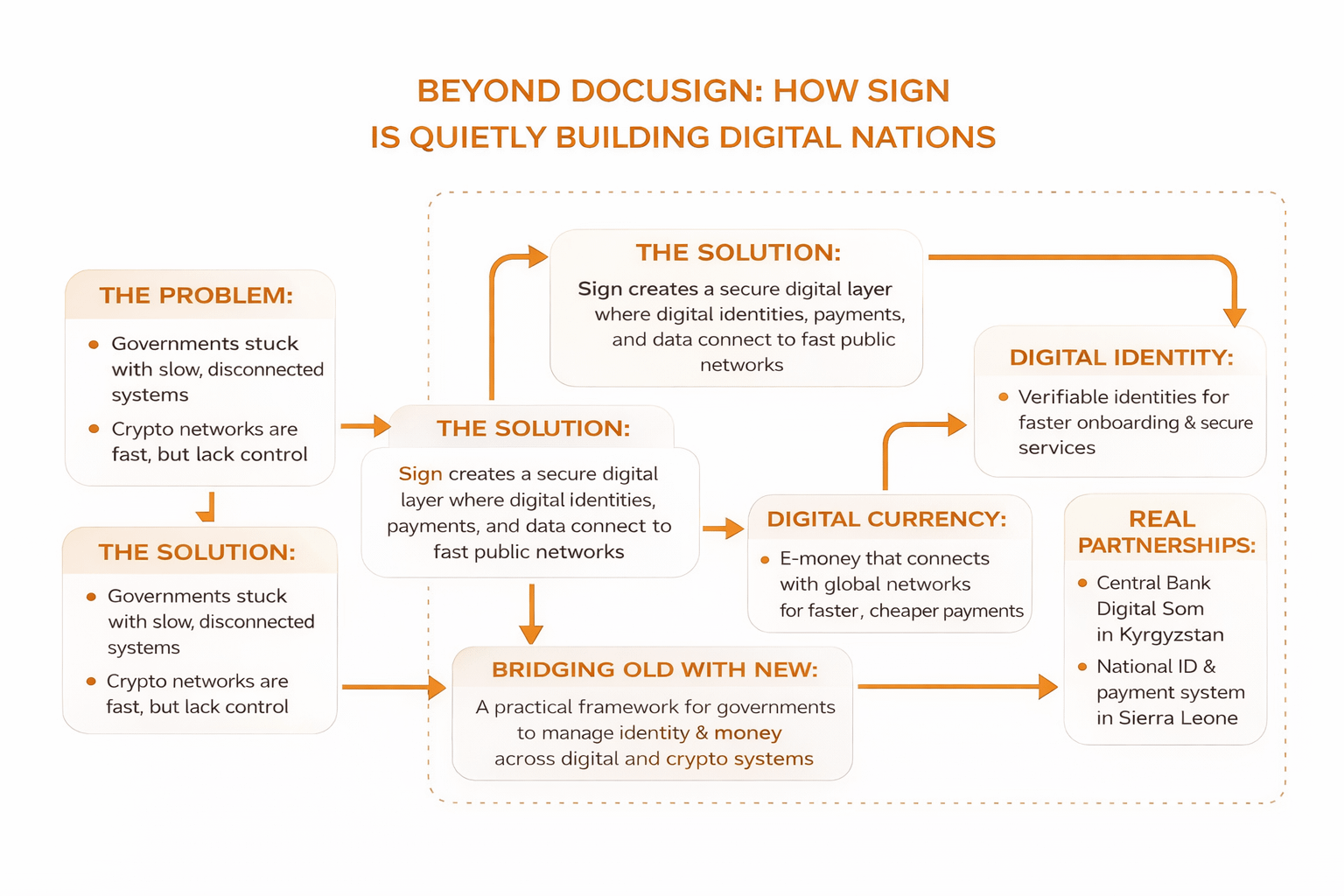
What made this more real for me were the actual partnerships. In Kyrgyzstan, Sign is working on the Digital Som, a central bank digital currency aimed at serving millions of people. In Sierra Leone, they are helping build a national identity and payment system. These are not test ideas. These are real-world implementations with real users.
Under the surface, the system is built in layers. There is a protocol for identity verification, a distribution system for payments, and a network that balances privacy with transparency. You don’t need to understand every technical detail to see the direction. It’s about making systems that can scale, handle real users, and operate in complex environments.
They also have strong momentum. Funding, community growth, and adoption are all moving in the right direction. But what stands out is not just growth—it’s where that growth is happening. While most projects are focused on market narratives, Sign is moving into areas that require long-term commitment and real-world integration.
That doesn’t mean it’s risk-free. Government partnerships are slow. Regulations can change. Scaling across countries is not easy. These are serious challenges. But that’s also what makes the project different. It’s operating in a space where things are difficult, not just popular.
For me, Sign stopped looking like a simple blockchain tool and started looking like infrastructure. Not something you trade, but something systems run on. And in a market full of short-term noise, that shift is hard to ignore.
In One Line
👉 This article explains how Sign is evolving from a simple tool into infrastructure for digital nations.