
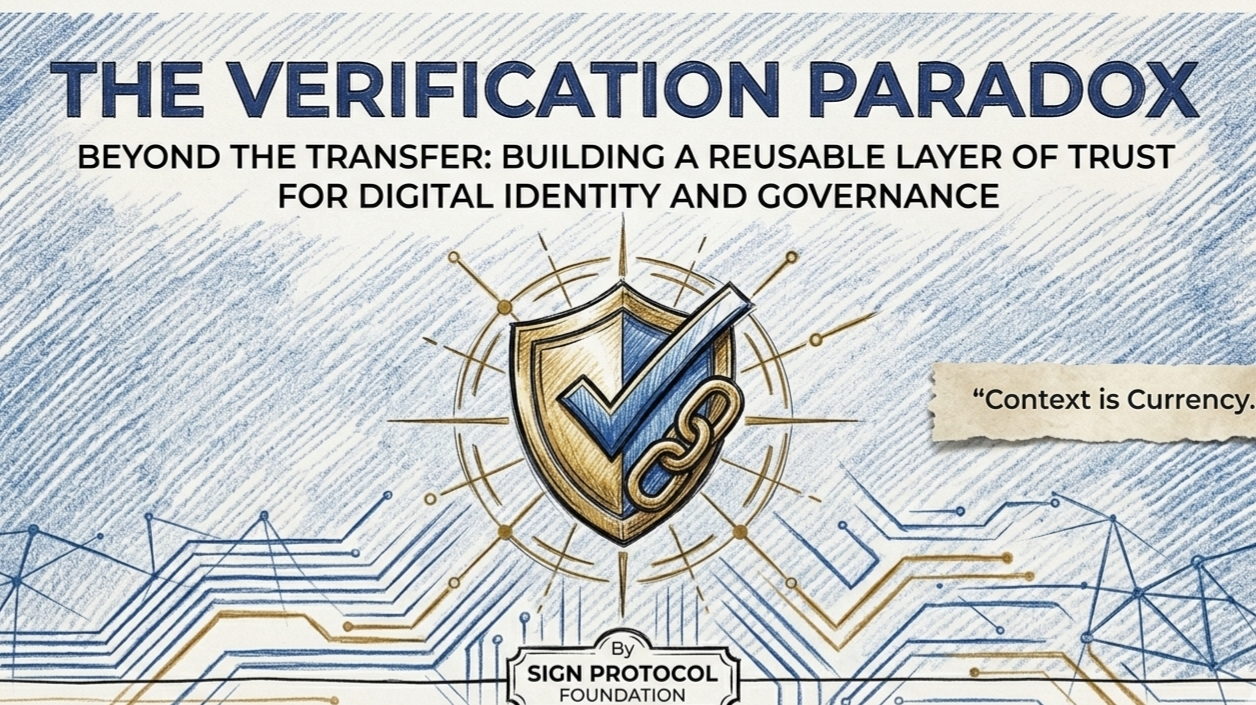

I’ve spent enough time in this space to see the same cycle repeat until it’s deafening. Every bull run, we get a fresh batch of Layer 1s promising the same trinity: faster, cheaper, more scalable. We’ve become obsessed with the Transfer—how quickly can I move X from point A to point B?
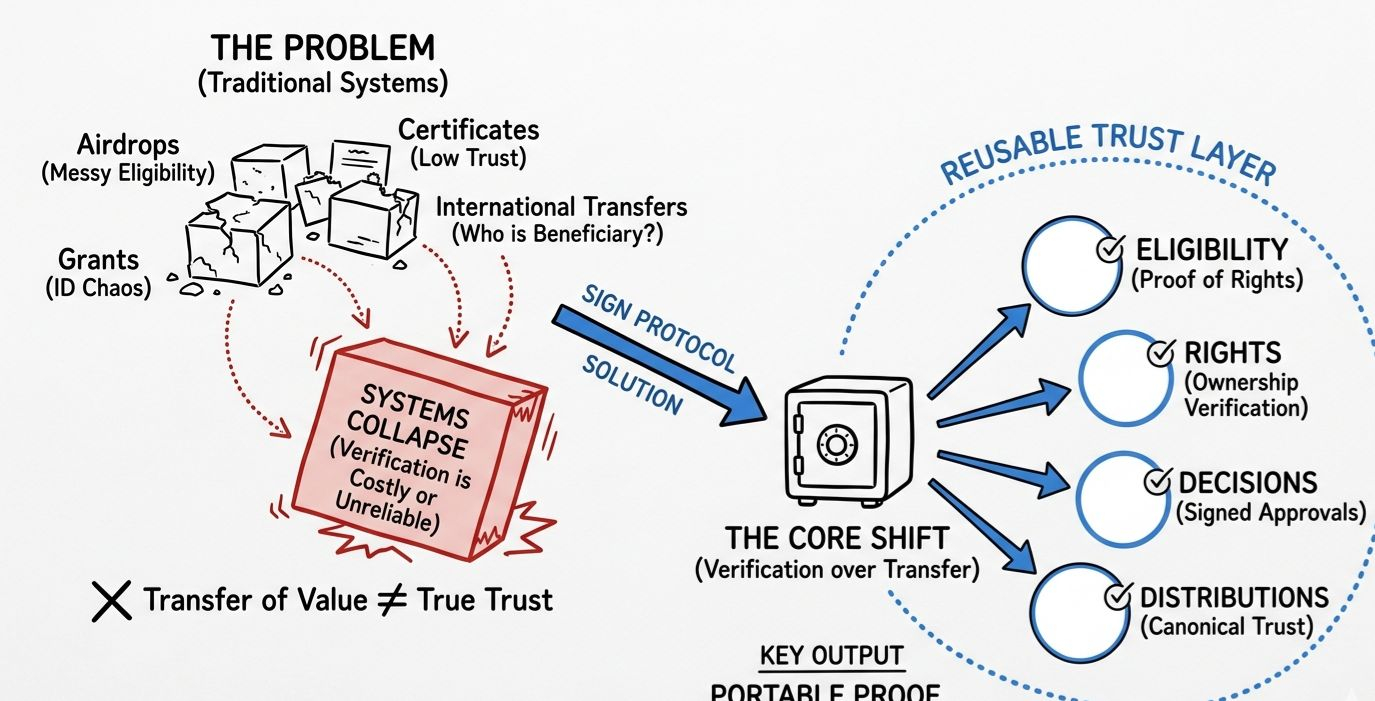
But here’s the thing that keeps me up: moving value is actually the easy part now. The real friction, the "invisible wall" that causes systems to collapse, isn't the transfer. It’s the Verification.
When a project fails, it’s rarely because the transaction didn’t go through. It’s because the eligibility was murky. When a certificate is ignored, it’s because the source is dubious. When an airdrop turns into a sybil-infested nightmare, it’s a verification failure.
In my view, we don’t need more pipes; we need better filters. That’s where Sign Protocol enters the frame, and frankly, it’s doing it with a level of stoicism that makes most "hyped" projects look like toys.
Beyond the "Credentials" Label
Most people look at SIGN and think, "Oh, another decentralized ID or credential project." I think that’s a massive oversimplification.
To me, SIGN is building a Portable Proof Layer.
In the current digital landscape, your "rights" are siloed. If you prove your identity or your contribution in one ecosystem, that proof is often a prisoner of that specific database. SIGN flips the script. It’s about Evidentiary Coordination. It asks:
Who gave the green light?
Who actually earns this reward?
What is the "canonical" version of this decision?
Can we verify this three years from now without calling a centralized API?
It’s not just a "Passport." It’s the ledger of intent and eligibility.
The Tech is Philosophical
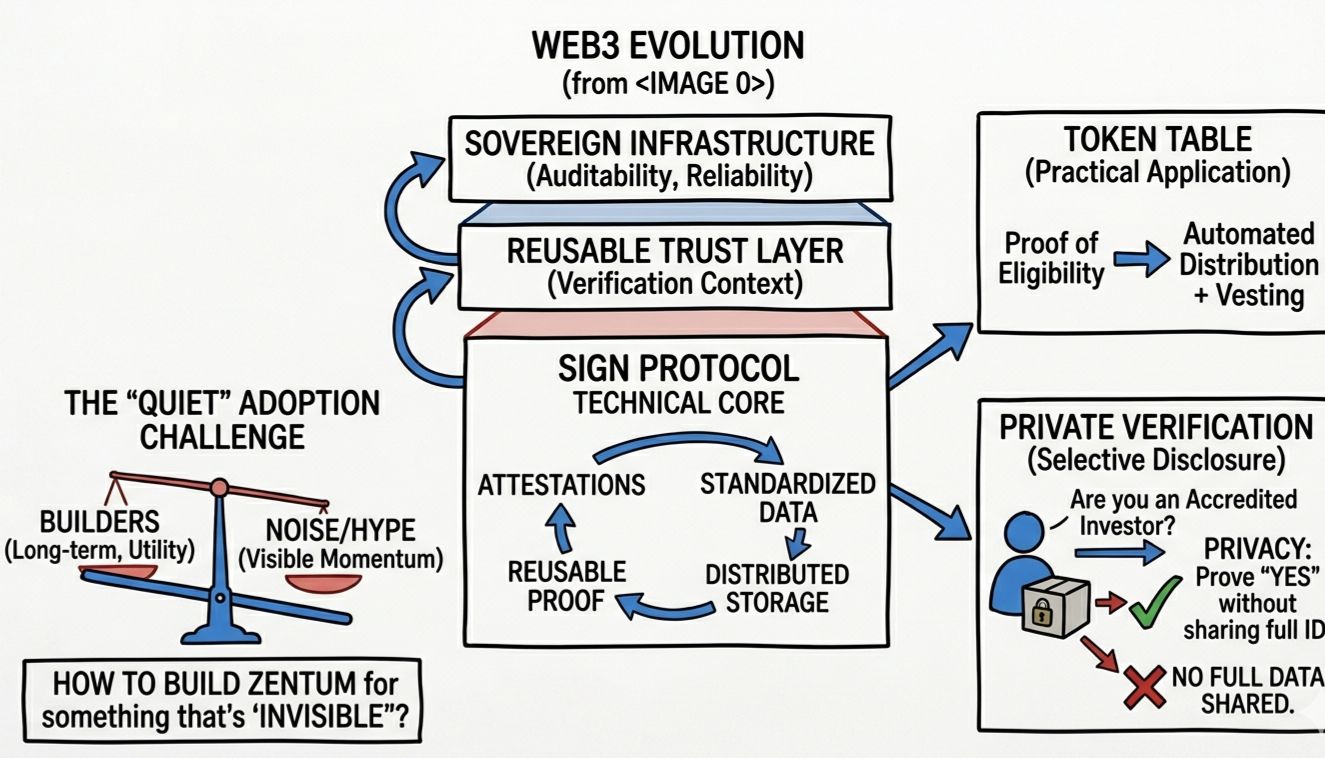
Technically, SIGN leans on Attestations (signed digital statements). But the genius isn't in the signature; it's in the standardization.
The protocol focuses on four pillars:
Creation: How we format the truth.
Storage: Where the truth lives.
Discovery: How we find the truth.
Reusability: How we take that truth to another app.
I find their Selective Disclosure feature particularly compelling. We live in a world where institutions want proof, users want privacy, and regulators want transparency. It’s a messy love triangle. SIGN solves this by allowing you to prove you are "over 18" or "a certified developer" without handing over your entire life history. It’s sovereign infrastructure for a world that has forgotten what sovereignty looks like.
Grounding the Theory: TokenTable
I always get skeptical when a project is 100% theory and 0% utility. SIGN avoids this trap with TokenTable.
Managing token distributions and vesting is a nightmare of manual spreadsheets and human error. By linking their verification tech to actual cap-table management, they’ve turned a "philosophical" project into a "operational" necessity. They are attacking the points where errors are most expensive. That, to me, is where the real demand for verification comes from.
The "Silent" Strategy: A Red Flag or a Hidden Gem?
If you look at SIGN’s marketing, it’s... quiet. In a market that thrives on noise, this is jarring.
Usually, Layer 1s scream for attention because they need to suck in liquidity to survive. SIGN behaves like a utility—like electricity or a plumbing standard. You don’t "hype" the protocol that ensures your bank records are accurate; you just expect it to work.
My take? This is a double-edged sword.
The Pro: It attracts builders, not "mercenary" farmers. It suggests a long-term horizon and institutional maturity.
The Con: It’s incredibly hard to build "momentum" around something that is essentially invisible infrastructure.
The Hard Truths (Risks)
I wouldn't be doing my job if I didn't point out the friction points. SIGN is playing a high-stakes game:
The Breadth Risk: By trying to solve verification for everything (from governments to DeFi), they risk being a "jack of all trades, master of none." Specialist projects might eat their lunch in specific niches.
The Token Question (SIGN): We have to ask: Does the network's growth actually capture value for the token? Or is the token just a sidecar to the tech?
Supply Dynamics: As with any infrastructure play, future unlocks and market absorption will be the ultimate test of its economic floor.
The Verdict
We are moving away from the "Move Fast and Break Things" era of Web3. We are entering the "Audit and Verify" era.
The most successful systems of the next decade won't be the ones that move the most tokens; they will be the ones that provide the most reliable Context.
I look at SIGN and I don't see a project trying to kill Ethereum or Solana. I see a project trying to give them—and the legacy world—a backbone of trust. It’s an attempt to clean up the "Verification Layer" that we’ve all just lazily ignored for years.
It’s not flashy. It’s not "fun." But if they succeed in becoming the global standard for attestations, they won't just be a part of the ecosystem. They will be the ground the ecosystem is built on.
$SIGN @SignOfficial #SignDigitalSovereignInfra
