
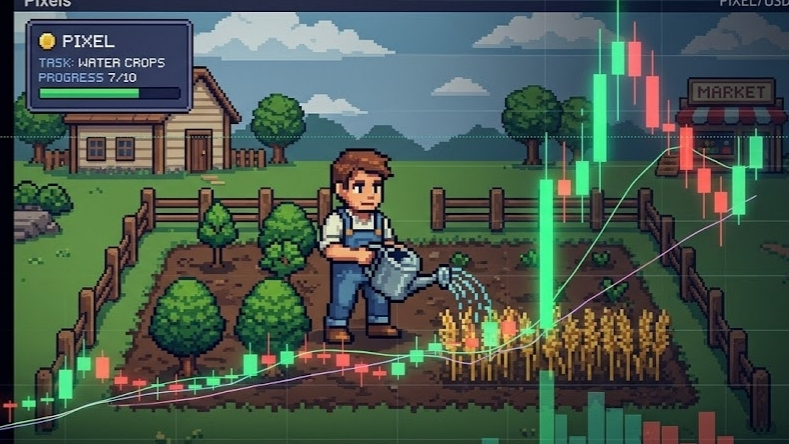
When I first looked at Pixels, it felt… predictable.
A farming game is a farming game. You plant seeds, you wait, you harvest. The rhythm is slow, steady, almost comforting. It behaves the same way everywhere—whether it’s an old offline game or something newer online. Effort goes in, rewards come out. That’s the quiet assumption sitting underneath it all.
And at first glance, Pixels doesn’t seem to challenge that.
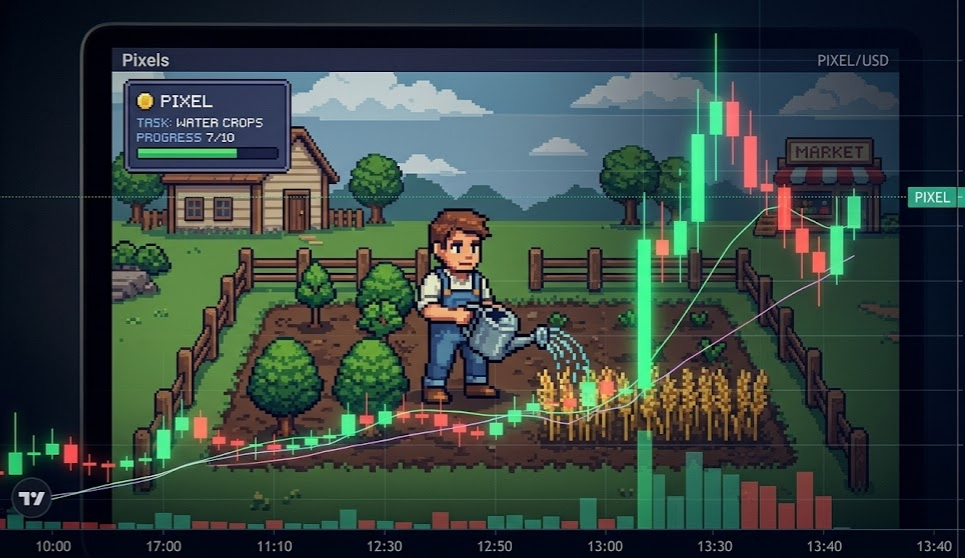
You log in, gather resources, maybe tend to crops, complete a few tasks. It’s structured in a way that feels familiar, almost intentionally so. Nothing about planting wheat or chopping wood suggests complexity. It feels like a closed loop. Stable. Repeatable.
But then a small question started forming.
What exactly is being grown here?
Because the more I sat with it, the more it felt like the farming itself wasn’t the core system. It was just the surface layer—the visible part of something else that behaves… differently depending on where you look.
The idea seems simple: do work, earn rewards.
In Pixels, that reward often comes in the form of the PIXEL token. You complete tasks, you receive tokens. It’s clean. Almost mechanical. Like a vending machine—you put in time, something comes out.
But the more I thought about it, the less stable that equation felt.
Because unlike a traditional game, the reward here doesn’t stay inside the system. It leaks outward. It has value beyond the game, shaped by markets, speculation, and behavior that has nothing to do with farming at all.
So the same action—watering crops—doesn’t always mean the same thing.
Sometimes it’s just gameplay. Other times, it’s labor. And occasionally, it becomes something closer to strategy, or even risk.
That shift is subtle, but it changes everything.
I had to pause for a moment when I first realized that the “farm” isn’t really the system. It’s more like an interface.
Underneath, Pixels is built on the Ronin Network, which means every action connects to a broader economic layer. The crops you grow, the items you craft—they aren’t just game assets. They can be owned, traded, priced.
And that introduces a tension that’s easy to overlook.
Because farming, as a concept, is supposed to be predictable. You plant, you wait, you harvest. But markets are not predictable. They respond to behavior, hype, scarcity, timing.
So now the question shifts slightly:
If the input stays the same, but the outcome depends on something external, is the system still stable?
This feels like a small detail at first, but it connects to something much larger in Web3.
There’s always this quiet balance between structure and outcome. The structure—code, rules, mechanics—tries to stay fixed.
But the outcomes they drift. They depend on users, incentives, even mood.
In Pixels, that tension shows up in how rewards are distributed.
The game uses a mix of activity-based earning and resource generation. You perform tasks, you get rewarded. But the value of those rewards isn’t controlled by the game itself. It’s shaped by how many players are participating, how tokens are circulating, how demand forms.
So the system is stable in design, but unstable in effect.
And maybe that’s the point—or maybe it’s the risk.
The more I looked into it, the more interesting it became.
Because Pixels isn’t just about farming mechanics. It’s quietly experimenting with incentive alignment. It’s asking: how do you design a system where players keep playing, not just because it’s fun, but because it feels economically meaningful?
That’s where land ownership comes in.
Players can own virtual land, which acts almost like a small economy within the game. Others can interact with it, generate activity, even contribute to its output. On the surface, it feels like customization. But underneath, it’s closer to a participation model—where ownership changes how rewards flow.
It reminded me, oddly, of renting space in the real world.
Except here, the “space” is digital, and the activity happening on it feeds back into a token system.
But I’m not entirely sure I’m interpreting that correctly.
Because the more layers you uncover, the harder it is to tell where the game ends and the economy begins.
And that brings up a broader challenge in crypto systems.
There’s always this effort to merge use with value. To make systems where participation naturally creates economic output. But that balance is fragile. Too much emphasis on rewards, and the system feels extractive.Too little, and engagement fades.
Pixels seems to sit somewhere in between.
It’s not purely a game, but it’s not purely financial either. It’s trying to maintain a steady rhythm while quietly integrating a variable economy underneath.
Whether that balance holds… remains to be seen.
There’s also the question of scale.
At one point, Pixels reached hundreds of thousands of daily users. On paper, that sounds impressive. But in practice, it introduces new variables. More players mean more activity, but also more competition for rewards, more pressure on the token system.
So the same farming action—planting, harvesting—becomes diluted over time.
Not because the mechanic changes, but because the environment around it does.
That’s the part that almost slipped past me at first.
The system doesn’t need to change internally for the experience to shift externally.
Maybe that’s the core idea here.
Farming, in Pixels, looks like a fixed process. But it behaves differently depending on context—market conditions, player density, token demand. The structure stays steady, but the meaning of each action keeps shifting.
And that raises a quiet, slightly uncomfortable question.
If the value of an action isn’t determined by the action itself, but by everything around it… what exactly are you interacting with?
Is it a game?
An economy?
Or something in between that hasn’t fully settled yet?
I keep coming back to that original assumption—that farming is simple, predictable, stable.
In Pixels, it still looks that way. The interface hasn’t changed. The crops grow the same. The loop repeats.
But underneath, the texture feels different. Less fixed. More responsive. Slightly uncertain.
And maybe that’s where things are heading more broadly in Web3.
Systems that appear steady on the surface, but behave dynamically underneath. Systems where participation means different things depending on timing, scale, and context.
I’m not sure if that makes them more engaging or more fragile.
Maybe both.
Because the next time I look at a simple action—planting a crop, completing a task—I’m not entirely convinced it means just one thing anymore.
