
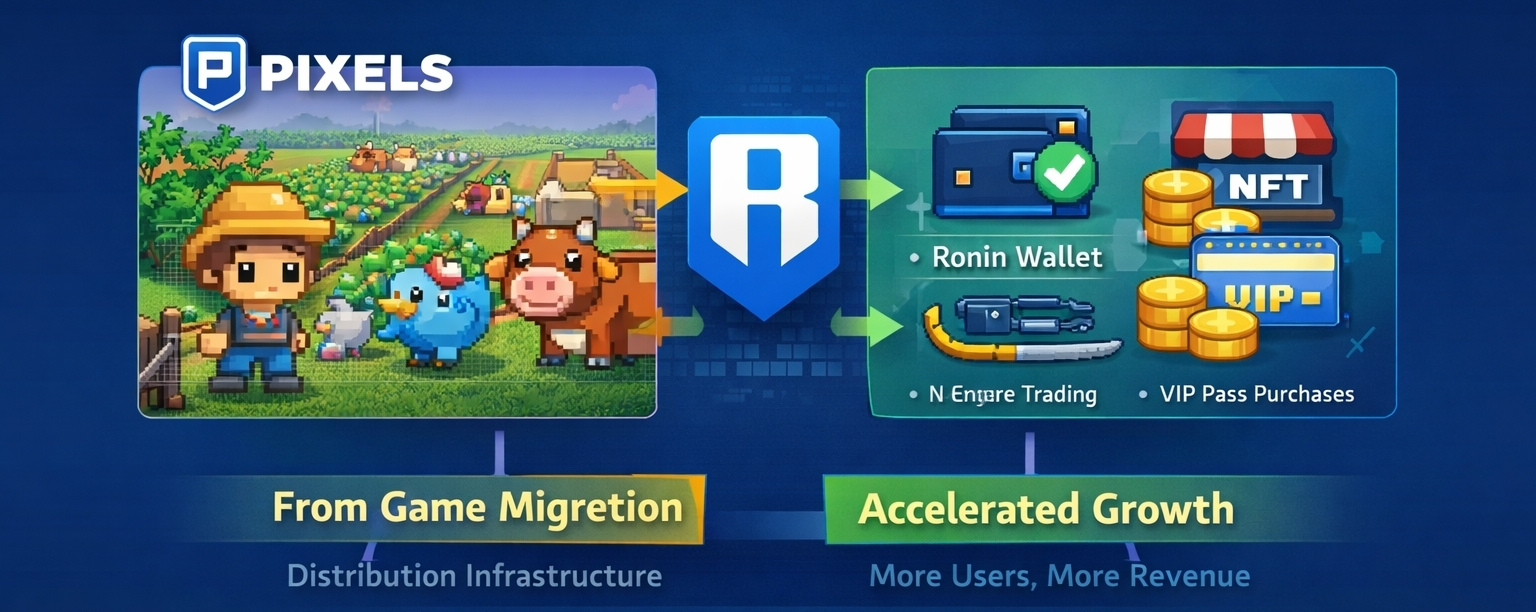
The more I look at Pixels, the less I think its Ronin move was a simple chain switch. To me, it looks more like a very sharp distribution decision.
That is the part people miss.
A lot of Web3 game articles still talk like growth comes from one big thing. A token launch. A farming loop. A viral moment. But Pixels feels different when I trace the actual path. When Ronin announced the migration in September 2023, Pixels was not some empty game hunting for relevance. It already had around 100,000 monthly active wallets, 5,000 daily active users, and 1.5 million monthly transactions. Then it moved into an ecosystem built for gaming, not into a blank chain hoping players would show up later.
That is why I think the real Pixels story is not “Ronin made Pixels exist.” It is that Ronin reduced how many growth problems Pixels had to solve by itself.
Once Pixels went live on Ronin, the flow became much tighter. Players could log in with Ronin Wallet, earn BERRY, and interact with assets through Ronin-native rails like Mavis Market. That sounds like product plumbing, but it matters more than that. In Web3 gaming, onboarding is not a side issue. It is distribution. If the wallet is familiar, if the market is already there, if the chain already has gamers, the game starts closer to conversion. 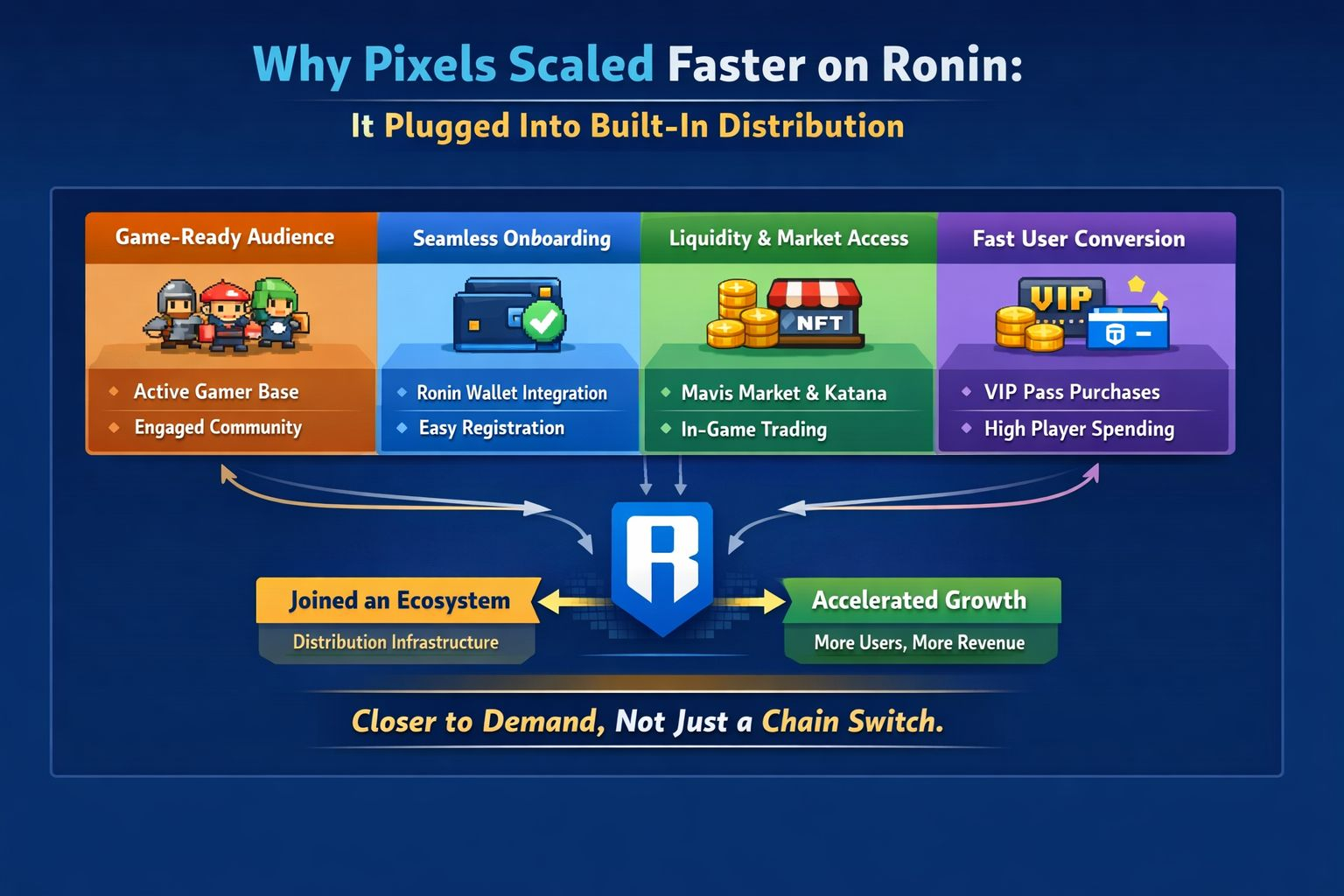
And Pixels clearly benefited from that setup. Ronin later said Pixels’ DAU surged past 100,000 after migrating, and that players spent about 190,000 RON on VIP passes in the first week. I think that detail matters a lot. It means Ronin was not just sending Pixels traffic. It was sending users who were ready to spend, not just click.
That is the hidden advantage I see in Pixels.
Most Web3 games still try to do five hard things at once. Build the game. Teach users the wallet. Create liquidity. Earn trust. Then somehow turn attention into an economy. Pixels still had to execute, obviously. Ronin did not magically build product-market fit for it. But Ronin gave it a much warmer starting point. Later, Ronin also opened the RON/PIXEL pool on Katana, making it easier for users already inside the ecosystem to swap into PIXEL without leaving Ronin’s own environment. That is what native distribution really looks like. Not noise. Flow.
What makes this even more relevant now is the market mood. Web3 gaming is no longer in that earlier phase where people clap for chain migration alone. The bar is harder now. Tokens need utility, economies need tighter design, and users do not stay just because a game is “on-chain.” Even Pixels itself has talked openly about sustainability, the need to phase out BERRY’s inflationary pressure, and the shift toward a cleaner in-game economy centered more carefully around PIXEL. That tells me the team understood a very real market truth: distribution gets attention, but economic design decides whether that attention holds.
At the time of writing, PIXEL is still actively traded, with Binance showing live market cap and 24-hour volume on its price page. So the project is still being watched by the market. But I do not think the deepest lesson is about price. I think it is about structure.
My honest read is this: Pixels scaled faster on Ronin because it moved closer to demand that was already organized.
Not just gamers. Not just wallets. Not just liquidity.
A whole environment that already knew how to carry a game forward.@Pixels #pixel $PIXEL
