
Last winter, I sat on my balcony in Sargodha watching my neighbor's kids chase each other with a single shared toy. They passed it so quickly that no one really played with it for more than a few seconds. The toy never felt owned; it just moved. That image stayed with me.
This morning on Binance Square, I opened the CreatorPad campaign for Pixels and started the task on Understanding Token Velocity and Its Impact on $PIXEL Valuation. I scrolled through the metrics breakdown, noting the velocity charts and circulation data points on the dashboard. Something clicked uncomfortably while staring at those numbers—the way the interface highlighted rapid transaction flows in the game economy. It disturbed a belief I've carried for years: that high activity and constant token movement always signal a healthy, thriving project.
The uncomfortable truth is that in many utility-driven ecosystems, especially gaming ones, elevated token velocity often reveals fragility rather than strength. We celebrate "usage" and "adoption metrics" as if rapid circulation equals demand, but it frequently masks the opposite—users treating the token as a fleeting tool rather than something worth holding. When tokens change hands too fast, the underlying value equation weakens because the same economic activity supports a smaller sustainable market cap. People spend or sell quickly to grab in-game items, upgrades, or quick exits, then move on. The token becomes like that shared toy: passed around constantly, yet never truly possessed by anyone for long.
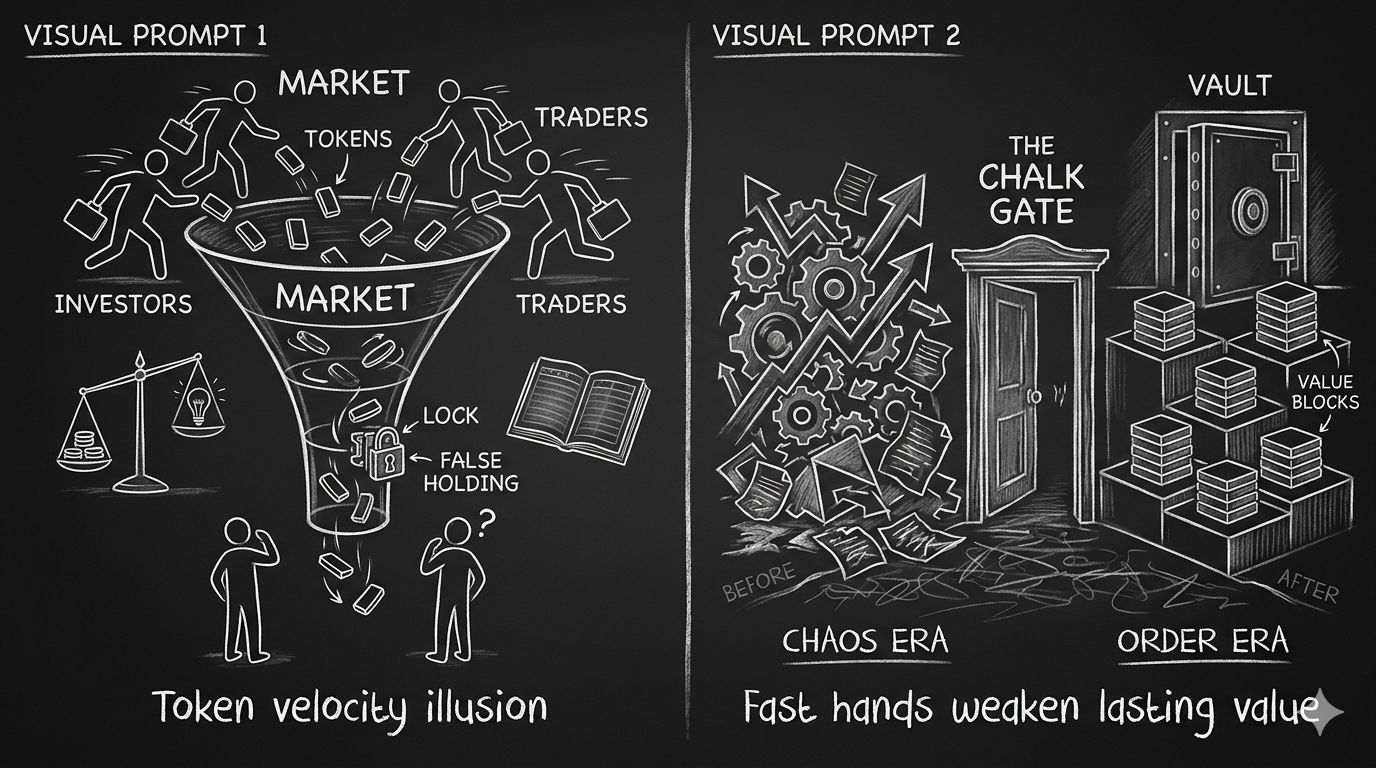
This challenges the common crypto assumption that more transactions and higher velocity prove real utility and future success. In practice, it can indicate the reverse—speculative churn or short-term extraction where holding feels riskier than cycling through. Low velocity, by contrast, might suggest genuine belief or sticky utility: users who see enough long-term reason to keep tokens in their wallets rather than immediately converting them for pixels on a screen or quick profits. The math is straightforward and unforgiving; velocity sits in the denominator of basic valuation models. Push it too high without mechanisms that encourage holding, and you dilute the token's capacity to capture lasting value from the activity it enables.
Pixels serves as a clear example here. As a social farming and exploration game on Ronin, it relies on PIXEL for in-game purchases, guild access, NFT-related actions, and various perks. The campaign task forced me to confront how the game's design inherently pushes circulation—players farm, earn, spend on virtual land or pets, then repeat. That moment on the velocity screen made the idea land: the very utility that drives engagement can accelerate turnover to a point where the token feels more like a temporary ticket than a stake in the world being built. It's not a flaw unique to this project; it's a pattern across many GameFi setups where the loop rewards activity over retention.
What this reveals beyond any single token is a deeper tension in crypto design. We keep building systems that prioritize speed and volume because they look impressive on dashboards and attract short-term participants. Yet the quiet, slower-moving projects—those where users pause and hold—often develop more resilient communities. They treat tokens as extensions of shared belief rather than disposable resources. The risk isn't low activity; it's activity that never translates into committed ownership. When velocity runs unchecked, it turns ecosystems into efficient pass-through machines rather than value-accumulating ones.
This leaves me with one unresolved but confident question: in a space obsessed with metrics that reward motion, how many projects are quietly undermined by the very circulation they celebrate? @Pixels #pixel $PIXEL