When I started looking deeper into Pixels, I decided to ignore the usual discussions around farming, NFTs, and gameplay loops. Those are already well understood. Instead, I focused on something more specific.
The economy.
Not just how players earn tokens, but how resources behave inside the system.
That is where I started thinking about player-driven scarcity.
In most games, scarcity is predefined. Developers decide how much of a resource exists. They control drop rates and define limits. Players simply interact with that system.
But this model has limitations.
Because it is static.
No matter how players behave, the system does not adapt deeply. It may adjust slightly, but the core structure remains fixed.
Pixels, in my view, has the potential to move beyond this.
Instead of fixed scarcity, it can support dynamic scarcity driven by player activity.
This changes everything.
I started thinking about what happens when resource availability depends on how players behave.
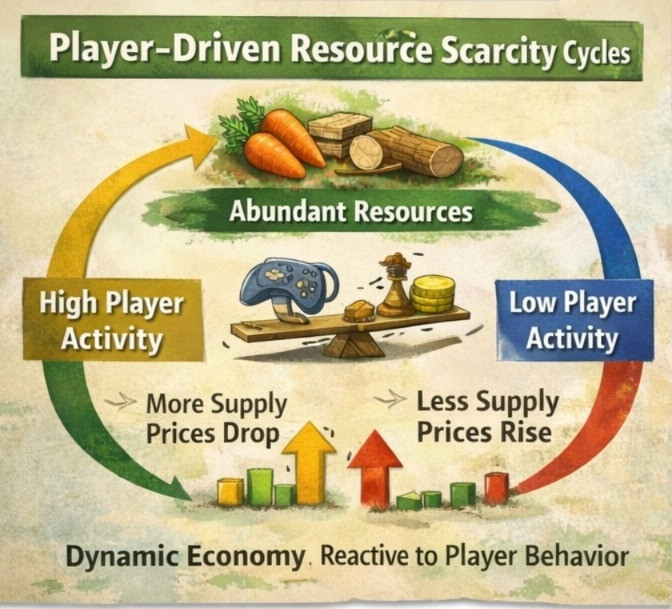
If more players farm a specific resource, supply increases. Prices drop. The resource becomes less valuable.
If fewer players focus on it, supply decreases. Prices rise. The resource becomes more valuable.
This seems simple, but the impact is deep.
Because now players are not just participants.
They are shaping the economy.
What I find interesting is how this creates feedback loops.
Players respond to scarcity.
Scarcity responds to players.
This creates a cycle.
Not controlled by developers alone, but influenced by the community.
I think this is where Web3 gaming becomes different from traditional gaming.
Ownership is one part.
But economic influence is another.
Another thing I have been thinking about is strategy.
In static systems, optimal strategies become obvious over time.
Players learn what works and repeat it.
The system becomes predictable.
But in a dynamic scarcity model, strategies must evolve.
What works today may not work tomorrow.
Players must adapt.
They must observe the economy and anticipate changes.
This creates a deeper layer of gameplay.
Not just actions, but decisions.
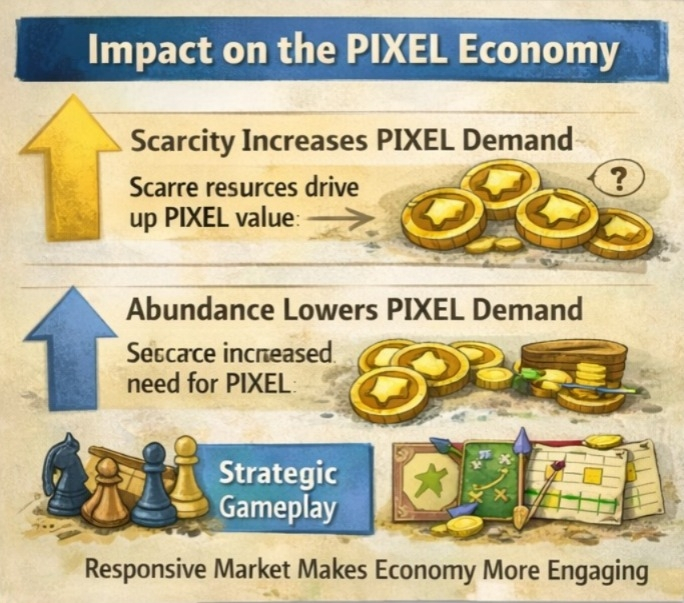
I also see this affecting token demand.
PIXEL is tied to in-game activity.
If resources become scarce, players may need more PIXEL to compete.
If resources are abundant, demand may decrease.
This creates natural fluctuations.
Not artificial ones.
I think this is healthier because it reflects real activity.
Another point I find important is balance.
Dynamic systems can become unstable.
If not designed carefully, they can create extreme outcomes.
One resource could become too rare.
Another could become too common.
This can break the economy.
So the system must include controls.
Not rigid ones, but stabilizing mechanisms.
Maybe soft limits.
Maybe adaptive adjustments.
But something must exist.
I also think about player behavior.
Not all players act the same.
Some optimize for profit.
Some play casually.
Some explore.
This diversity affects scarcity.
It creates unpredictability.
And that unpredictability makes the system more alive.
Another thing I notice is how this could encourage specialization.
If resources behave differently, players may focus on specific areas.
One player becomes efficient in farming one resource.
Another focuses on something else.
This creates interdependence.
Players rely on each other.
This strengthens the ecosystem.
I also see potential risks.
Players may try to manipulate scarcity.
Groups could coordinate and control supply.
This is possible.
So systems must detect abnormal patterns.
They must prevent exploitation.
This is not easy, but it is necessary.
From a broader perspective, I think this approach aligns with real economies.
In real markets, supply and demand interact constantly.
Prices change.
Behavior adapts.
Nothing stays fixed.
Pixels can reflect that in a meaningful way.
I also think about long-term sustainability.
Static economies often degrade.
Players find optimal paths and exploit them.
The system becomes repetitive.
Dynamic scarcity can delay that.
It keeps the system evolving.
It keeps players engaged.
Another angle I have been exploring is how this affects new players.
If scarcity is dynamic, entry conditions change.
Sometimes it may be easier to enter.
Sometimes harder.
This must be managed.
New players should not feel blocked.
So onboarding design is important.
I also think about data.
To support dynamic scarcity, the system must track activity.
It must analyze patterns.
It must respond correctly.
This requires strong infrastructure.
Without it, the system cannot adapt.
From my perspective, this is not widely discussed.
Most conversations focus on gameplay or earnings.
Very few focus on how the economy behaves internally.
But I think this is one of the most important layers.
Because the economy defines long-term value.
I also see this as a shift.
From developer-controlled systems to player-influenced systems.
Not fully decentralized, but more responsive and adaptive.
Another thing I find interesting is how this could evolve over time.
At early stages, systems may be simpler.
As player activity increases, complexity grows.
The economy becomes richer.
More interactions and more dependencies appear.
This creates depth.
I also think about how this connects with NFTs.
If resources are scarce, NFTs linked to them gain value.
If resources are abundant, value may drop.
This connects different parts of the ecosystem.
From a design perspective, I think this requires careful balance.
Too much control removes dynamism.
Too little control creates chaos.
The system must sit in between.
For me, this is one of the most interesting directions for Pixels.
Not because it is obvious.
But because it is subtle.
It changes how the game feels over time.
I am watching this closely.
Not just as a feature, but as a foundation.
Because if the economy works well, everything built on top of it becomes stronger.
That is how I see Pixels from this angle.
Not just as a game.
But as a system where players shape scarcity.
And scarcity shapes behavior.