
Most people think play-to-earn gaming is about earning money while playing games. But the reality is very different.
Over time, many so-called play-to-earn games stop feeling like real games. They slowly turn into systems where players are not truly playing—they are just trying to extract value as efficiently as possible. And this is where the real problem begins.
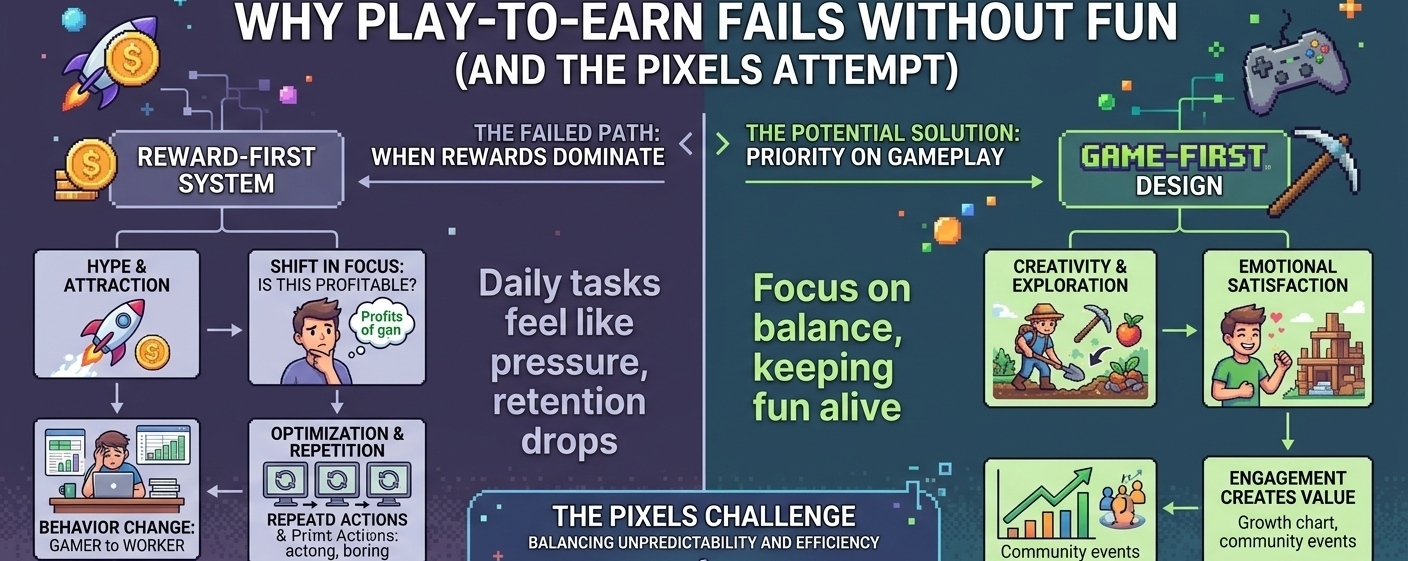
At first, everything looks exciting. Rewards feel attractive, numbers go up, and players join in large numbers. But after some time, behavior starts to change. People stop asking “Is this fun?” and instead start asking “Is this still profitable?”
The moment this shift happens, the game already starts losing its purpose. Because gaming was never meant to be a financial job. It was meant to be an experience.
The biggest issue in most play-to-earn systems is not technology. It is psychology. When money becomes the main motivation, players stop behaving like gamers and start behaving like workers. Daily tasks start feeling like pressure, repeated actions become routine, every move turns into a calculation, and slowly the fun disappears.
At this stage, even a well-designed game starts feeling boring, because the mind is no longer playing for enjoyment—it is playing for output. And once that happens, retention starts dropping. Because when rewards slow down or market conditions change, players leave quickly. Not because the game was bad, but because the “fun layer” was never strong enough to survive without money.
Most projects make the same mistake. They believe rewards create engagement. But in reality, it works the opposite way. Engagement creates value, and rewards only support it. If a game is not fun on its own, no reward system can save it long term.
This is why so many play-to-earn games follow the same cycle: launch, hype, farming, selling pressure, and then collapse. It is not only an economic problem—it is a design problem.
When I looked into Pixels, one thing stood out. They are at least aware of this core issue. Instead of starting with “earn first,” they are trying to focus on game first. That sounds simple, but in crypto gaming it is actually rare.
Their idea is simple: if the game is not fun, nothing else matters. This approach tries to fix the foundation instead of only adjusting the economy. But there is still a challenge. Because once real money enters the system, fun becomes fragile. Even a small imbalance in rewards can completely change player behavior.
Here is something many people don’t openly say. The moment you attach money to gameplay, pure fun becomes difficult to protect. Every action now has two meanings—gameplay and earning potential. And when both mix, players naturally start optimizing.
This is not wrong, it is human nature. But it changes everything. Now the question is no longer “Is this game fun?” It becomes “How do we keep it fun while players are optimizing it?”
And this is one of the hardest problems in crypto gaming.
When optimization takes over, gaming starts losing creativity. Players stop exploring, they stop experimenting, and they simply follow the most efficient path. Once a game becomes predictable, it becomes boring. That is why many play-to-earn games slowly start feeling like jobs instead of entertainment.
Even if players are earning money, emotional satisfaction disappears. And without emotional satisfaction, long-term retention becomes almost impossible.
If Pixels wants to succeed where many others failed, it must solve one key problem: how to keep fun alive while the economy is always active. Because the economy will always push players toward efficiency, optimization, and extraction. But fun needs creativity, exploration, and unpredictability. These two forces often clash with each other, and balancing them is extremely difficult.
Play-to-earn is not a bad idea. The problem is execution. If a game focuses only on rewards, it becomes unsustainable. If it focuses only on fun, it misses economic potential. The real future belongs to systems that can balance both—but that balance is very hard to maintain.
Pixels is trying to move in that direction. But whether it succeeds or fails is still unknown. Because in crypto gaming, the hardest thing is not building a game—it is building a system where fun survives money.
