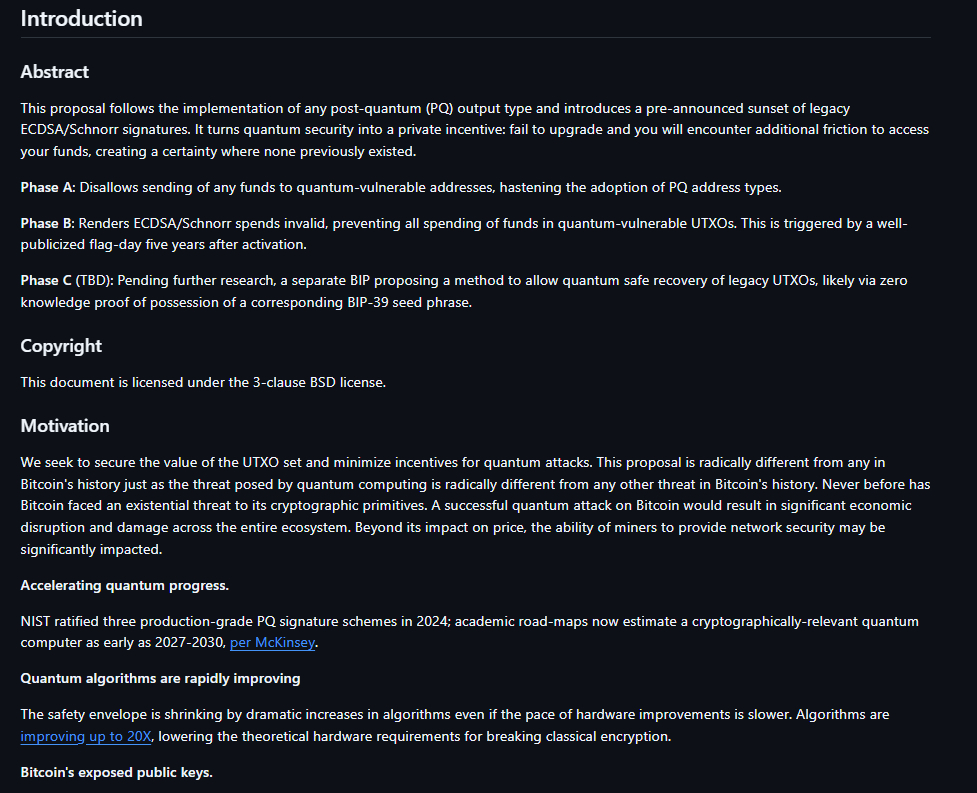
Bitcoin developers just formalized a proposal to freeze over $450 billion worth of Bitcoin.
> Quantum computers are coming. Old wallets with exposed public keys will eventually be crackable.
> They want to freeze them before someone else cracks them.
> The proposal is BIP-361. Co-authored by Jameson Lopp. It just hit Bitcoin's official repo this week.
> The mechanism is a soft fork. Three years after activation, you can no longer send Bitcoin to old wallet types.
> Two years after that, those coins become permanently unspendable.
> Around 6.5 MILLION $BTC affected. Roughly 25% of all supply.
> Lopp himself acknowledges what this is. He rejects the word "confiscation" and prefers "burning."
> Here is the part nobody is talking about.
> The chain cannot tell the difference between Satoshi's dormant coins and a longterm holder waiting for $500,000 to sell.
> They look identical on chain. The early miner who set up a wallet in 2011 and forgot about it.
> The OG who bought at $200 and never moved them.
> The cold storage wallet sitting in a safe. All burned together.
> But the deeper question is how this is even possible.
> Five people have merge authority on Bitcoin Core. One person merges roughly 65% of all code.
> Six mining pools control 96 to 99% of all blocks. Activation requires their signaling.
> A coordinated decision by maybe two dozen people can change the rules and burn 25% of the supply.
> Bitcoin has done this before. In 2010, a bug created 184 BILLION $BTC out of thin air.
> Satoshi himself coordinated a fork to erase it. The chain rolled back 50 blocks.
> Ethereum did it in 2016. The DAO got hacked for $60 MILLION.
> Developers rewrote history to take the money back from a wallet whose owner had not signed off.
> The principled chain that refused to fork is now called Ethereum Classic and it is a fraction of the size.
> The lesson is the same in both cases. When the cost of the principle is high enough, the principle bends.
> Bitcoin was supposed to be the one thing nobody could touch.
> What Bitcoin actually is and what this proposal is forcing into the open, is a network that can be changed when enough of the right people agree.
> Most of the time they don't but the option has always been there.
> Decentralized at the participation layer. Coordinated at the change layer.
> The freeze might never happen. Activation requires consensus that does not exist yet.
> Tether's CEO Paolo Ardoino has already pushed back. "Code is law" he says. Don't touch the rules.
> The plan is already written down. The way to do it is already worked out. The list of people who would need to say yes already exists.
> The only question left is whether someone, someday, decides the reason is good enough.
The freeze might never happen. The fact that it could is the part that matters.