
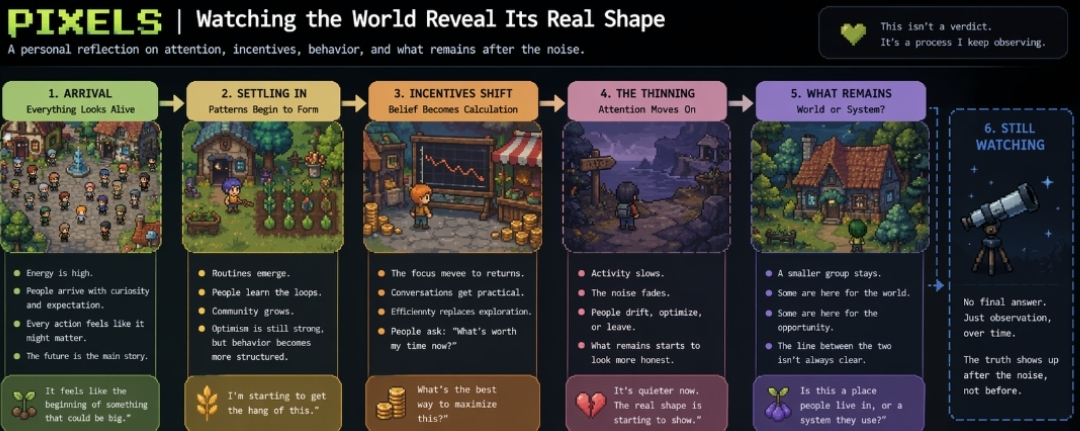
I keep circling back to Pixels, though it never quite asks me to.
There’s something about the way it sits there—open, simple, almost patient—that makes me want to linger longer than I expect. I’m not pulled in by anything loud. It’s quieter than that. More like I’m standing at the edge of something that looks like a world, waiting to see if it behaves like one.
At first, it’s easy to get absorbed in the surface. The farming loops, the movement, the small sense of ownership over space—it all settles into a rhythm quickly. Not exciting in a sharp way, but steady. Predictable. That kind of predictability can feel comforting, especially in a space where everything else tends to spike and crash without warning. Here, things grow slowly. You return, you tend, you repeat. It almost feels like it wants to be trusted.
But I’ve learned to hesitate at that feeling.
Because I’ve seen how these rhythms shift once enough people pass through them. Early on, nobody questions much. There’s a kind of collective agreement to treat everything as meaningful. Every action feels like it might matter later. Every hour spent feels like it might turn into something more than it is. People talk in a forward-looking way, like they’re inside the beginning of something important. And maybe they are. Or maybe they’re just inside the part that always feels important.
I notice when that language starts to thin out.
It doesn’t happen all at once. It never does. It fades in pieces. Conversations get shorter. Less speculative. More grounded in what’s actually happening instead of what might happen. You start to see people adjust their behavior without saying it out loud. They become more precise. More selective. The same actions that once felt exploratory start to feel measured. You can almost sense the moment belief turns into calculation, even if nobody admits it directly.
Pixels doesn’t resist that shift. It absorbs it.
That’s what I keep watching. Not the mechanics themselves, but how people settle into them over time. Whether they keep engaging in a way that feels like presence, or if it slowly turns into something closer to routine maintenance. There’s a difference, even if it’s subtle. Presence has a kind of softness to it. Routine feels tighter, more deliberate, less forgiving.
And in Web3 spaces, routine usually comes with a reason.
I don’t think most people come here just to farm or explore, not in the pure sense those words suggest. There’s always something layered underneath. A quiet expectation. A question that sits in the background of every action: what does this become? Not just the game, but their time inside it. Their effort. Their consistency. It’s hard to ignore that layer, even when the environment tries to feel simple.
That’s where Pixels starts to blur for me.
Because it presents itself like a place you can exist in without pressure. A space that doesn’t demand urgency. But the people inside it still carry that urgency with them, even if they soften it. You can feel it in how they move, how they choose what to do, how long they stay. The world says one thing. The behavior says another. And somewhere in between, the truth sits quietly, not fully revealed.
I’ve seen this pattern repeat enough times to recognize its shape, even when the details change. A project begins as an idea people can project onto. Then it becomes a system people learn to navigate. And somewhere along the way, it either deepens into something that holds attention naturally—or it starts depending on reasons that feel more external than internal.
Pixels hasn’t made that clear yet. At least not to me.
There are still people moving through it like it’s a place, not just a loop. That matters. But it’s hard to tell how much of that is real attachment and how much is just early-stage persistence—the kind that fades once the environment stops rewarding it in obvious ways. I don’t think you can separate those two things right away. Time has to do that.
And time in Web3 is strange. It moves quickly, but reveals things slowly.
What interests me isn’t whether Pixels succeeds in the way people usually measure success. It’s whether it holds its shape once attention shifts elsewhere. Because attention always shifts. It doesn’t disappear—it just relocates. And when it does, whatever remains starts to look more honest.
That’s the version I’m waiting to see.
Not the one full of activity and expectation, but the one that exists after that fades. The one where fewer people are watching, fewer people are talking, and the ones who remain aren’t there for the same reasons they started with. That’s when a “world” either feels real or starts to feel like something else entirely.
Right now, Pixels sits somewhere in between those states.
I can’t fully read it yet. I don’t think anyone can, even if they sound confident. It still carries that early softness, that openness that lets people believe in it in different ways at the same time. But underneath that, there’s a structure forming, shaped quietly by how people actually behave when nobody is asking them to believe—only to continue.
I keep noticing the small things. Who logs in without urgency. Who drifts. Who optimizes. Who disappears without saying anything. Those patterns tell more than any roadmap ever could.
And I’m still here, watching it unfold in pieces, not trying to define it too quickly, just letting it show what it becomes when the reasons for being here get a little harder to explain…