
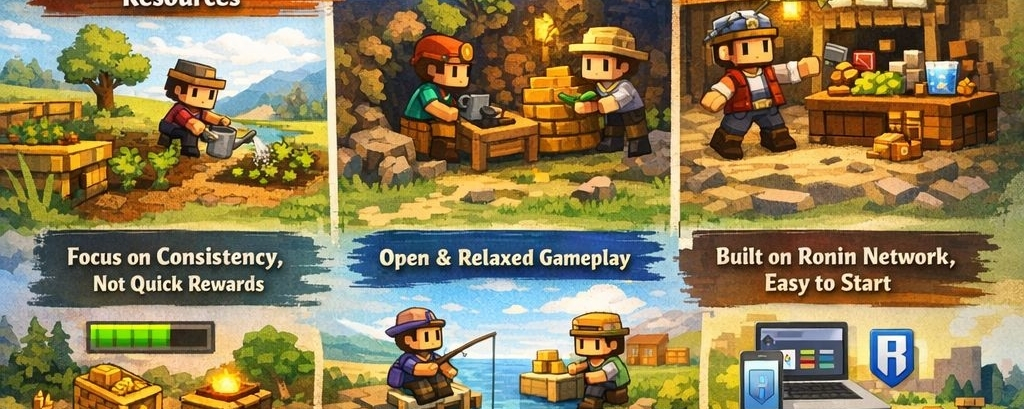
Pixels is a simple open world Web3 game where you farm,,, explore,,, and build step by step. My first reaction to it was simple and good.
At first, the game feels very simple. You spawn, start farming, collect resources, move around the map, and complete small tasks. If you have played other Web3 games before, your first thought might be the same as mine: this looks like another basic farming game with blockchain features added.
But after spending more time in it, that first impression slowly changes.
It does not change suddenly. It changes in a quiet way. You start to notice that there is actually a deeper system behind the simple gameplay.
At first, I was just repeating actions like harvesting, upgrading, and moving around. But later, I realized something important: progress in this game does not come from short bursts of effort. It comes from consistency over time. The game tracks your activity and rewards long-term effort....
Because of that, my thinking also changed. Instead of asking, “What gives me the fastest reward?”
I started asking, “What should I improve so I do better in the future?” This is a very different way of playing compared to most Web3 games, where players usually focus on quick rewards.
In Pixels, the gameplay is slower, but it feels more stable and meaningful.
It is not about doing one big action. It is about doing many small actions that build up over time.
This changes how you play each session. It starts to feel less like grinding and more like slowly building something.
The game is built on the Ronin Network, which also improves the experience. Starting the game is very easy compared to many other blockchain games. There are fewer complicated steps, and you can start playing quickly. It feels like a normal game first, not a crypto system.
This is very important in Web3 gaming because many players leave before they even start due to complicated setup. Here, you enter the game easily, and the blockchain part stays in the background.
Another good thing is that the game feels open. There is no single forced path. You can focus on farming, exploring, trading, or simply progressing at your own pace. The game does not force you into one “best” strategy.
This freedom is important because it allows players to enjoy the game in their own way.
As I played more, I noticed how different systems are connected. Resource timing becomes important. Upgrades start to stack over time. Trading becomes more useful when you understand scarcity. Exploration is not just for fun—it also helps you find opportunities.
Individually, these systems are simple. But together, they create a deeper experience that rewards long-term thinking instead of short-term gains.
Because of this, your mindset slowly changes. You stop playing just to get quick rewards. Instead, you start playing to improve your long-term position in the game.
This type of design is not very common in Web3 games. Most games focus on fast rewards and hype cycles. Pixels feels different because it does not force urgency. It allows progress to build naturally.
Even the economy supports this idea. It encourages steady progress instead of quick profit. You feel like you are slowly improving over time instead of chasing short spikes.
Another positive point is that the game does not overload you with crypto language. It does not constantly remind you that it is a blockchain game. Ownership is there, but it does not disturb the gameplay.
This balance is difficult to achieve. Too much focus on Web3 can ruin the fun. Too little can make the blockchain part feel useless. Pixels manages to stay in between.
Of course, the game is not perfect.
Sometimes it can feel repetitive. Some systems are not very clear for new players. And if your mindset is not aligned with slow progress, the game may start to feel like a grind.
But it does not feel like a game that is trying to hide its problems. It feels more like a game that is still growing and improving over time.
That is an important difference.
Instead of trying to impress players instantly, it feels like a world that wants players to stay and understand it over time.
That is the main reason my opinion changed after a few days.
It is not trying to win you in the first session. It is trying to see if you stay longer.
In a space where many Web3 games fail quickly due to short attention spans, this approach feels different.
Right now, I would call it promising but still developing. It is not revolutionary yet, but the direction is interesting. If it continues to focus on simple gameplay, long-term progress, and easy access through the Ronin Network, it could become something strong in the Web3 gaming space.
I am still observing it.
But unlike most blockchain games I have tried, I did not feel like quitting after the first day. And that alone makes it stand out for me.