
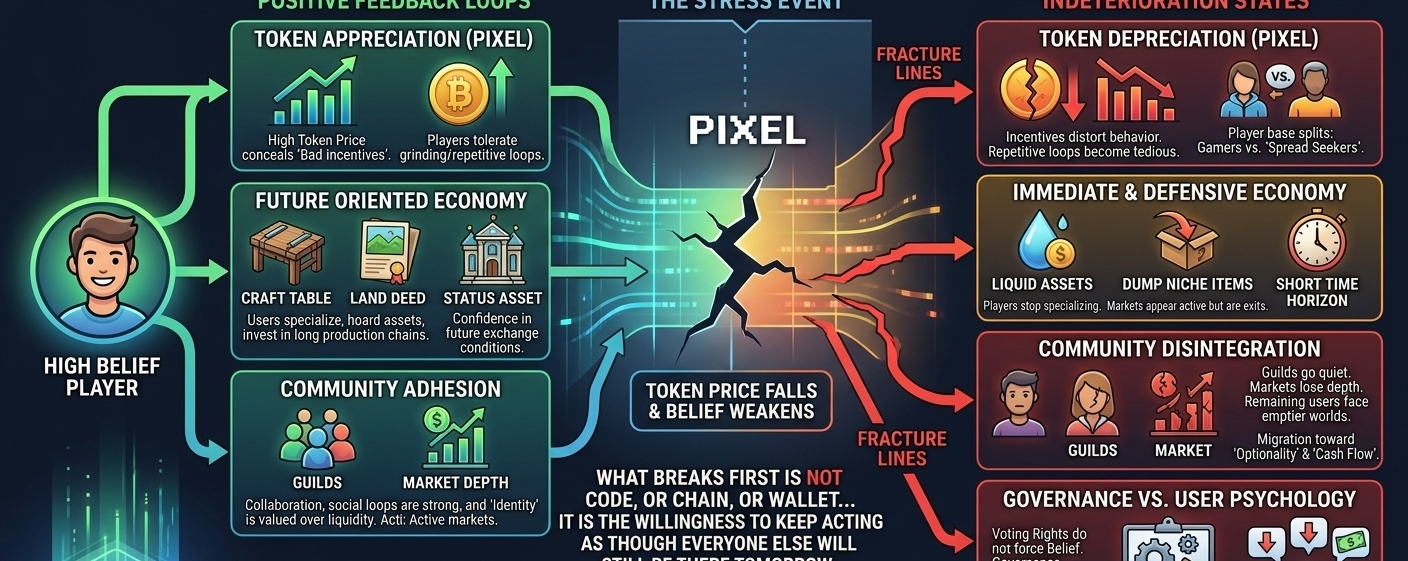
I have watched enough tokenized systems to know that stress does not arrive as a dramatic event. It usually arrives as indifference. Volume thins out, users become selective, and rewards that once looked generous start to feel like compensation for inconvenience. In a system like PIXEL, where the token functions as coordination infrastructure inside a game economy, the real test is not whether activity grows during optimism. It is whether participation survives when extraction becomes harder than enthusiasm. That is where I start when I study any protocol tied to social behavior: what breaks first when people no longer assume tomorrow will be better than today.
The first pressure point is the conversion of players into labor. Many tokenized game systems depend on an elegant fiction: that entertainment and income can coexist without distorting each other. In calm markets, that fiction holds because rising prices conceal bad incentives. Users tolerate repetitive loops, resource grinding, and transactional friction because token appreciation subsidizes boredom. But once price falls sharply from prior highs and the token becomes less valuable, behavior changes fast. The player base splits into those who still want the game and those who only wanted the spread between effort and payout. PIXEL has traded far below earlier peaks, which matters less as a chart fact than as a behavioral signal: expectations reset downward.
When that happens, every in-game action gets repriced mentally. Time spent farming resources is no longer framed as progress; it is compared against wages, against other games, against simply doing nothing. Systems built around participation incentives often underestimate how ruthless that comparison becomes. If rewards decline, users do not slowly reduce engagement. They often disappear in clusters. Guilds go quiet, markets lose depth, social loops weaken, and remaining users experience emptier worlds. The protocol may still be technically online, but coordination has already degraded. What looked like community was partially yield sensitivity wearing a social mask.
I think this is where many observers confuse retention with subsidy. A large active base during incentive campaigns can resemble product-market fit, but under stress it may reveal itself as temporary mercenary flow. In that environment, token emissions intended to sustain activity become a tax on conviction holders. More rewards may keep numbers stable for a while, yet they also create future sell pressure. Fewer rewards may protect supply dynamics, yet they risk accelerating user exit. That is the structural trade-off: defend engagement or defend scarcity, rarely both at the same time.
The second pressure point is pricing trust inside a closed economy. Any protocol coordinating behavior through a token needs users to believe that effort today maps to purchasing power tomorrow. Not guaranteed value, just enough continuity that planning feels rational. In game-linked economies, this is harder than in pure financial systems because users are pricing two layers simultaneously: the token market outside and item usefulness inside. If either layer destabilizes, the other inherits the damage.
Consider what happens when participants suspect that rewards earned now will be worth materially less later. They stop specializing. They hoard liquid assets, dump niche items, shorten time horizons, and avoid long production chains. The economy becomes immediate and defensive. Crafting, upgrading, investing in land, or building status assets all require confidence in future exchange conditions. Without that confidence, rational actors migrate toward speed and optionality. Markets then appear active, but the activity is mostly exits routed through whatever liquidity remains.
This is where latency matters more than most teams admit. If token price adjusts in seconds while in-game earning rates, sinks, and balancing mechanisms adjust slowly, users arbitrage governance delay. They know the market clears faster than policy. So instead of behaving like citizens of an economy, they behave like traders front-running administrators. That gap between market speed and governance speed can hollow out trust even when no malicious actor exists. Incentives do the damage cleanly enough on their own.
I also think token holders often misread what governance means in these systems. Voting rights do not create authority over user psychology. You can approve emissions changes, modify sinks, redesign loops, even reweight rewards. None of that forces belief. Once enough participants view the token primarily as something to sell rather than something to coordinate around, formal governance becomes reactive theater. It can still change parameters, but parameters are not sentiment.
An uncomfortable question follows: if rewards disappeared for six months, how much of the network would remain because the experience itself is worth returning to? Many projects avoid asking this because the answer can destabilize the narrative more than any market drawdown. Yet without that answer, it is hard to know whether the token is coordinating genuine demand or simply renting attention quarter by quarter.
I do not say this to dismiss PIXEL specifically. I say it because systems that merge play, markets, and ownership face a harsher version of the same law. When belief weakens, people simplify their motives. They choose liquidity over identity, cash flow over loyalty, optionality over immersion. What breaks first is rarely the chain, the wallet, or the code. It is the willingness to keep acting as though everyone else will still be there tomorrow.