
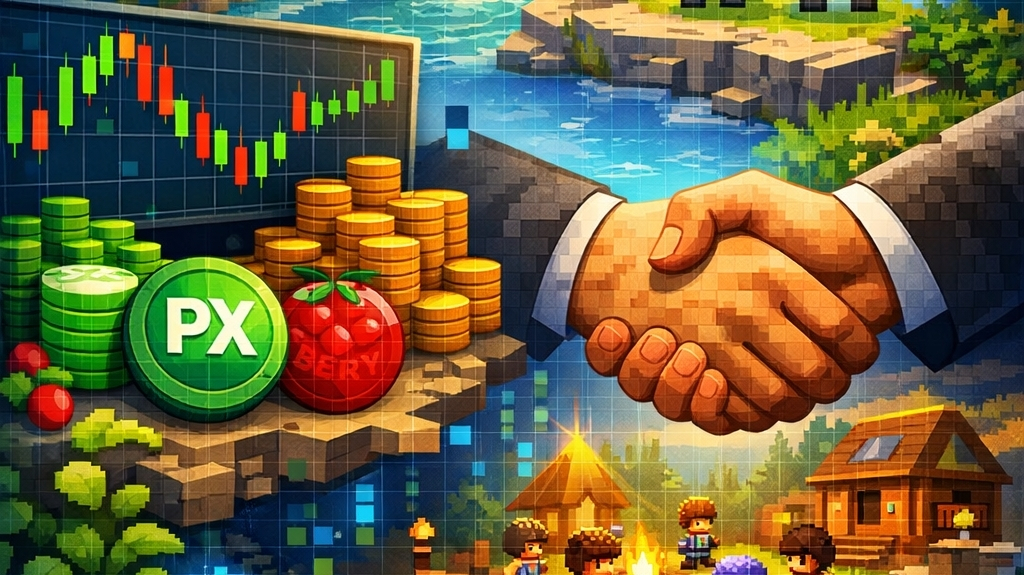
Pixels isn’t trying to be complicated and that’s exactly why it works. At first glance, it looks like a simple pixel-style farming game. You plant crops, explore land, gather resources. But once you spend time inside the world, you realize something deeper is happening.
This isn’t just a game. It’s an economy. It’s a community. And it’s one of the clearest examples of where Web3 gaming is actually heading.
A Game That People Actually Play
Most blockchain games struggle with one thing: real users. Pixels solved that.
After moving to the Ronin Network, the game exploded in popularity, crossing over 1 million players and consistently hitting strong daily activity. That’s not bots that’s real people logging in, farming, trading, and interacting.
And that’s important.
Because in Web3, attention is everything. If players aren’t staying, the token won’t either. Pixels managed to keep both alive.
Simple Gameplay, Deep System
The beauty of Pixels is how easy it is to start.
You don’t need to understand crypto to play. You just jump in, start farming, explore new areas, and slowly build your land. But behind that simple loop, there’s a full economic system running:
Resources have value
Time has value
Strategy has value
And most importantly your progress actually belongs to you.
That’s where the Web3 layer quietly does its job.
The PIXEL Token: More Than Just a Price
Let’s talk about the token, because that’s where most people focus but also where most people misunderstand.
PIXEL isn’t just there for speculation. It’s tied directly into the game:
You use it for premium upgrades
You unlock features and content
You interact with the broader ecosystem
You participate in governance decisions
Alongside PIXEL, there’s also an in-game currency ($BERRY), which helps keep the economy balanced. This dual-token system is a smart move it reduces pressure on PIXEL while keeping gameplay smooth.
Recent Market Snapshot
Right now, PIXEL is trading far below its all-time highs. Like many GameFi tokens, it saw a massive surge early on, followed by a steep correction.
But here’s the interesting part:
even after the price drop, activity didn’t disappear.
That tells you something important people are still playing, not just trading.
Recent Updates: Building, Not Hyping
While the price cooled off, the team didn’t.
Instead of chasing hype, Pixels has been quietly improving the core experience:
Expanding token utility inside the game
Improving reward systems for active players
Introducing guilds to make the game more social
Strengthening the in-game economy
The guild system, in particular, is a big step. It shifts Pixels from a solo experience into something more collaborative where players can earn and grow together.
And that’s where retention really starts to build.
The Reality Check
Let’s be honest PIXEL hasn’t had a smooth ride.
The token dropped significantly from its peak, and like many Web3 projects, it faced the pressure of market cycles, token unlocks, and changing sentiment.
But this isn’t unusual.
Early-stage Web3 projects are volatile by nature. What matters is whether the foundation is still being built while the noise fades.
In Pixels’ case, it is.
Why Pixels Still Matters
Pixels stands out because it gets one thing right that many others miss:
It focuses on players first, token second.
That might sound simple, but in Web3, it’s rare.
It has real users
It has a working economy
It continues to evolve
It’s expanding beyond just one game
It’s slowly turning into something bigger a platform, not just a product.
Final Thoughts
Pixels isn’t perfect. It’s early. It’s still finding its balance.
But it’s real.
And in a space full of empty hype, that matters more than anything.
The charts will go up and down. The sentiment will shift. New projects will come and go.
But the projects that survive are the ones people actually use.
Right now, Pixels is one of t
