
I did not go looking for a game that day.
It was one of those quiet sessions where the charts were open, nothing exciting was happening, and I was scrolling more out of habit than interest. The kind of moment where you are not really chasing opportunities anymore, just passing time between candles.
Somewhere in that low-energy drift, I opened Pixels.
I did not expect much. To be honest, I assumed I would close it within a minute.
At first, it seemed almost too simple.
Plant something. Walk a little. Step away. Return later. No pressure. No urgency. No loud message telling me to optimize, grind, or earn more. In crypto, that kind of experience is unusual. Most things demand attention immediately. They try to pull you in with constant signals, rewards, and reminders.
Pixels does the opposite.
It lets you settle in.
And strangely enough, that is what kept me there longer than I planned.
At some point, I stopped thinking about tokens altogether. I was no longer checking value or trying to calculate anything. I was just moving through the experience. Not intensely, not with a strategy, but in a way that felt natural — almost like it had slipped into the background of my mind.
That is rare.
In most Web3 projects, you can feel the system too quickly. You know there is something to maximize, something to extract, something to watch. Pixels does not introduce itself that way. It does not announce the economy first. It hides the machinery just enough that you arrive before you realize what is happening.
Then, gradually, everything starts to reveal itself.
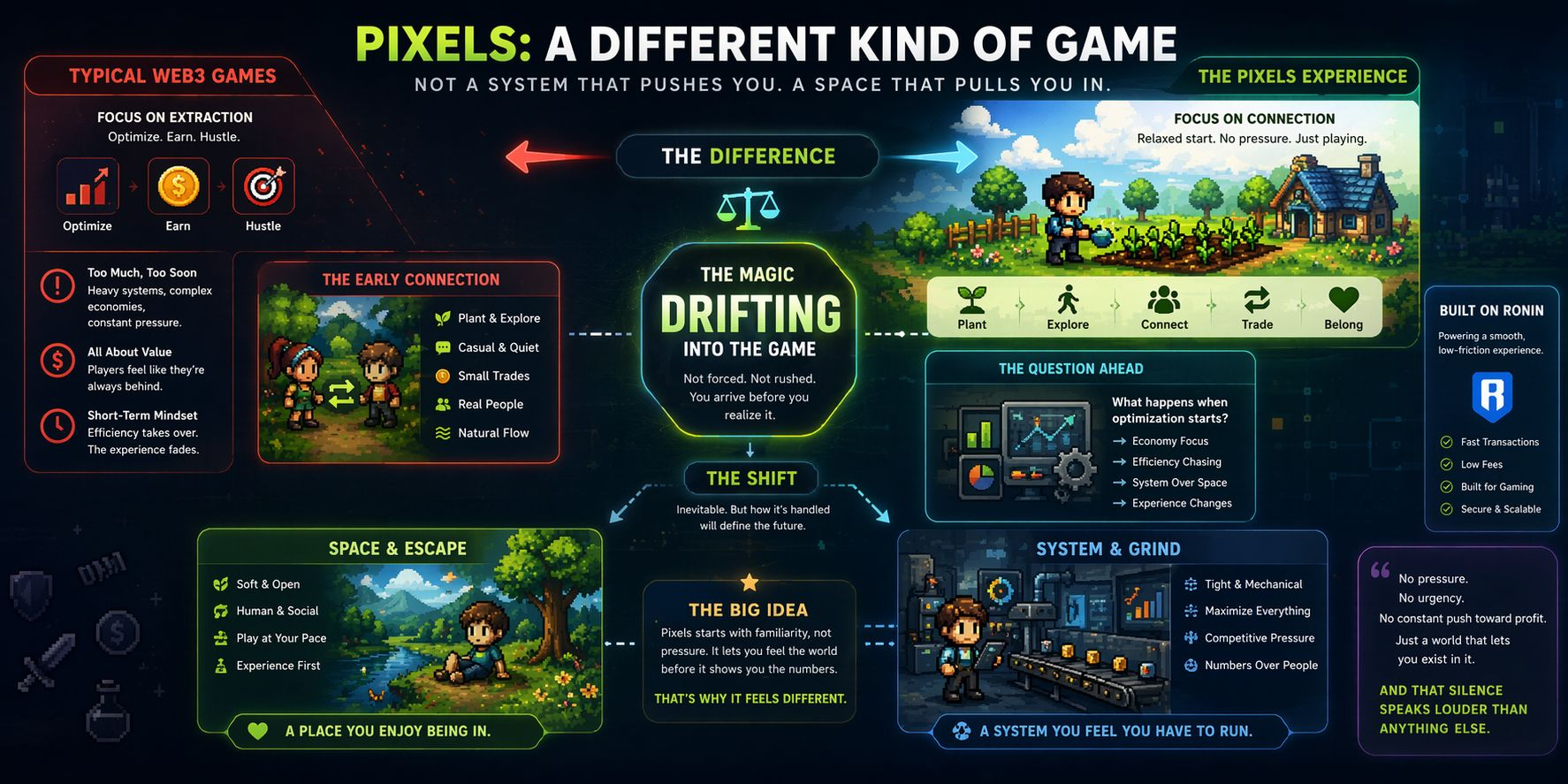
You notice other players. Small trades. Tiny exchanges. Quiet activity that suggests something deeper without forcing it in your face. Nothing dramatic. Nothing aggressive. Just enough to make you curious.
That was the moment I paused.
It felt less like the game was trying to drag me into an economy, and more like it was allowing me to drift into one.
That is a very different feeling.
Most projects begin with value and hope people stay for the experience. Pixels seems to do the reverse. It begins with comfort, with familiarity, with ease. By the time you notice the economy, you are already part of it without having to think too hard about it.
That part stayed with me.
The technical side matters too. It runs on Ronin Network, but the chain does not dominate the experience. There is no constant friction, no repeated reminder that blockchain is sitting underneath everything. It just works smoothly in the background.
And honestly, that made me think.
For a long time, Web3 has been obsessed with exposing the tech. Wallets, confirmations, transactions, bridges — everything visible, everything announced, almost as if the project needs to prove it is decentralized at every step. Pixels feels different. It does not spotlight the infrastructure. It lets the experience come first.
That sounds like the better approach.
But I am still not fully sure.
Because there is always that turning point. The moment when people stop casually participating and start optimizing every move. The moment a game stops feeling like a place and starts feeling like a spreadsheet.
That changes everything.
Right now, Pixels feels calm because nothing is forcing you to act. But the structure is still there. The token exists. The economy exists. It is simply not shouting at you yet.
So the question that kept coming back to me was this:
What happens when people stop seeing it as a place and start seeing it only as a system?
That is where most Web3 games begin to lose their spark. They feel alive at first, but once efficiency takes over, the whole experience becomes more rigid, more mechanical, less human.
Pixels does not feel like that right now.
It feels like a space.
Not a system.
And maybe that is exactly why it stands out.
You do not enter with a plan. You do not feel behind. You just move around, do small things, and somehow that becomes enough. It creates a quiet sense of connection instead of forcing engagement.
But in crypto, softness rarely lasts forever. Attention eventually shifts toward value, and value always pulls people toward optimization.
So I am left with two thoughts.
One part of me thinks this is the smarter route. Let people relax first. Let them feel something before you show them the numbers. That could solve a lot of the retention problems Web3 keeps repeating.
But another part of me wonders whether this calm exists only because it is still early.
Because once people start chasing efficiency, the feeling could change completely.
Still, I cannot ignore what that first hour felt like.
No pressure. No urgency. No constant push toward profit.
Just a loop that did not demand anything from me.
And in a space where everything is usually fighting for your attention as quickly as possible, that silence felt louder than anything else.