
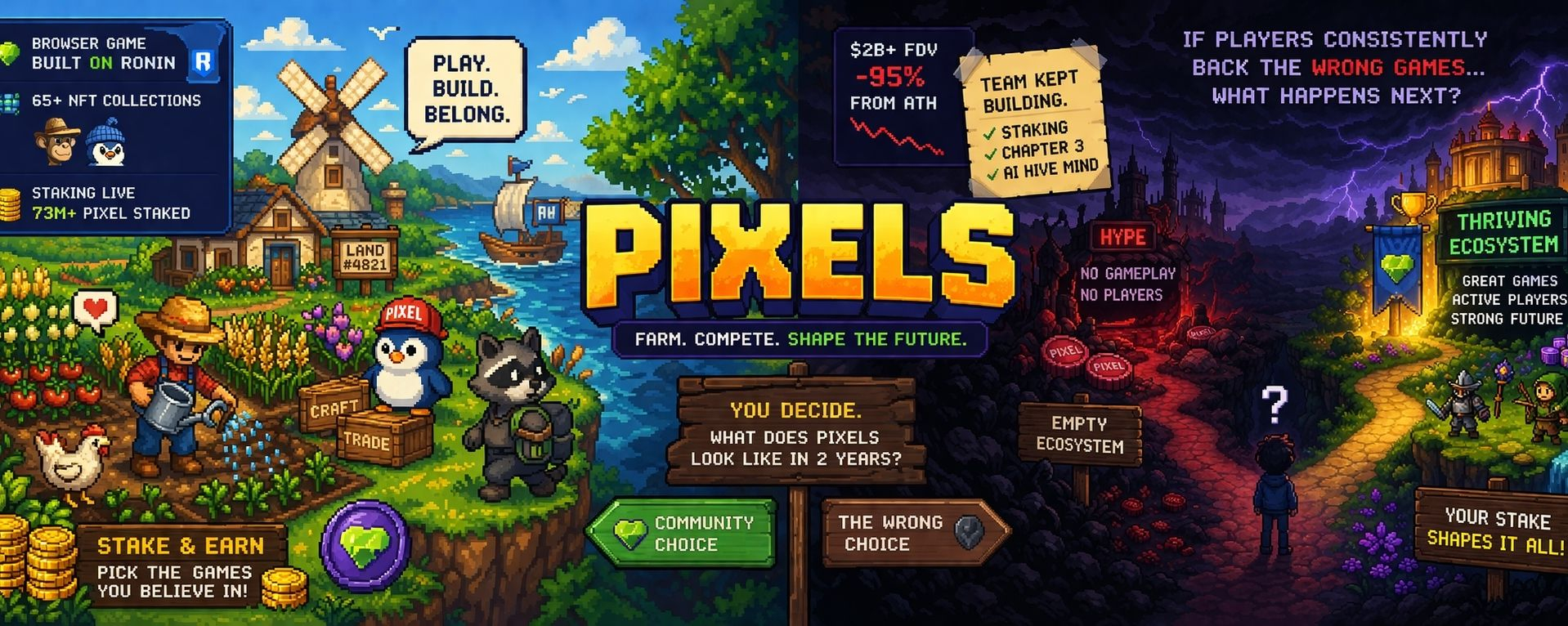
Honestly, when I first heard about Pixels, I ignored it for months. A farming game on a blockchain? I had already lost time and money on Web3 projects that promised everything and delivered nothing. The last thing I wanted was another game that existed purely to move tokens around and call it "play-to-earn." But then a friend kept talking about it. Not about the token price. About his farm. His crops. His land location. That's what got me curious. When someone in a crypto community stops talking about price and starts talking about gameplay, that means something real is happening.
The Game Itself Is the Reason People Stay
Pixels is a browser-based open-world farming game built on the Ronin Network. You farm, you gather resources, you craft things, you explore, you build. Simple on the surface. But the longer you play, the more you realize there's a real economy underneath all of it. The game supports over 65 NFT collections, letting popular avatars like Bored Apes and Pudgy Penguins show up inside the game world. That kind of interoperability sounds like a marketing feature until you actually see it in action and realize it genuinely pulls different communities into one shared space. In my view, that social layer is what keeps daily active users coming back even when PIXEL's token price isn't doing anything exciting.
The Token Took a Beating. The Team Kept Building.
Let's be honest about something. PIXEL reached a fully diluted valuation of over $2 billion before dropping roughly 95% from its all-time high. That's a brutal number. A lot of projects would have gone quiet after that. The Pixels team didn't. Instead, they announced a clear strategic shift in April 2025. They moved away from chasing broad daily active user numbers and started focusing on players with higher lifetime value, people who actually spend, hold tokens, and engage consistently with the platform. I think this was a mature and honest call. Most Web3 game teams obsess over DAU as a vanity metric. Pixels looked at their data and decided quality matters more than quantity.
Staking Changed How I Think About PIXEl
The update that really shifted my perspective was the staking launch. Pixels launched its ecosystem staking system, letting players stake PIXEL tokens across three games: Core Pixels, Pixel Dungeons, and Forgotten Runiverse, with each game offering different APR depending on how much of the reward pool it receives. This is not the typical "lock your tokens and earn passive yield" setup. The more PIXEL players stake to a specific game, the bigger that game's reward pool grows. So players are essentially voting with their tokens on which games deserve to thrive. I find that genuinely interesting. It's governance that actually connects to something people care about. Within two weeks of staking going live, the community had already staked over 73 million PIXEL tokens across the three games. That kind of early response shows the demand for real utility was already sitting there waiting.
Then there's $vPIXEL. It's backed 1:1 by PIXEL but it can't be sold. It's only for spending or staking, and players can withdraw it with no fees and use it across multiple games in the ecosystem. The design gives players a real choice. You either pay a fee to extract PIXEL out of the ecosystem or you use vPIXEL freely within it. That friction is intentional and smart. It rewards people who are actually playing, not just farming tokens to dump.
Chapter 3 and Where This Goes Next
Chapter 3: Bountyfall launched on October 31, 2025, introducing team-based competitions, new earning mechanics, and large-scale prize pools. The competitive layer on top of the core farming loop gives the game a reason to keep pulling players back beyond just tending crops. Pixels also integrated an AI agent swarm called Hivemind in July 2025, designed to deliver real-time game data and community insights. That's an unusual move for a farming game, but it signals the team is thinking about the player experience at a deeper level than most.
From my experience watching Web3 projects over the years, the ones that survive are never the loudest ones during the bull run. They're the ones still shipping when nobody is paying attention. Pixels took a 95% drawdown, rebuilt their tokenomics, launched staking, dropped a major chapter update, and kept expanding the ecosystem quietly while other games faded away. That kind of persistence is rare. I'm not saying this is a guaranteed win. Nothing in crypto is. But if you're looking for a Web3 gaming project that has shown it can survive a real storm and come out the other side still building, Pixels is one of the very few names I'd put on that short list.