
I didn’t open Pixels thinking about tokens… I opened it like I open any normal game just to see what’s inside. That alone felt unusual. Because for the past two years, every Web3 game I tested since early 2024 started the same way wallet first, asset first, then gameplay.
So I’ve been quietly testing a different question lately… what happens if ownership comes later?
Pixels gave me a clean environment to observe this. No immediate wallet pressure. Just log in, plant, move, explore. Simple loop. And somewhere between watering crops and walking into Terra Villa, I realized, I had already crossed the hardest barrier in Web3 gaming without noticing it.
Engagement came first. Ownership didn’t.
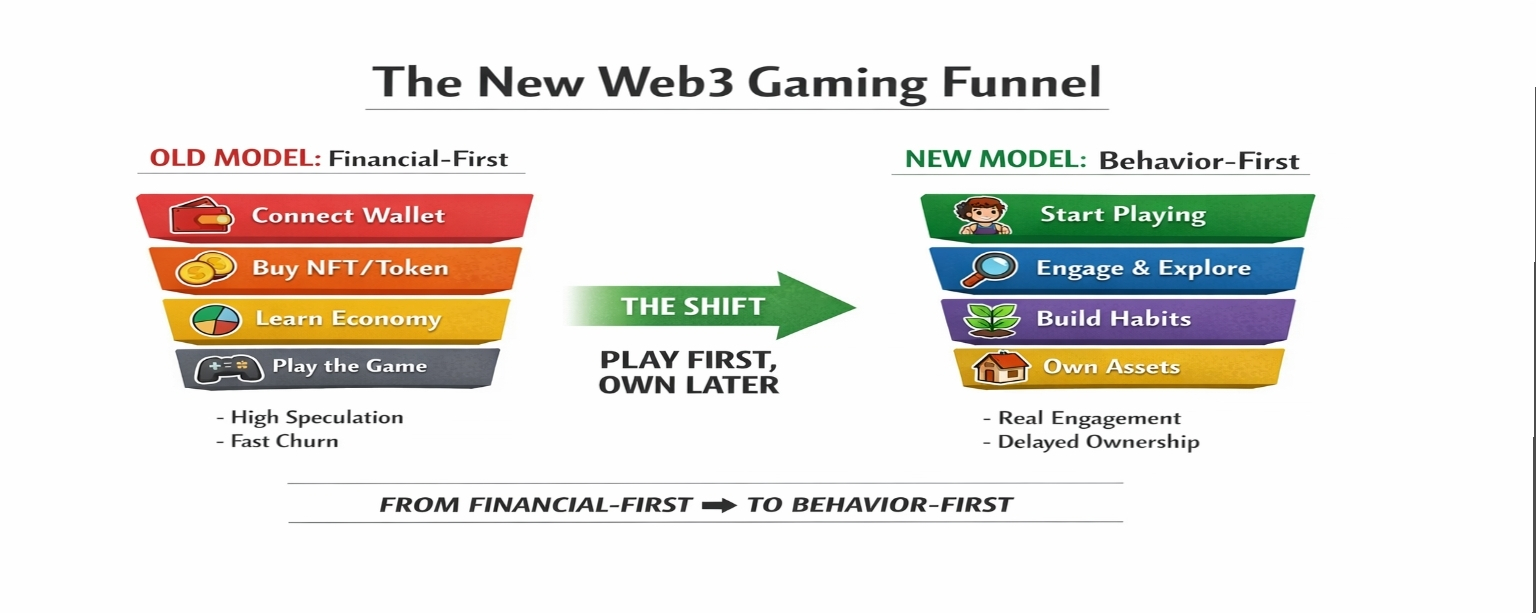
That flips the traditional funnel completely.
If you look back at most Web3 gaming models between 2021 and mid-2024, the structure was very clear. Step one: connect wallet. Step two: acquire NFT or token. Step three: understand the economy. Only then step four: maybe enjoy the game. Reports have shown this pattern as well. For example, DappRadar’s 2023–2024 blockchain gaming reports showed high wallet connection numbers but relatively low long-term retention across many GameFi projects.
The assumption was ownership creates commitment.
But in reality, commitment rarely started.
Pixels, especially after its Ronin migration and broader push in late 2024 and early 2025, took a quieter approach. Email login. No mandatory wallet. Then gradually optional connection to Ronin Wallet. If you check their official docs and ecosystem notes, the onboarding friction is intentionally reduced. That’s not just UX-it’s behavioral design.
And here’s where it gets interesting for traders and investors.
Because this is not just a game design tweak. It’s a funnel redesign.
When I played, I didn’t think about PIXEL price, supply, or emissions at first. I thought-what’s the next task? Where should I go? What should I do to make some progress?
That shift from financial thinking to behavioral action is where real retention is built.
By the time I started understanding land systems, shared farming, and resource loops, the idea of ownership felt… natural. Not forced. Not marketed. Just a next step.
That’s powerful.
Because now ownership becomes a consequence of engagement, not the entry ticket.
From an economic perspective, this changes how we evaluate Web3 gaming tokens. Traditionally, token demand was front-loaded-players buy early to participate. But that model creates pressure, speculation, and fast churn. We’ve seen that pattern repeatedly in 2022–2024 GameFi cycles.
In a “play first, own later” funnel, demand is delayed but potentially stronger.
Why?
Because it’s tied to behavior.
If a player logs in daily, completes tasks, builds routines then when the ownership option appears, it becomes an emotional and functional decision. Not just speculative.
Pixels’ live systems reflect this layered approach. There’s soft currency (coins), harder progression paths, and then $PIXEL as a premium or governance-linked layer. Task systems reset, resource loops cycle, and time is required. This time friction yes, many people complain about it but it helps stabilize the economy.
Still, let’s not ignore the risks.
Delayed ownership also means delayed monetization. For investors, that raises questions. How long does it take for a free player to convert into a paying or owning participant? What’s the actual conversion rate? Public dashboards don’t always show that clearly.
Then there’s token pressure. As of early 2026, $PIXEL has already gone through volatility phases post-listing and ecosystem expansion. Like most gaming tokens, it reacts to user growth narratives. But if engagement isn’t real, then price sustainability doesn’t hold.
Another point-casual onboarding brings casual users. Not all of them convert. Some just play and leave. So the funnel becomes wider, but not necessarily deeper for everyone.
So yes… the model is smarter. But not magic.
From my observation, Pixels is not trying to solve Web3 gaming with hype. It’s trying to slow things down. Build habit first. Then introduce the value layer.
That’s a very different philosophy.
And honestly… it feels closer to how real games work.
If you zoom out, this might signal a broader shift. Web3 gaming moving from financial-first systems to behavior-first systems. Where tokens follow usage not the other way around.
As a trader, this changes how I look at these projects. I don’t just look at token charts anymore. I ask are players staying without incentives? Are they playing when rewards feel small? Are they building routines?
Because if the answer is yes… then ownership demand might come later, but it might be more real.
Pixels didn’t make me think about owning anything in the beginning.
It made me play.
And somewhere in that quiet loop plant, wait, collect, I started to understand something simple but overlooked…
In Web3, the strongest economies might not start with ownership.
They might start with habit.
